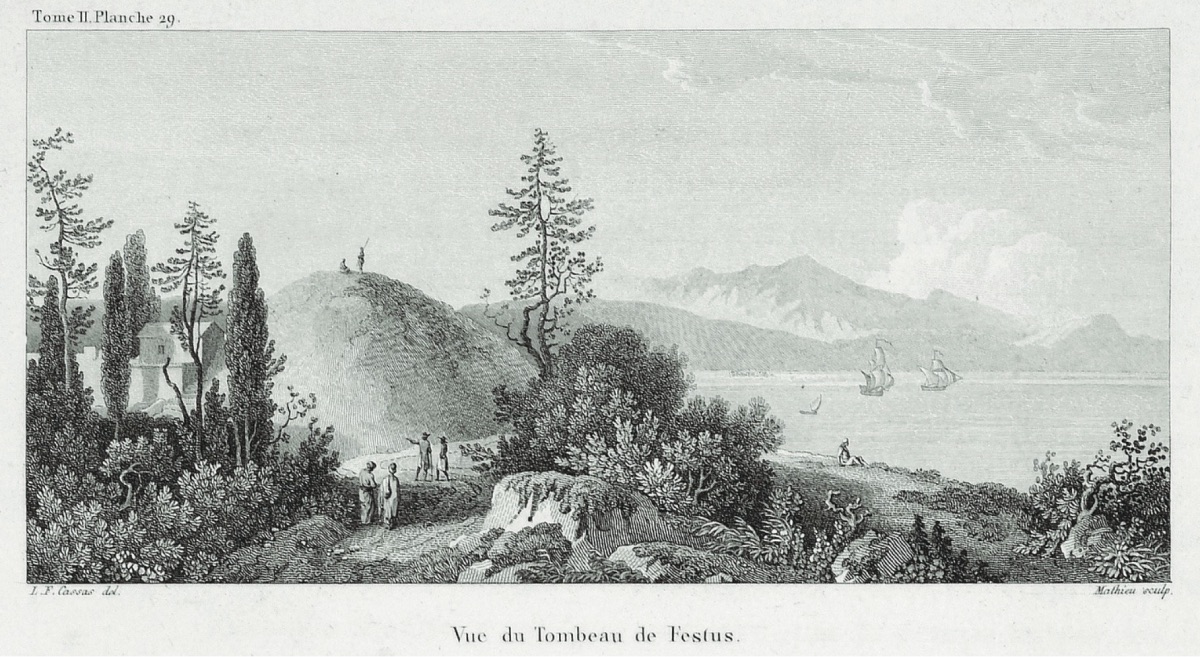
Festus Tumulus at the Entrance of the Dardanelles (1784, Aguste de Choiseul-Gouffier) Ramon Muntaner, a Catalan soldier and writer (1270-1336), recounts his life and adventures with the Catalan Company between 1302-1307 in his work the Crònica. Between 1309-1315, Muntaner served as the governor of the island of Jerba in Tunisia on behalf of the King of Sicily, Frederick. It is known that the Catalan chronicler Ramon Muntaner participated in the military expedition against the Turks and Greeks. He documented all the events that the Catalans carried out in Turkey in his chronicle. Based on this chronicle, the Spanish writer Francisco de Moneada wrote his famous work, "The Military Expedition of the Catalans and Aragonese Against the Turks and Greeks." In Muntaner's chronicle, it is narrated that the joint military company of Catalans and Aragonese, under the leadership of Roger de Flor, came to Istanbul in 1303 to fight the Turks and entered the service of the Byzantine Emperor Andronikos II Palaiologos, as well as providing information about the Turks:
"The peninsula is entirely fifteen leagues long and no point is wider than one league, surrounded by the sea on all sides. It is the most fertile peninsula in the world, with plenty of good bread, good wine, and all kinds of fruit. At the entrance of the peninsula, inland, there is a beautiful castle named Hexamillion, meaning six miles, because here the peninsula is six miles wide; it protects the entire peninsula from the center. The strait on one side of the peninsula is called the Dardanelles (Çanakkale Boğazı), while on the other side is the Gulf of Saros; in the middle of the peninsula are beautiful settlements named Gelibolu, Potamos, Sestos, and Madytos. Besides these, there are many interesting and beautiful farms...
In the morning, as I said before, the Company truly stayed in Gelibolu. I wanted you to know Gelibolu, the capital of Macedonia and where Alexander was born and became lord. For this reason, just as Barcelona is the coastal capital and Lleida the inland capital; Gelibolu is the coastal capital of Macedonia. Another beautiful city of the Macedonian kingdom is named Edirne (Adrianople); and the distance between Gelibolu and Edirne (Adrianople) is a five-day journey. And the Emperor's eldest son, Lord Michael, was in Edirne (Adrianople). I wanted to inform you that the Gelibolu peninsula is located on the western side of the Dardanelles, while on the east is the Erdek (Artaki) Cape, where the Grand Duke spent the last winter with his army. This place, named Artaki, is a part of the city of Troy. The second port is located in the middle of the Dardanelles. In this port, there is a beautiful castle named Paris, built by Priamos's son Paris. Paris forcibly abducted Helen, the wife of the Duke of Athens, to the island of Bozcaada (Tenedos), which is only five miles away from the Dardanelles.
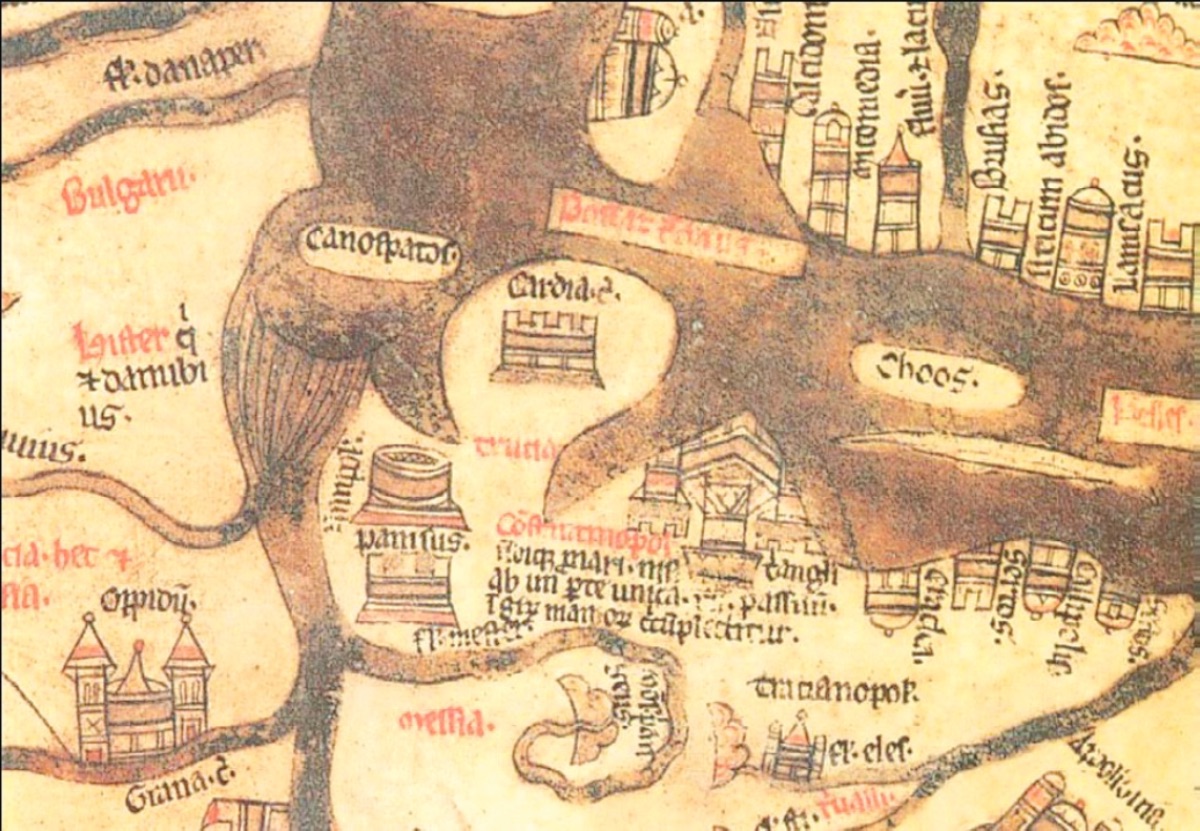
Hereford World Map (1300) In the past, there was a goddess on the island of Tenedos; in a certain month of the year, noble men and women from Romania (meaning the Western Roman Empire R.A.) would make sacred pilgrimages here. In those days, Helen, the wife of the Duke of Athens, made a sacred journey there with hundreds of knights. Priamos's son Paris also traveled there in the same way, with fifty knights by his side. As soon as he saw Helen, he fell so deeply in love that he told his men he would take Helen with him. Although the hundred knights with Helen protected her for a while, Paris managed to abduct the woman. But after this event, such a great war broke out that the city of Troy, three miles in size, was besieged for thirteen years, and later was shamefully conquered, burned, and destroyed. The peninsula extending towards the sea from where the Dardanelles ends is called the Gulf of Edremit; this is also another port of the city of Troy."