
"On Friday, October 6th, they set out and directed their course between Turkey and the island of Lesbos until they reached Cape St. Mary. On Sunday, they passed the cape and saw an uninhabited island called Tenio (Bozcaada) on the left and an inhabited island belonging to Byzantium called Imroz (Nembro). The weather was bad, and the wind continued to increase in the afternoon; after making some progress, they wanted to take refuge on the nearby island of Tenio, but due to the wind and current, they could not do so and anchored in a strait between Turkey and the island of Tenios. Nearby was the great city of Troy. From here, they could see the structures in Troy and other buildings like a fortress with walls having gates and towers at intervals. It was situated on a plain by the sea and extended towards high mountains. On the other side of the city, a high and steep hill rose; it was said that a fortress called Ilion once stood there.
"Opposite the city was the island of Bozcaada (Tenio), which was once the port where ships used to dock. It was occupied by King Priam, who built a great fortress called Tenedos on it to protect the ships. Although this island was once full of inhabitants, it was now deserted. A boat was sent from the ship to fetch water and wood, and some officials from the embassy went to see the island. They found many vineyards and fruit trees, many game animals like partridges and rabbits, and the ruins of a large fortress.
The reason for the uninhabited state of this island of Tenio is as follows: About twenty years ago, the Byzantine Emperor promised to give the island to the Genoese in return for their help with some galleys in his war against the Turk; however, he later sold it to the Venetians. They settled there and fortified the town and the fortress. When the Genoese heard this, they claimed the island was theirs, that the emperor had promised it to them, and that he had no right to sell it to another. This led to a dispute between the Genoese and the Venetians, and both sides began to arm their fleets. They inflicted great slaughter on each other over this island. They made peace on the condition that the island would belong to neither party, the town and fortress would be reduced to ruins, and the island would be left uninhabited. This is one of the reasons for the hostility between the Genoese and the Venetians today.
On Wednesday, the wind was still unfavorable, so they could not set out and had to wait until Sunday. On Sunday afternoon, a ship arrived at the port of Bozcaada (Tenio). They sent someone to find out where it came from. It was coming from Gallipoli, which belonged to the Turk but was in Greek territory, and was heading to the island of Chios with a cargo of wheat. They brought news that a great plague was spreading in Gallipoli. The ambassadors waited for thirteen more days due to the opposition of the wind. From the island of Bozcaada (Tenio), they could see a very high mountain in Greek territory called Aynaroz (Menteston). There was a monastery belonging to Greek monks who led very holy lives and did not allow any woman, dog, cat, or any domestic animal capable of breeding to come near them, and they did not eat meat. This monastery was very rich, and they said the road from the foot of the mountain to the summit where the monastery was located took two days...
On Wednesday, October 22nd, there was a favorable wind, so they set out after staying for fifteen days between the island of Tenedos/Bozcaada (Tenio) and the lands of Turkey. On the same day at noon, they came to an uninhabited island called Mambre (Mount Athos). The next day the weather was calm; therefore, they could not enter the strait. But on Friday evening, a favorable wind arose. They entered the Dardanelles (Domanya strait), and the entrance was so narrow that one side was at most eight miles away. On the right side was Turkey. Here, on a high hill overlooking the sea, there was a fortress with a large town and a wall around it. According to what they said, a year and a half ago, eight Genoese galleys had come and plundered the town. The fortress was known as 'the end of the roads,' and when the Greeks came from their countries to destroy the city of Troy, they set up camp at this fortress and dug three large trenches in front of it leading to Troy. On the other side of the strait, on a hill by the sea, there is another fortress called Xetea (Seddülbahir); these two fortresses guard the Domanya strait. A little further on, on the Turkish side, there are two large towers and a few houses nearby. This place is called Döbek. It is said that the city of Troy extends from Cape St. Mary to this place, and this is a distance of sixty miles. At sunset, the ship came to a town on the Greek side by the sea. This town was called Vituperio.
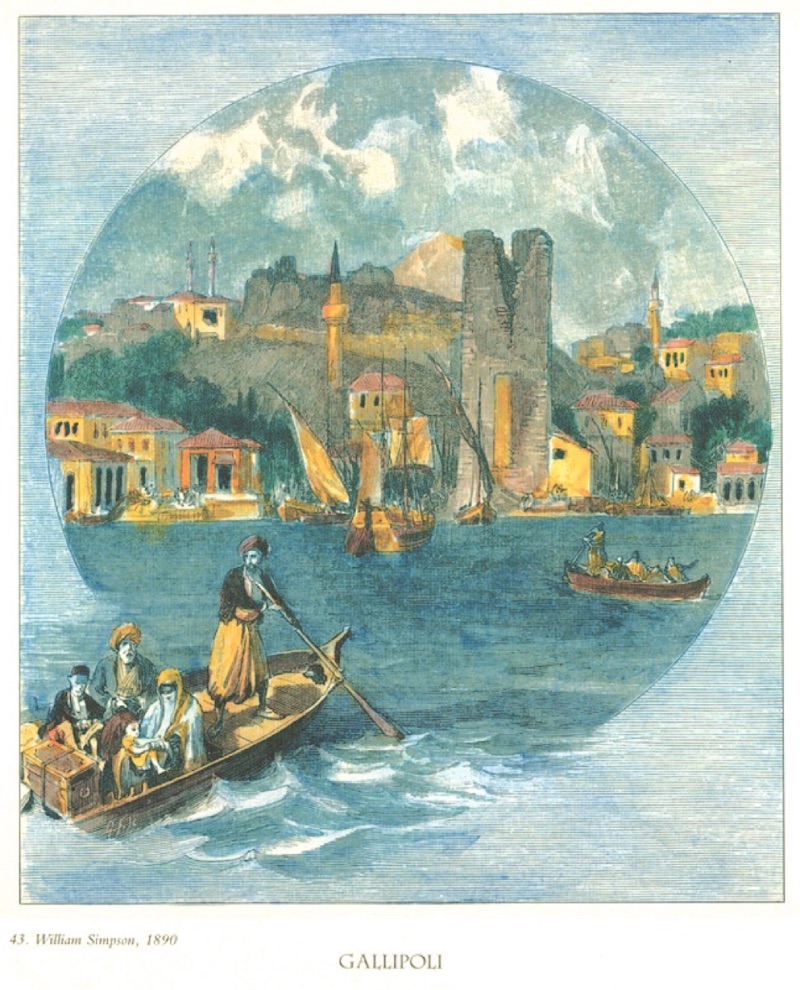
On Saturday, they came to Gallipoli, consisting of a fortress and a town on the Greek side. However, it was occupied by Süleyman Çelebi, the eldest son of the Turk. The Turk kept his entire fleet, consisting of forty ships and galleys, in the port of Gallipoli, and the fortress was fortified with a large garrison. Gallipoli is the first place occupied by the Turks in Greek territory, and the distance between the fortress and Turkey is at most ten miles.
By taking this fortress, the Turks have gained all the places they occupied in Greece, and if they lose it, they will lose this place they conquered; because their fleet is here, and therefore they can quickly bring help from nearby Turkey. The road from the strait to Gallipoli is very narrow, but after this, the sea becomes a little wider. Above Gallipoli are two fortresses called Satorado and Eksamilo. The Turkish side consists of high hills, while the Greek side is flatter and covered with cornfields.
At night, they reached a cape on the Turkish side called Quinisco (Çardak), and it is said that when Timur Bey defeated the Turk, some troops from the battle came to this cape and turned it into an island. On Sunday, they reached an inhabited island called Marmara'."