
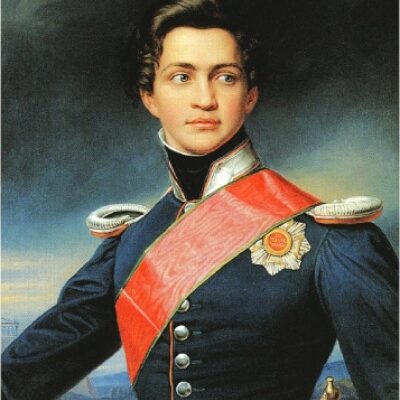
Alexis de Valon was born in 1818 in Saint Priest de Gimel, France, as the son of a famous politician. To complete his education in classical cultures and languages, he embarked on a year-long journey to the Aegean Region in 1842. The notes he took during his travels were published in 1846 in the renowned cultural and literary magazine of the time, Revue des Deux Mondes, under the title A Year in the East. These writings were republished as a memoir book in 1846. De Valon, who attracted attention with his strong literary and poetic language, also published his impressions of his trip to Spain in the same magazine. As a promising writer, he wrote his last article in 1851 on the London Industrial Exhibition. In the same year, at the age of only 33, he drowned in a lake near his family castle. De Valon's impressions, who passed through Çanakkale in 1841, were largely influenced by Homer's epics. However, we also see that he touches on the political developments of the period:
"On a beautiful evening, we set sail from Izmir on a ship named Rhamses, and soon I saw the city, where I left many friends and would most likely never see again, fade and disappear among the waves in the distance. On the ship, I saw many compatriots, a graceful, beautiful woman, witty sailors, and Izmir was quickly forgotten. Sitting on the deck, as we talked about France, Rhamses was gliding over the calm sea like a lake, and the pleasant colors of twilight were spreading around us in waves. After a very beautiful day, a magnificent night followed, and in the subsequent nights, it was impossible for us to close our eyes. As we were caught by the first light of day, we were drinking punch and still chatting and laughing. In the morning, as the wind completely died down, we began to closely observe the land and could wander over a river filled with oak groves. This was Troy (Ilion)! The river we saw flowing into the sea in front of us was formerly known as the Dümrek Stream (Simoeis). The two hills we saw on the shore were known as the tombs of Patroklos and Hector. In the distance, the great blue mountain with its three snow-covered peaks rising to the sky was Mount Ida (Kaz Dağları), and behind us, in the midst of the shimmering waves, was Tenedos (Bozcaada). The conversation had ceased, and we were all silently watching the deserted shore. During our long student life, each of us had seen this noisy and bustling place in our dreams countless times. Wasn't it strange to swiftly glide over this calm sea, which we always thought was filled with the ships of Agamemnon and Ulysses, on a steamship with pleasant female passengers? Remembering a few half-forgotten lines from Vergilius or Homer, and pronouncing the place names that had been so familiar for years for the first time in years, each of us was recalling our youth or a long-lost friend. The shore began to fade on the horizon, and as I lost sight of this small valley immortalized by the name of poems, I doubted what I had just seen. It was as if I had been a plaything of a dream.
At noon, we entered Çanakkale, a beautiful blue river squeezed between two green shores, calm like the Loire, and a few hours later, we anchored in front of a small, white, inconspicuous town between Abydos (the city east of Nara Cape. R.A.) and Sestos (the ancient city on Akbaş Cape opposite Abydos. R.A.). These two cities are famous due to an attempt that cost Leander his life and a severe fever attack suffered by Lord Byron (the famous English poet representing Romanticism, 1788-1824. R.A.), and apart from that, they are nothing more than two small villages. These villages, with their large pink-roofed houses seen among greenery and flowers that do not reflect the so-called Eastern character in any way, resemble the Chinese villages described by some travelers. When Rhamses arrived at the port, it was suddenly surrounded by boats filled with long-bearded Turks, veiled women, and people of every color. The deck was chaotic, sailors were cursing, women were screaming, and porters were fighting. Finally, the commotion subsided, everything was put in order, and one hundred eighty-six new Muslim passengers boarded the ship. Among the ships tied to the shore with ropes, one was much more loaded than the others. A young Arab, who seemed to be a passenger of this ship, was standing on a small pile of bales and directing the rowers from above. His white clothes accentuated his dark skin even more. The embroidered black wool coat he had thrown over his shoulder in an interesting manner inevitably drew all eyes to him. I had never seen a face as beautiful and energetic as that of this young man. Intelligence and kindness shone from his large, black eyes, and there was a unique nobility and pride in his demeanor. During the initial confusion, he had ordered his rowers to stay away. When Rhamses was loaded and ready to move, he shook hands with six veiled women, whose long garments did not prevent their youth and beauty from being seen, one by one. The young Arab, without appearing at all disturbed, took his odalisques to a place at the front, stationed a strangely dressed black man as a guard at their door, and then came to sit on the deck, where another slave brought him a magnificent hookah.
A little later, the Gelibolu Fortress and the Çanakkale walls, which make Istanbul one of the most difficult cities in the world to conquer, do not resemble our fortified positions at all. These are pure white structures with holes resembling the portholes of ships, where old cannons without carriages, usually operated by a single artilleryman with the help of three or four peasants during wartime, are placed. Nevertheless, these batteries have proven themselves today, and perhaps it is useful to recall a memory that shows the political situation of France in the East thirty years ago in our time.
In February 1807, the British government, dissatisfied with the influence of the French ambassador General Sebastiani (Horace Sebastiani, who served as France's ambassador to Istanbul from 1805-1807. R.A.) in Istanbul and wanting to force the Ottoman Empire to join the forces united against France at any cost, ordered Admiral Duckworth to proceed with his fleet to the walls of the Ottoman palace and threaten the Sublime Porte. Taking advantage of a favorable wind, the Admiral suddenly appeared at the entrance of the Dardanelles, easily passed in front of the disarmed walls, and reached Gelibolu. There, he encountered an Ottoman fleet; a fleet consisting of one ship, five frigates, and two two-masted sailing ships. The crew was quietly celebrating the Feast of Sacrifice on land, and the British Admiral, without taking much risk, burned and destroyed these abandoned ships. Shortly after, following this unfortunate challenge, which was punished in the same place, the Admiral continued on his way, and by evening, the people of Istanbul, in a state of astonishment, saw the British flags waving in a fleet anchored between the capital and the islands. At that time, the Russian army was also threatening from the Danube: It was thought that the Dardanelles could never be crossed, and the Sultan could not initially prevent his weakness in the face of the unexpected appearance of the enemy fleet. He sent his trusted man Ismail Bey to General Sebastiani and secretly told him to leave the country. The ambassador proudly stated that the arrival of the British fleet did not frighten him; that he had the confidence of the Ottoman Empire, and that he would only leave Istanbul upon the Sultan's explicit order. Meanwhile, Admiral Duckworth was threatening to bombard the city and trying to impose peace terms on the Sultan: 1. The Ottoman Empire would ally with England and Russia; 2. The Dardanelles batteries would be immediately handed over to England; 3. Wallachia and Moldavia would be annexed to Russia, and finally, the French ambassador would be expelled. The Admiral was late in these faits accomplis. General Sebastiani's determination had influenced the Sultan. He arrogantly told the British ambassador that he would not negotiate until the fleet returned to the Dardanelles.
During these negotiations, defense preparations had immediately begun. The news of the ships being burned had incited the people of Istanbul, cries for revenge were heard from all sides, and after the initial shock, a general enthusiasm followed. The Janissaries were taking up arms, the elderly and children were carrying loads; General Sebastiani, along with two hundred Frenchmen, was directing the work and encouraging them by setting an example to these people, who seemed to have regained their former boldness for a few days. Forty-eight hours had passed, and the surroundings of Istanbul and Galata were magically equipped with twelve hundred cannons, and the Dardanelles walls had organized their batteries. The British ambassador Arbuthnot, realizing that he was mistaken about the Muslims, decided to change his conditions and limited his demands to the expulsion of the French ambassador. This request was also arrogantly rejected. Summoned by the Sultan, Sebastiani found the Sultan among his soldiers, on horseback, and in battle attire. This ruler, raised in the Harem, seemed to have grown up on the battlefields. Selim said to him, "The British want me to expel the French ambassador, to declare war on my best friend; write to your Emperor that if necessary, we will all die, but just as I trust him, he must trust me."
The situation of the British fleet was becoming increasingly critical; it was surrounded on all sides, and the besiegers were becoming aggressive. The Admiral did not delay in setting sail and did not unfurl the sails of his ships. This time, the Dardanelles batteries awaited him during this passage. The fleet was fired upon from all sides, two corvettes sank in front of Gelibolu, the flagship Royal-Georges lost its main mast. A 400-pound marble cannonball destroyed sixty soldiers between two decks on the Standart. Admiral Duckworth and Admiral Louis were severely wounded, and the shattered ships barely took refuge in Malta. Thanks to General Sebastiani's determination, there was a great sensation in Europe. This was the result of a bold, swift, and unexpected attack."