
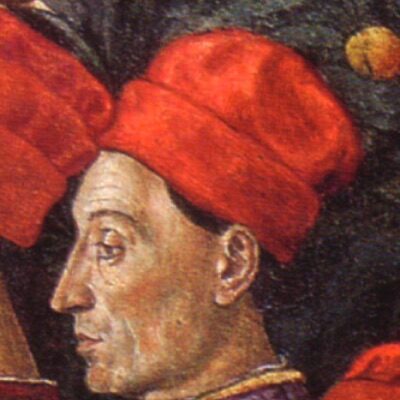
Ciriaco d'Ancona or Cyriacus de Pizzicolli, or Cyriacus Anconitanus (Latin: Ciriacus Anconitanus, Italian: Ciriaco de' Pizzicolli;) born 1391 in Ancona - died 1455 in Cremona, was an Italian merchant and humanist, considered one of the first epigraphists and pioneers of archaeology. He copied various Greek and Roman inscriptions. Many ancient sources were purchased by him and brought to Italy, thus reaching the present day.
Due to being a merchant, he traveled to regions such as Edirne, Istanbul, Northern Aegean Islands, Crete, Chios, Miletus, Lesbos, the Peloponnese, and Epirus between 1412 and 1454. Besides these regions, he visited significant monuments like Hagia Sophia, the Acropolis of Athens, and the ruins of the city of Delphi; he recorded the structures and inscriptions he saw everywhere he went by drawing them. Ciriaco d'Ancona, who made the first discovery of ancient Smyrna (Izmir) in 1429, passed through the Dardanelles in 1444. His notes clearly reflect the prejudices Europeans of his time held against the Turks:
"On September 24, we reached the Dardanelles (Hellespont). Near Lâpseki (Lampsakos) and on the opposite shore of the strait at Gelibolu (Gallipoli), we encountered the Pope's fleet of twelve ships and, together with our ship's captain Alexios, visited Lodovico Loredan, the commander of the Pope's fleet. On the same day, with a favorable north wind blowing frequently, we set sail towards Gökçeada (Imbroz), observing the ancient Thracian and Hellespont cities along the coast. Along the European coast, we saw Lysimachia, Gallipoli, Sestos, Killia, and Madidorkrissa; along the Asian coast, we saw mostly Phrygian cities. Shortly after, we passed Abydos and Siegeum, saw the famous promontory of Troy, and in the distance, Bozcaada (Tenedos).
After leaving there, (Proconneusus in Propontis - Marmara Island in the Sea of Marmara R.A), for three days and three nights, accompanied by peaceful Neptune, we reached the Dardanelles with winds blowing from the northeast and north and came face to face with the Pope's Christian Fleet at the site of ancient Lampsakos. The fleet under Loredan's command had blocked the strait from Gallipoli towards the peninsula. Together with our magnificent captain Alexios Disypatos, we visited the magnificent captain of the fleet, Alvise Loredan, congratulating him for completing his mission. On the bright Sunday of September 27, with the wind increasingly in our favor, we crossed the Dardanelles and noted that the Asian shore of the strait was strategically controlled by our galleys. Finally, the sun set as we passed through the Aegean Sea and arrived at Gökçeada.
But a strong wind stirred the sea and caused large waves, and I was able to board the ship with great difficulty. A day later, on the good day of January 29, I disembarked in Gelibolu with my old friend, dear Lıca Catanio. The first two people who approached us in the harbor were, by chance, God's beloved servants Poggio and Catrinelli, who were here to trade with the barbarians of Gelibolu (Turks), and from your nation (Genoese) Anconan Bartolomeo Foroflaviniano. As was customary, we embraced each other, and the young one (Foroflaviniano) told us what he knew about the latest situations of our mutual friends. Together with my guide, Latin Lodovico Farmacopolo, I found the attached inscription on a marble altar belonging to the barbarian faith. What I found is perhaps the result of my efforts to look at something made to honor this ancient city. Although written in Greek, a Latin name is also added:
(Honorable) people, Loukıs Phlaouios Valloniso Pollion, the first person of the city, the source of prosperity and many good deeds for his country.
My friend Andreolo, do you see that this brief inscription is for a man with the Latin name Lucius Flavius Pollio, who performed generosity and good deeds for his city, and that the people of Gelibolu erected a bronze or marble statue of him?"