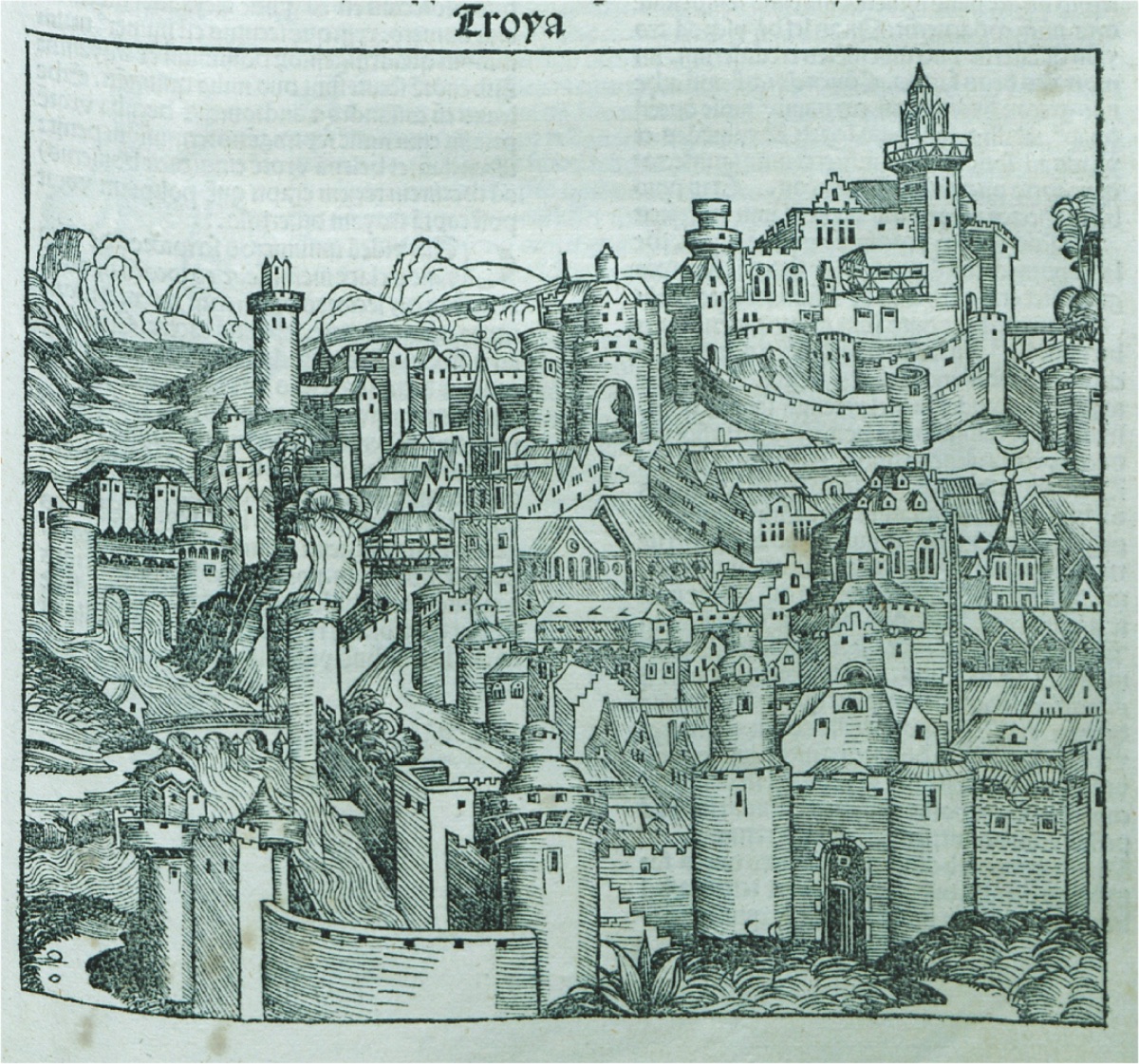
Imaginary City of Troy from Schedel's World Chronicle Dated 1493 The adventurous life of Pero Tafur, who comes from a noble Spanish family, begins with his participation in the siege of Gibraltar in 1435. From there, Tafur travels by sea to Genoa and then to Rome. After his pilgrimage to Jerusalem, he tours Egypt. After staying in Egypt and its surroundings for about a year, he arrives in Istanbul (Constantinople) on November 24, 1437. After being received by the emperor, he establishes relations with the Genoese in the city and travels with them to Edirne. He visits Murad II. After a Black Sea journey, he sets sail to return to his country, passing by the shores of Çanakkale in 1437. Tafur's account is quite interesting as it describes the situation before the conquest of Constantinople by Mehmed the Conqueror in 1453. What is even more intriguing is that Pero Tafur mentions that, 16 years before the conquest of Istanbul (Constantinople), the topic of Turks taking revenge for Troy was being discussed among intellectuals:
"I stayed on the island of Chios for twenty days and there was nothing to do. Later, we set sail towards Turkey, not far away, to a place called Foça (FojaVecchia). They say this is a port of Turkey; there is a Genoese settlement here, and I met a friend from Seville. Since he had good relations with the Turks, I asked him if he could send one of his men with me to Troy and if I could rent a horse, and he helped me. I traveled for two days by land to the place they said was Troy (Alexandria Troas RA.), but I couldn't find anyone who could give me information, and I arrived at the place they called Ilium. This is located opposite the port of Bozcaada (Tenedos). There are villages all over this country, and the Turks accept the old structures as heirlooms and do not destroy anything, but build their houses right next to them. This situation allows me to see ancient Troy as indeed a large ruined building and to understand the great hill formed by the destruction of so much marble and stone, this coast, and the port of Bozcaada (Tenedos) opposite. However, I couldn't learn much. I saw my ship standing there, and two days later we set sail. A lot of resin is produced on the island of Chios, and mostly Genoese, who took the island from the Greeks and call themselves Mayoneses, live on the island. Since the Greeks could not defend it, they pay taxes to the Genoese, raising their standards. The Genoese use this island for their journeys to the Levant and the Dardanelles/Çanakkale Strait.
We set sail, and suddenly a great storm broke out and damaged the ship. Skilled sailors repaired the damage as best as they could, and we passed Cape St. Maria at double speed, leaving the Genoese-owned island of Mytilene on our left, and arrived at Bozcaada (Tenedos), where we anchored and went ashore.
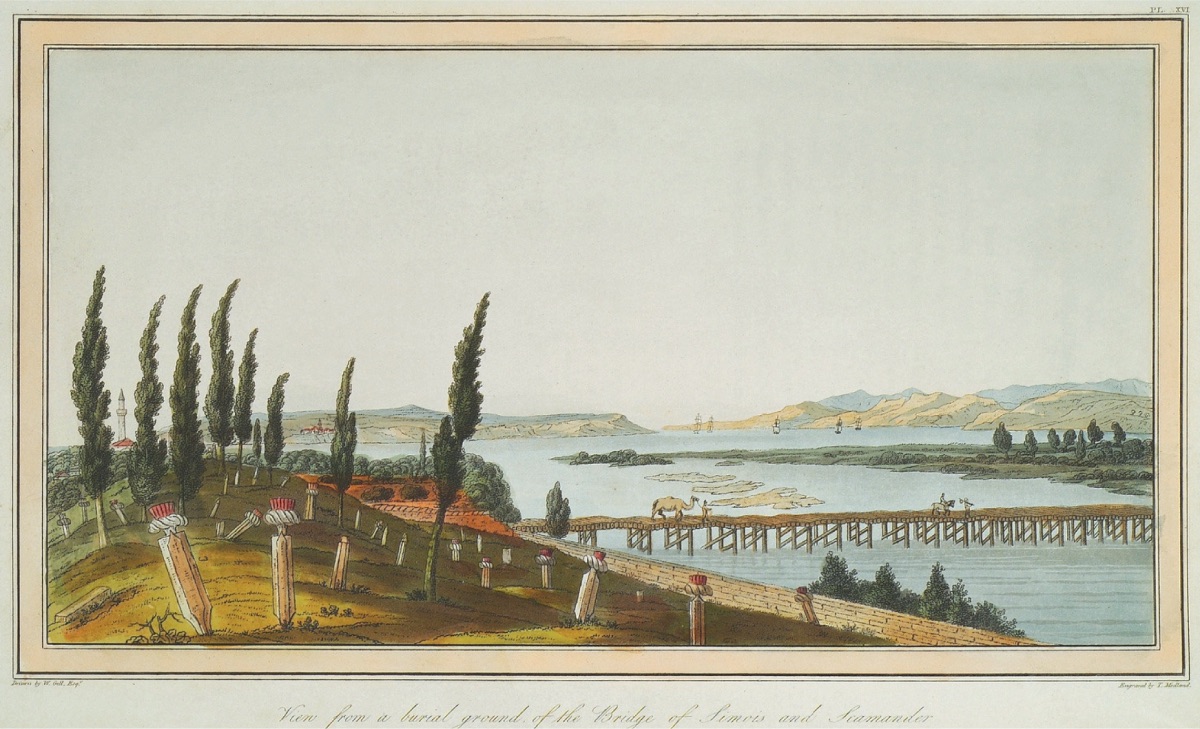
Old Kumkale Cemetery and Wooden Bridge at the Mouth of the Karamenderes River into the Strait (1801, William Gell) There are many lands surrounded by vineyards, but they are ruined. The port of Bozcaada (Tenedos) looks so new, as if it was built by masters just yesterday. The breakwater is made of large stones and columns, and there is a very nice anchoring and mooring place for ships here. There are other places for ships to anchor, but this is the most suitable because it is opposite the entrance to the Dardanelles/Çanakkale Strait (Romania). There is a strong castle on top of a large hill above the port. This castle has caused many conflicts between the Venetians and the Genoese, and as a punishment, the Pope had it destroyed so that it would belong to no one. This is actually a bad solution because the port is one of the best in the world. No ship can pass the very narrow strait without first anchoring here. It is known how many ships the Turks contact there, waiting deceitfully and killing many Christians. From there, many buildings of Troy can be seen, and undoubtedly the Greeks living there can provide information about this place.
The next day we departed and sailed towards the entrance of the quite narrow strait. On the side where the Turks are, the water is quite shallow. This strait is called the Dardanelles/Çanakkale Strait, and it was the entrance and port of Troy. On the side where the Greeks are, the water is quite deep. Here was the Viteperio tower built by Achilles with Patroclus, or so they say it should be. The strait is so narrow here that on clear days even the flags on the opposite shore can be seen. We passed through this strait and passed the villages on the Turkish and Greek sides, arriving at Gallipoli (Gelibolu), a famous place; it has a beautiful port and a magnificent castle. This was the first place the Turks conquered when crossing into Greek territory. The Turks preserved the walls and the castle; they did not do this elsewhere because when faced with defeat, they could protect themselves here.
We left Gallipoli and reached the Sea of Marmara (Marmora)...
...But now the Greeks are ruined and gathered together; at this time, Istanbul (Constantinople) was the only fortified place left. Some still call themselves lords, but now the Christian nation is scattered around the world like Moor slaves (The word 'Moor' was used by Europeans to refer to African slaves R.A). Like the mudejares (Moors) with us, they are completely destroyed, crushed, and dispersed. The Turks truly took revenge for Troy. Even before I arrived and before Istanbul (Constantinople) was taken, the Greeks were already subdued as they are now. If the Turks had not extended their hands over the city, the fear would have been the fear coming from the Christians of the West, and they would not have dropped their weapons. But due to the great indifference of the Christian princes and others, Istanbul was lost. If God had allowed it, if the Turks could succeed in everything they tried, and seeing the Christians' failure to take revenge for their mistake, how futile the fear would have been."