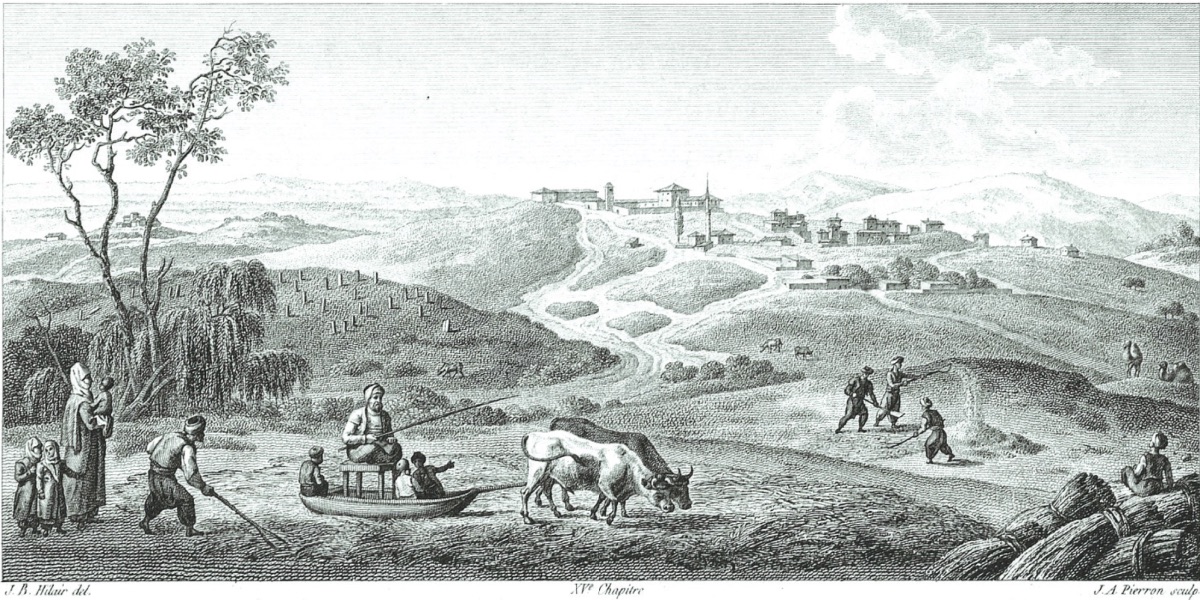
Pınarbaşı Village and Cemetery (1784, Aguste de Choiseul-Gouffier) Born in London in 1789, Edward Daniel Napier served as an officer in the British Navy and is also known for his historian identity. Edward Daniel, the fourth son of the famous Colonel George Napier, was married to Sarh Lennox, the daughter of the 2nd Duke of Richmond. Napier, who had many prominent figures in the British Navy in his family, joined the army in 1803. Throughout his military career, he participated in many wars and sieges. From 1808, he served on frigates in East India. After a highly successful military career, he was elected as a member of the Royal Society in 1820. His most important work is the 6-volume Florentine History. Napier died in London in 1853 at the age of 62. Napier visited the Dardanelles and Troas in 1839, and his observations reflect more of a historian's approach:
"...Immediately after our arrival, with the very beautiful view caused by the smoke following the salute shot; with the magnificent sun rising over the distant Mount Ida, let's take a look at the current state of Beşik Bay (Besheeka Bay). In the distance before us, the tumuli, which have long been the resting place of the buried sorrow and anger of Ajax, Hector, and Achilles after their great deeds, can be seen. To the west, the barren and sun-scorched hills shine in the morning sun, which is most favored by the gods; to the north,
"Not so far from the famous lands of Ilion,
The Thracian shores are visible across"
As the "Broad Hellespont" (Dardanelles) washes the steep shores, at Jenicher (Yenişehir) point, its current doubles towards the Aegean Sea; then it passes along the coast with the wind through Beşik Bay (Busheeka Bay) and shows its effect in the efforts of the fleet's ships to anchor bravely...
An Example of a Tumulus on the Asian Shore of the Dardanelles (1801, William Gell)
However, we were also able to anchor in the winding harbor, in the marketplace made up of a kind of boats and tents where numerous Greek and Jewish ships from Smyrna (Smyrna) and other places were anchored at very short distances from each other. Here, in the increasingly important harbor, bread, fruit, and all kinds of goods were offered from boats with very beautiful forms to the ships; especially strong Greeks adorned with their red caps, large builds, and short, warrior-like mustaches above their shaved faces were doing this.
These men, mostly from Bozcaada (Tenedos), had a completely opposite appearance to the crew of Smyrna (Smyrnalı) boats, filled with mostly bearded and turbaned Jews selling very beautiful Persian carpets, perfumes, and other rich grapes from the East, famous for their fashionable goods.
Sometimes the close oars, sometimes the huge sails of the ships with a light wind, create an indescribable scene. This picture is completed by the advantageous southern wind used by small ships heading towards "The Sultan's City" Imperial Stanboul (Istanbul)...
...
I always see the peasants in this part of Anatolia as an honest and hospitable kind (the following anecdote is an example: Very close to where we landed, there was a mansion (Hasan Pasha mansion. R.A.) under the control of a Turk named Yusuf Ağa. Shortly after the fleet's arrival on the shore, the person supplying food from the mess hall goes to the farm to find the Ağa to get things like chicken and lamb and leaves the choice and price to him. The Ağa states that everything is at the service of the British officers, but he is not a merchant. Even though the English insist, their request is refused, upon which they ask the Turk how they can present a gift to them. Later, as he tells, when the French, who were doctors, wanted to pay for what they received, they were asked to advise on how to treat a sick child. However, our friend has to say that he does not understand medicine, but the next day, he brings the ship's surgeon, and under his supervision, I believe his daughter is treated, and the old Ağa's heart is won, along with (God forbid) a dozen good sherry and port wine are accepted. Although they have very few desires, they are poor, but they share whatever they have with foreign travelers. In return for their hospitality, the thanks of foreigners in a language they can understand is enough. In contrast, the Greeks, who smile and think of how they can take advantage of you, are quite far from the principle of honesty...
...
Entrance of the Dardanelles (1801, William Gell)
As we crossed the plain, we saw how they harvested and threshed or plowed the fields with oxen and horses. This tradition, going back to ancient times, is also mentioned in inscriptions and in Homer:
In the orderly threshing floor, to tread the white barley,
How broad-browed oxen are yoked to the plow,
If the barley is quickly winnowed,
Under the feet of the bellowing oxen (Iliad, XX)."