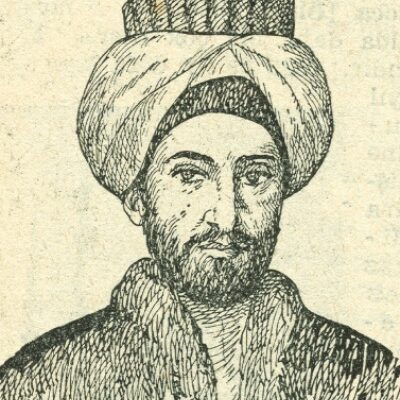
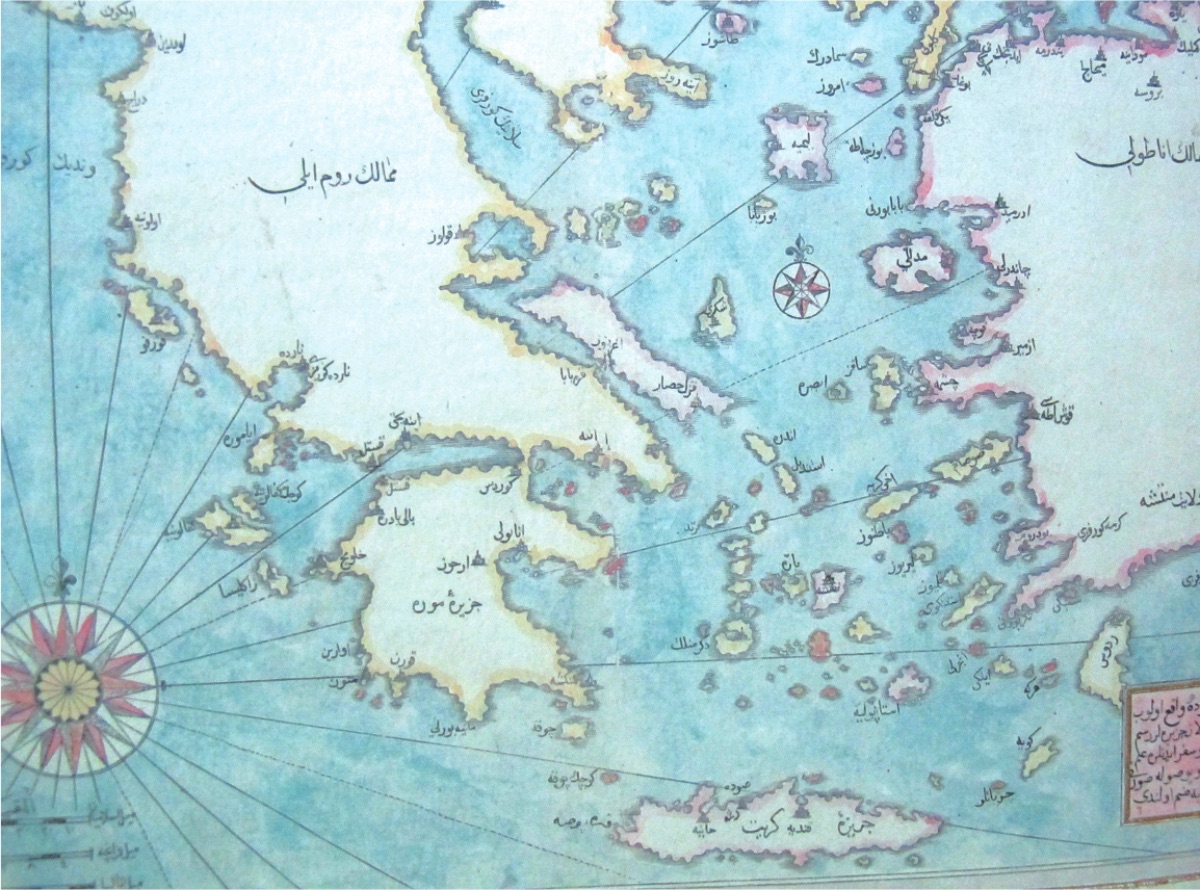
Western Anatolia, Islands and the Troad Region (1630, Katip Çelebi) Katip Çelebi or Hacı Halife (February 1609, Istanbul - October 6, 1657, Istanbul) is a Turkish-Ottoman scholar known for his works on history, geography, bibliography, and biography. Katip Çelebi was part of the unit (Silâhdar Alayı) responsible for keeping the records of the army prepared to suppress the Abaza Mehmed Pasha Revolt in 1624, and he participated in the Tercan campaign with his father. In 1630, he joined the Hamedan and Baghdad campaigns under Hüsrev Pasha. In his works Cihannüma and Fezleke, written in 1632, Katip Çelebi provides information about the cities, castles, and stations captured by the army, along with the cities and regions he visited during this campaign. He kept the army's records during the Siege of Baghdad. After the campaign, he returned to Istanbul and attended the lectures of Kâdızâde. During times of peace, he visited bookstores and libraries in Aleppo to gather sources for his works. Katip Çelebi, who dedicated his entire life to research and education, passed away in 1657, leaving behind very important works. His grave is located on the right side of the main road descending from Vefa to the Unkapanı Bridge in Unkapanı:
"Biga Liva
It is the second sanjak affiliated with the Kaptan Pasha Province. It is still referred to as the Pasha sanjak.
Boundaries: To the west and south is the Sea of Marmara, and to the north and east is Karesi.
Districts: İnepazarı, also known as Ezine, Balya, Biga, Çan, Kazdağı, Kale-i Sultaniye (Çanakkale), Güvercinlik, Lapseki, Kapıdağı, and Marmara.
Characteristics: Previously, the capital city of this region was the city known as Troy or Truva. This city, located on the mainland opposite Bozcaada, is larger than Istanbul. Troy was founded in 492 after the death of Moses. Its first king was Dardanos. The state established here lasted for 297 years. Alexander, the son of King Aleksandr ibn Bermamot, fell in love with the beautiful wife Helena of Minlayi, the king of the city of Mizistre in the Morea, while he was a guest there. The city was destroyed due to the war that broke out to obtain this woman. It is said that one day, the wife of King Alexander of Troy, while pregnant, had a dream. In her dream, she saw a fire coming out of her private parts and burning the city, and she told the king about her dream. The king informed her that the child she would give birth to would harm the city and the state. After the woman gave birth, the king wanted to kill the child. However, since the woman did not agree, she wrapped the child in a cloth and left it in a forest in the area. A shepherd wandering in the area found the child, took him, and brought him to his wife. Since they had no children, they raised him as their own. As the child grew, he began to trouble the local children. The people complained about this child to the king. The king summoned the shepherd along with the child and scolded him, asking, "Why don't you control your son?" The shepherd then explained that the child was not his own, that he found him wrapped in a cloth in a certain place, took him home, and raised him, not knowing he would be so troublesome. Listening to the shepherd's words, the king realized that this child was his own and took him from the shepherd to the palace. One day, when the king went hunting, he left the child in the palace. A fight broke out between this child and the king's other child, who stayed in the palace, and this child killed his brother and, out of fear, boarded a small boat and fled to the Morea, becoming a guest of the kingdom of Misitre. The king of Mizistre had a beautiful wife, unmatched by anyone. The child fell in love with this woman. Meanwhile, the king of Mizistre needed to go to the island of Crete, which was under his rule. The king left his guest at home and set out for the island of Crete with a few galleys. Before setting out, he left a galley in the harbor to bring news to Crete if needed. Later, the guest decided to win over the king's wife and go to the city of Troy, his father's country. The woman took her jewelry and a substantial amount of gold, boarded the galley left in the harbor, and set out for Troy with these men. When they arrived in Troy, the child's parents were delighted. Much time had passed since he killed his brother and fled, and the incident had been forgotten. Since they had no other children, they longed for him. Therefore, they were pleased.
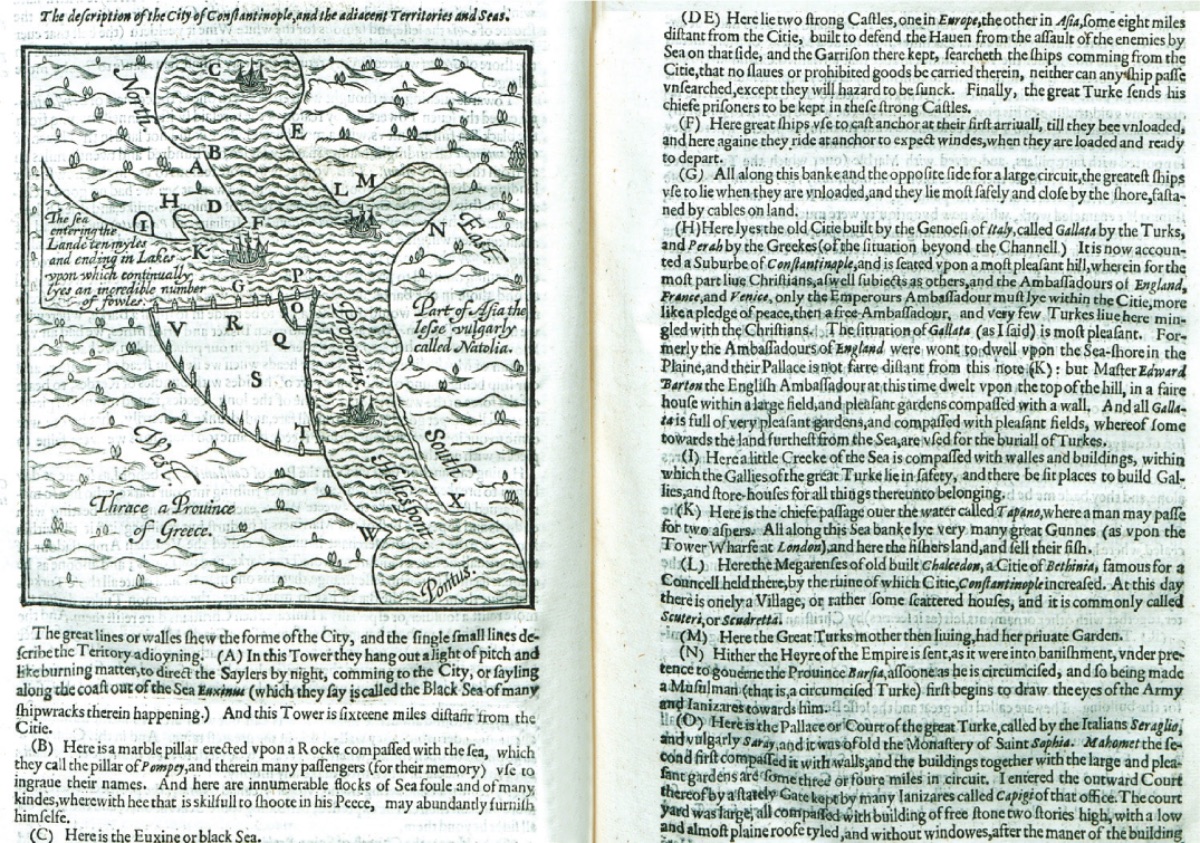
The Dardanelles and Surroundings (1617, Fynes Moryson) When the king of Mizistre returned from Crete, he learned that his wife had gone to the city of Troy with the guest. He immediately set out and came to the king of Troy, to whom he was also subject, and requested that his wife be taken from his son and returned to him. The king of Troy did not accept this request and wanted to kill the king of Mizistre. The commander of Mizistre in Troy informed the king of this situation. The commander told the king, "What are you waiting for? The king wants to kill you. Don't wait any longer, retreat to the Morea side. Let me give you a ship," and out of fear of death, he listened to this advice and went to Misitre. When he reached his country, he informed the surrounding kings of the situation. Finally, together with them, he gathered a large army and besieged the city of Troy by land and sea. However, since the fortress of Troy was strong and its people numerous, they could not capture it. In the tenth year of the siege, a wise man made an interesting and large wooden horse statue and placed a few brave soldiers inside, leaving it near the fortress. Not wanting to destroy such a magnificent work, those in the fortress took it inside. The incident is as follows: They placed this statue, made in the shape of a horse, on a few wheels and put a few brave soldiers inside, leaving it where the army was located and setting an ambush at night. When the statue was taken inside the fortress, those in ambush would bring news. The people of the fortress thought the enemy had fled and left the statue because they could not take it. Some in the fortress said the statue was not empty and should be broken, while most said, "Isn't it a pity? This is an artistic thing, the enemy left it there because they couldn't take it, let's take it inside and place it inside the fortress gate." However, since the horse-shaped statue was too large to fit through the fortress gate, they demolished the gate to rebuild it. As a result, as soon as the spy lying in ambush saw this, he informed his soldiers of the situation, and without wasting any time, the enemy soldiers besieged the fortress again. When they attacked the gate, the soldiers inside the horse statue came out and entered the fortress together, killing the people and destroying the fortress.
The ruins of this great city still remain. Among these ruins are artistic columns and high-quality marbles. The columns and marble stones in Istanbul were mostly brought from here. It is located opposite Kapıdağı Island and Edincik. From the location of Troy, the shores of Rumelia and the northern shores of Gelibolu can be seen. Even Süleyman Pasha, after watching the shores of Rumelia from here, told Orhan Gazi that he wanted to conquer those places. Therefore, this place is called "Temaşalık." It is also famous as the Palace of Belkıs."