
"We saw two chained bashi-bazouks on the deck, who had committed a terrible murder in Istanbul and were being sent back there. They were black-skinned Arabs who looked extremely frightening and savage; we were not pleased with their joining the passengers on our boat. After these wretched captives came on board, no more music was played.
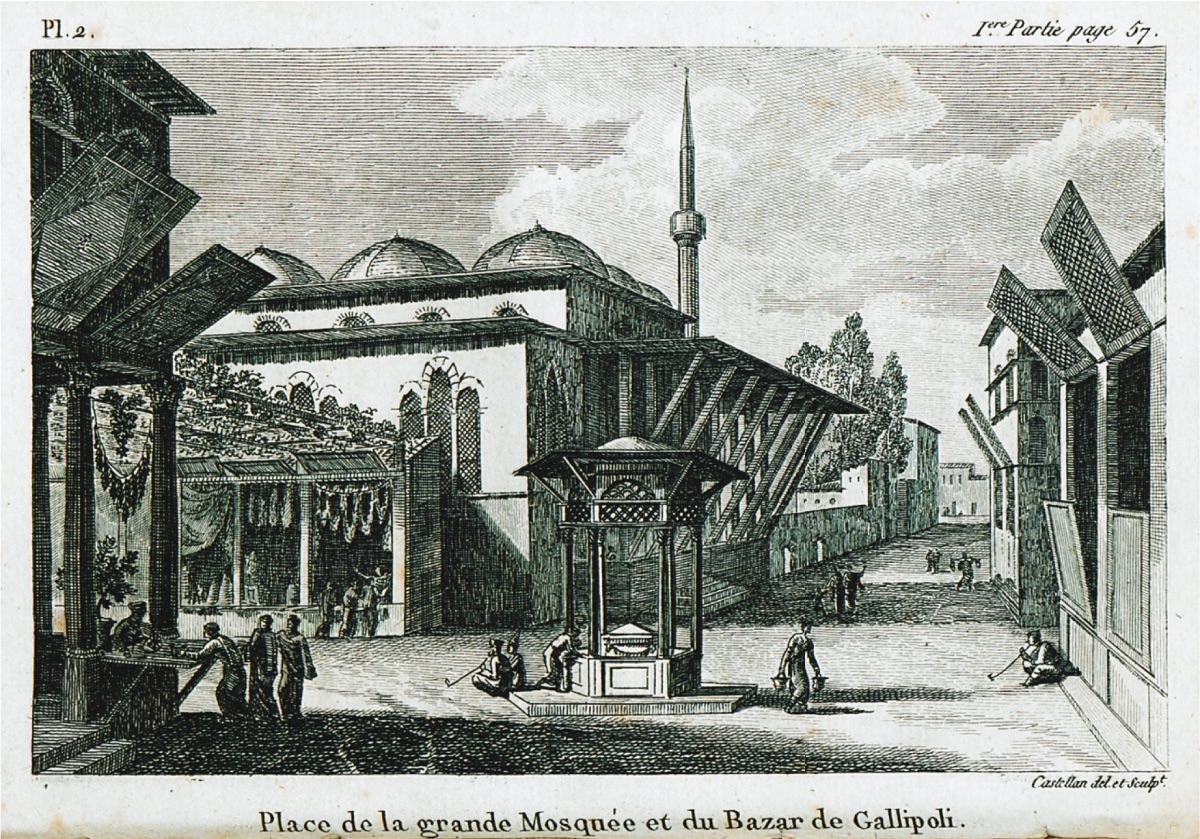
We stopped once at Gallipoli: a place that looks extremely beautiful from the sea, just like Syros, but inside it is as wretched as an Eastern town can be. Here, a French detachment on its way to Crimea joined us, their commander was a remarkable, handsome officer. Two French officers who came to see him off shook his hand warmly and, while kissing his stern cheeks, said very emotionally, 'Adieu, mon cher ami!' This dreadful Crimea!
We also took on many Greek and a few Turkish deck passengers at Gallipoli, who had their quilts, water jugs of ancient form, and baskets of bread and melons for the journey. The poor Turkish women looked very uncomfortable with their white yashmaks and loose, impractical feraces. They huddled in a corner, not moving at all, resembling frightened sheep. As soon as the men arranged their bundles, they spread their prayer rugs and began to pray; they knelt and bowed until their foreheads touched the deck...
Unfortunately, we were still asleep when we passed Mount Ida, Sestos, and Abydos, which I very much wanted to see, early in the morning. However, I was awake when we passed the white castles in the Dardanelles and watched them with admiration. I fully understood how important this region was for someone with the genius and ambition of Tsar Nicholas. It was pleasant to proceed with our steamer in the Dardanelles. We passed large French and English warships filled with soldiers, with every sail inflated by strong winds.
The Turks have named this town Çanakkale. This is the ancient Dardanos, where the significant treaty between Sulla and Mithridates was signed (as you see, I try to learn everything possible during my travels), and in modern times, another treaty was signed between the Turks and the English in 1809.
They point out the tomb of Hecuba on the hills above the town; it is said that Xerxes anchored his ships opposite this tomb by forming a bridge. Every inch of land in this region of the world is filled with famous classical and historical figures.
We could see the white-tented encampments of the bashi-bazouks commanded by General Beatson on the surrounding hills. They say everything in the Dardanelles seems quite primitive to travelers. You can see patient oxen drawing plows, women grinding wheat, spinning wool with a primitive spindle, or drawing water from ancient wells, just like in the times described in the Holy Book.
Our last night at sea was beautiful, but as the sun set, a fierce redness appeared. The fires of the coal mines on the mountains created a magnificent effect as darkness fell. Most spread over a few acres of steep and rugged slopes, covering the sky with a terrifying redness as if great cities were burning in the distance."