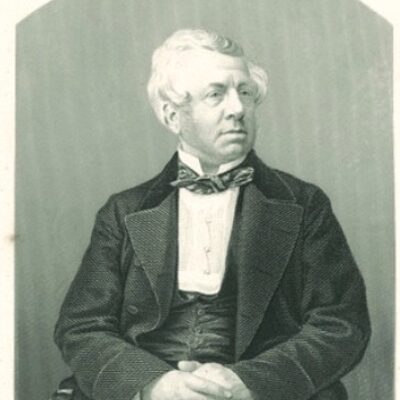
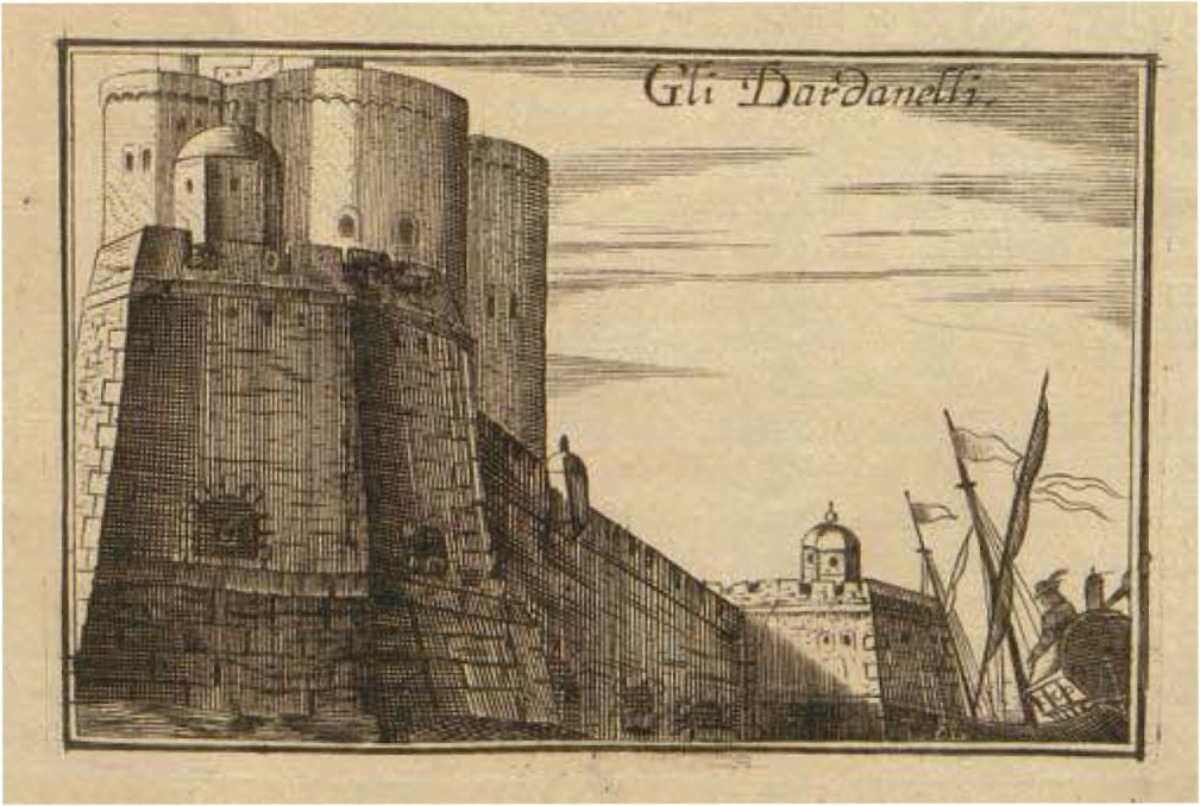
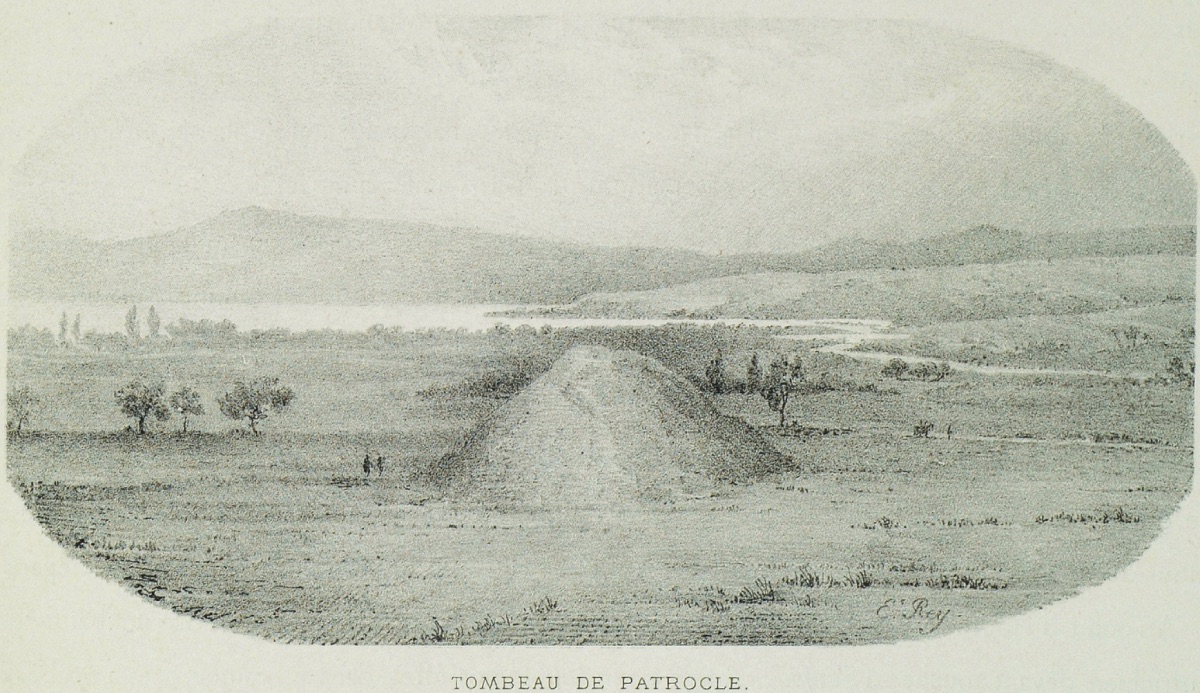
Fortresses in the Dardanelles (1686, Jacob Enderlin) Frederick Howard (1802-1864), who came from a noble family, earned a doctorate in classical languages at Oxford and was a well-known figure in both politics and literature of his time. At the age of 23, he attended the coronation of Russian Tsar Nicholas with his uncle, after which he took on active roles in politics, including serving as the Secretary of Ireland from 1835 to 1841. Howard served as the Minister of Forests in Lord John Russell's first cabinet, received the title of count after his father's death in 1848, became a member of the House of Lords in 1849, and was appointed as the rector of Aberdeen University in 1853. His writings, lectures, and especially his poetry made him one of the most important figures in 19th-century England. Howard also wrote a tragedy about the conquest of Istanbul. His journey to the East, which began on March 31, 1853, lasted a year, and he published his impressions from this trip as a book in 1854. His writings reflect the sympathy felt towards the Turks in Europe during the Crimean War. Howard's impressions of Çanakkale provide important insights into both the perspective of the intellectuals of the time on the East and Homer's works, as well as information about the Calvert family, who were serving as the British embassy in Çanakkale at that time. Frederick Howard made his first visit to the Çanakkale region during his Aegean journey, which he started from Istanbul, and later, during his return from the Aegean islands to Istanbul, he made his second visit when he had to wait at Beşik Bay across from Bozcaada due to some issues:
"July 10
I was on deck at five o'clock. We could easily see both shores of the Sea of Marmara. The service on deck was conducted by Captain Deriman. A well-intentioned, respectable man, Deriman.
After passing Marmara Island, we reached the Dardanelles. This strait, the sister of the Bosphorus, although not as magnificent, is still beautiful. It even has both classical and historical interest. We passed Lapseki (Lampsacuk), which retains its ancient name. Lapseki is the city tasked by the Great King to produce wine for Themistocles (a Greek commander who lived in the 5th century BC). We watched the strait narrowing from Sestos to Abydos, where Leander and Lord Byron swam across and where Xerxes likely built a bridge. We saw the famous tomb of Hecuba next to ancient Madytus. We passed in front of modern fortresses with large gun embrasures. Here, history and music are intertwined. Who wouldn't claim these dome-like green hills that are now visible as their own? And this leads me to repeat:
You believe in the green of every mound,
In each, the ashes of legendary heroes are found,
Surrounded by fixed landscapes,
Still flowing, your Dardanelles
(A Bride from Abidos).
After passing the Dardanelles, the Aegean Sea is before you with its magnificent view. The beautiful steep cliffs of Imroz Island are very pleasing to the eye. To the right are the high peaks of Samothrace, in front of you are the gentle slopes of Tenedos, and to the left stretch the low shores of Troy. Turning around a cape, we saw the British and French fleets. We went as far as the farthest point of the French fleet. The French fleet consisted of eight sailboats in double rows. Then we went halfway through the British fleet, which consisted of seven sailboats in a single row. The British had more steamers. The steamers were positioned behind the large ships. We stopped opposite Admiral Dundas's flagship, Britannia. The admiral greeted me with great hospitality.
July 11
This morning we learned that Admiral Hamelin would replace Admiral de la Susse, who commanded the French fleet. Admiral Susse had reached the age limit of sixty-five in the French navy. The British admiral had met him many times and liked him very much. Many of our captains came aboard. The liveliness of the large fleet, even though the crew complained about the monotony in Beşike Bay, cheered me up. They had been here for a month. I went ashore twice, before and after lunch. One of the places I visited was at the mouth of what they told me was Karamenderes (Skamandros). The clarity of the water delighted me. The clarity of the water is the first contribution to the beauty of rivers and also an invaluable blessing for ships. The width of the long river is about one and a half meters. One can easily understand why the waters of this river were insufficient for Xerxes' armies and why the Dardanelles is called wide. Suddenly a city appeared. We saw many shops selling drinks, pipes, and Persian carpets. If Achilles were here to see, surely there would be no shops selling such things. At dinner, the captains of the steamers were also among us. Smart men. We devoured the turtle and Berkshire-style cooked chops offered by the admiral with appetite. There is no better meal on earth. Admiral Hammelin arrived tonight.. Patroklos Tumulus Near Old Kumkale (1843, Etienne Rey)
July 12
Every day I took the Iliad to read. Although I hadn't read it in the original for a long time, I was pleased to be able to read it comfortably without a dictionary, notes, or translation...
July 14
At half-past eight, we gathered on the Caradoc ship with the admiral and almost all the captains in the fleet for a small excursion in the waters of Çanakkale. We extended as far as Gallipoli. On the way back, we stopped at a small town's fortress on the Asian side of Çanakkale. We went ashore. The military commander here welcomed us very warmly. They immediately offered coffee, pipes, and sherbet. The commander has a very friendly appearance. However, the regiment did not leave a very positive impression on us. We looked at the big guns. One of these guns nearly sank Admiral Ducworth's ship. One of them also resembles English guns from the same period. The number of guns, along with large marble and granite cannonballs, was seven. The diameter of the largest was about eighty centimeters. However, it is said that these guns are not as effective as other guns of the same size due to the difficulties in aiming and loading. We had our delayed picnic on the deck. Çanakkale was flowing in front of us, and our conversation was becoming more and more lively. Our joy was increasing.
During the day, a storm broke out for a few minutes, and we saw the famous current of the Dardanelles rolling into the open seas and into the darkness. Our return coincided with a beautiful sunset. Mount Athos was easily visible about eighty miles away. At night, we heard gunfire on the shore. The flag captain of our ship went to investigate; a Greek had been killed. However, it was unclear whether he was shot by thieves or his colleagues.
July 15
At six o'clock, I went to Captain Lushington's ship, Albion. After breakfast, I went ashore with the captain and the consul's brother, young Mr. Calvert (the first person to excavate Hisarlık Hill (Troy) in 1863-63). We climbed the mountain. I rode the consul's charming donkey. We wandered about twenty miles in Troy. Most places were covered with scrub, with small oak trees here and there and sometimes cultivated lands. Among them were such vehicles that if Homer saw them, he would surely be astonished. The threshing sled pulled by two very old oxen resembled rafts on the river. Riding it must be very enjoyable. I would like to experience this childish pleasure. We passed three small villages. In the last village, there were many columns lying on the ground. Probably due to the difficulty of transportation, no one touched them. Seven large granite columns caught our attention. There were some engravings on them that we thought were from the Roman period. Later, we climbed a hill with cliffs on the sides. As we climbed the hill, I felt regret for sitting comfortably on the backs of the animals. We saw large stones spread over a wide area on three adjacent hills. Thick double walls surrounded them, giving the impression of being restored. These are said to be the ruins of the Pesagi tribe. Now it is called Tschigri (Çığrı Mountain/Neandria ancient settlement. R.A). It is not far from the place marked on maps as Palae Scepsis, with its older and original name being Scepsiz. It is possible that Çığrı is the same city as Kenkreal, a fortress around Skamandros used as a refuge from Turkish raids before the conquest of Istanbul, as stated by a Byzantine writer. Could the plain below be Dardania, the city on the lower slopes of Ida before Troy was established? The later established city of Dardanus may have been founded just to be a city. However, it is impossible to think about which of the fiercely fighting Pelasgian, Clopenan, Greek, Trojan, Phrygian, Mysian, and Dardan peoples this city belonged to. We found remains of walls and stairs here. And we took some pottery fragments. Mr. Calvert says very few travelers have safely reached the hill. Based on his previous experiences, he said he couldn't even imagine how the inhabitants here made use of their horses. The inhabitants here must have built reservoirs for their water needs. The view from the hill is very impressive. We looked at the Trojan plain, where the scattered trees gave a deceptive appearance to the cultivated land. In front of us stretched the sunlit blue color of the Aegean Sea. Tenedos appeared in the distance with its small hills, and further back, Samothrace, Imroz, Bozcaada, and Limni islands, all fitting into their places. The high masts of the fleet were sleeping in deep red. Later, we saw a French warship named Friedland entering the bay. Gun salutes were heard from the French and British fleets to greet the newly arrived ship.
We descended the hill on foot. After our return journey, we were very pleased with the hospitality we encountered on the Albion ship at sunset. Admiral de la Susse had left us in the morning. The crew of both fleets had seen him off.
July 18
We set off again with Captain Lushington. We found our horses by the stream next to Skamondros, then crossed the Simois stream. We rode twelve miles towards the summer house of our consul, Mr. Calvert. This is the northern part of Troy. It is more fertile and pleasing to the eye than the land we saw before. Finally, we reached the consul's house. This house was previously used by a Turkish agha. It is in the middle of a small village called Erenköy. It has a very wide, magnificent view overlooking the Dardanelles, the Aegean Sea, and the islands with its deep blue waters. The house is also spacious and airy. We are very pleased with our host. Mr. Calvert has two large farms outside this house, one on the European side in Chersonese and the other in the Trojan plain. The farm in the Trojan plain is about seven thousand five hundred hectares. Since non-Muslim men cannot own land according to Turkish law, Mr. Calvert registered these lands under his wife's name. This example may give you an idea of the laxity of Turkish laws. The land tax that needs to be paid to the state is about ten pounds a year. Additionally, a tithe must be given. However, Mr. Calvert has not paid even the land tax, let alone the tithe. In the third year of owning these lands, the tithe alone reached one hundred and fifty pounds. Mr. Calvert describes Turkish lands as inexhaustible in terms of both agriculture and mining. While there are Turks willing to work for three pounds a year, apart from food, drink, and lodging needs, he prefers to employ Greeks for ten pounds a year.
We left our consul's autumn house at noon. At first, the weather seemed very hot to us. Our return journey was through the Thimbrek (Thymbrean) valley, which could be considered the most reasonable city next to ancient Troy, on a nearby hill near the Tymbrean Apollo temple. Here (Halileli village cemetery) were marble sections that could be the remains of an ancient city. Later, we toured part of the consul's new large farm.
July 21
The ship Niger arrived. The approach of these steamships after rounding Siegeum Cape, bringing news, is very exciting. Today's news is calmer. After having dinner with the hospitable and kind-hearted Admiral for the last time and a heartfelt farewell with the officers of the ship, I went ashore. In the cool of the evening, I reached the consul's summer mountain lodge. In the lodge, besides the consul's family, there was a Wallachian gentleman staying. This gentleman, like Chevalier d'Azeglio, who is now a painter, was exiled from his country by the Russians in 1848 for his free thoughts and actions.
July 22
I couldn't do much in the morning. Mr. Calvert is trying to create a museum from slowly gathered sections that seem to be very interesting. This work seems to provide him with both benefit and fame due to its antiquity. Already, he has a few small vases of the type called Etruscan, which he estimates to be from the time of Philip of Macedon. We had our meal at half-past three, then took a very nice ride on horseback.
The horses were a bit skittish for us to fully enjoy the scenery. But the views of the Dardanelles, the Gulf of Saros, and the islands at sunset, especially the most magnificent rise of Samothrace Island above sea level, were marvelous. We passed through this elegant, small grove. The Greeks here still continue their custom of sacrificing an ox once a year. They eat the sacrificed ox, then sing songs and dance. The only drawback here is that the trees have not grown very large. We saw a few beautiful silver ash trees. The air is filled with the sweet scent of the carob trees. The interior of this lodge is as captivating as the exterior, even more so. However, recently clouds of sorrow have hovered over this house. Mr. Calvert's mother, Mrs. Abbot, despite having given birth to sixteen children, still possesses a striking beauty. My aim is not to describe the houses I visited or stayed in, but it is impossible not to mention Mr. Calvert's attitude towards the various people around his house. With his kindness, energy, intelligence, helpfulness, and creative pragmatism, such people can easily be the ones to revive this land. Mr. Calvert brings European goods and tools to his farms in Gallipoli and Troy, and he is now trying to add another farm in the old city of Dardanus. He advises the villagers, distributes medicine. He has developed his business so much that he has now tied one foot here. He has lent money to the villagers at an interest rate of 20% per year. He is now collecting the money. I must note that all those he lent money to are Greeks. After bitter experiences, Mr. Calvert now prefers not to lend money to Turks. He has converted two Christians, who were claimed to have accepted Islam, back to their old religion. If it weren't for the pardon recently issued through the efforts of Lord Stratford, he would have been fined quite heavily. In short, he is quite an active person.
July 23
Mr. Calvert accompanied me to his consulate in the city of Çanakkale. Here, I boarded a small steamer named Ellena, belonging to the Austrian Lloyd company, operating between Thessaloniki and Istanbul. I was the only guest in the honor cabin. There was a young and very passionate Greek on deck. He was making nonsensical remarks about the advancing Turk in Europe. Unfortunately, this young man, who could advance his country, had a book of Faublert's memoirs in his hand.
...
October 14
Admirals Dubdas and Hamelin held a meeting this morning about where the anchorage would be if they advanced upwards. It was decided that the French would temporarily anchor at Gallipoli (or Zampzacus), and the British fleet at Çanakkale. Unfortunately, we will not be able to witness the allied fleets entering the Golden Horn together. Otherwise, it would have been a very grand spectacle. Dinner was eaten on the Charlemagne ship. The food was very delicious. The hospitality was excellent. I already like Captain M. de Chabannes very much. The ship's chaplain went out to give some short exhortations to the crew. One should repeat these exhortations frequently.
October 15
After breakfast, I left the ship with Mr. Calvert. We went by carriage to a village named Erenköy where he resides. We took a road I hadn't seen before, leaving the hills named Peneleus, Antilochus, Achilles, and Patroclus on our left. We went to the tomb of Ajax built there. There are some remains resembling Roman architectural style. This fourteen-mile journey sufficiently fatigued me after my recent weakness. But after an early dinner, I took a walk. The weather was quite cloudy for an eastern climate.
October 16
An extremely calm day. Mr. Calvert conducted the service; he said he had prayed for me during my illness; I expressed my respects and thanks to him. Many people come to Mr. Calvert for advice, even for surgery. After dinner, we took a beautiful walk among the narrow paths and vineyards, which must be very attractive in the fresh greenery of spring, with the ladies.
October 17
At seven o'clock, we mounted horses and went to Mr. Calvert's Asia Farm. Some new machines were being installed. It seemed a bit strange to me to see tools branded "Garrete of Saxmundham" and "Croskill of Beverley" in the Trojan plain. We went to see a mound recently opened, containing layers of calcified human bones, which we think are the remains of Trojans buried during the truce. The surrounding land was largely used as a burial procession. However, in the distant future, earthenware jars and coffins containing one or more very small earthenware jars and tear bottles may be excavated. While I was there, I took a jar from one of the excavations Mr. Calvert had conducted. Mr. Calvert suggests these are from the time of Alexander the Great or Philip. We had an excellent and light lunch with superbly prepared cream taken from Turkmen shepherds. Then we left the farm and climbed to the summit of Burnabaşı (the village of Pınarbaşı just below Ballıdağ, long believed to be Troy. R.A). Unfortunately, I had passed over this magnificent city superficially on my first journey. We drank our fill of water from beautiful springs in a wide and simple clearing. Our return journey was around the Cesietes hill. The view of the allied fleets rose before us. The fleet seemed to be in a silent sleep.
We arrived just in time for dinner on the Admiral's ship. The sun was gently setting. Although it was longer than the last time and I appreciated its beauty, it did not affect me much today. In the evening, the French ship Chaptal returned. The officers came to our ship. They brought news from Istanbul to our Admiral. This is important news. They brought news from the Sultan. As soon as the news was received, the Sultan wanted two ships and four or five steamers from the fleets to come to the Bosphorus urgently.
October 18
The admirals discussed the anchorage points in the Dardanelles. I received letters from home inquiring about my illness. I had dinner on the deck of Rodney (Captain Graham's ship).
...
This will be the first storm I will experience. I woke up at two in the morning to see the movement of the adjacent fleet. It was a beautiful sight. The pale moon, the lights of the ships shimmering on the silent and calm waters. I went back to bed. When I woke up, it was around six or seven. We had entered Çanakkale. Only a moderate wind was blowing from the north. The journey is cheerful. We are going head-to-head with the French ship Jupiter. Just at this moment, Admiral Hamelin's flagship Ville de Paris and the magnificent ship Napoleon proudly passed between us. We should be angry with our government for not sending one of those new ships here. They say our country is one where appearance is given importance. At noon, all the ships except Ville de Paris and Jena, which had scanned these places, anchored under the adverse effects of the Çanakkale winds and current. We are about a mile below the Rhodius (Sarıçay R.A.) river, which is larger than the Skamandros and Simoeis rivers, and Çanakkale. In the afternoon, I went ashore and walked a bit. Then I found Mr. Calvert at his house in the town. Together we rode to the ship on the shore. We had dinner with Captain Drummond on the Venageance ship. He recounted his semi-diplomatic duties throughout the summer with admirable delicacy and a voice worthy of respect.
October 29
The Dardanelles is a bit different today. The waters are noticeably calm. At sunrise, the Albion ship approached and passed us with its two steamers. Many ships from both fleets are in motion. I am sorry to write here that our ship, despite its marvelous captain, remained at the end. Since it was previously decided that we would not set off until morning, I went to the city and bid farewell to my dear friend Mr. Calvert for the last time."