
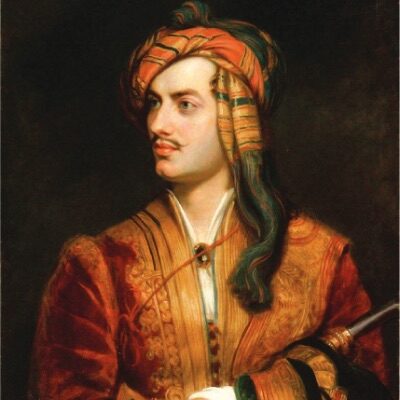
The famous poet, whose real name is George Gordon Byron (1788-1824), was born in London as the son of a noble military family. Byron, who received education at England's most prestigious institutions, wrote his first poems while at Cambridge. Considered the most powerful voice of English poetry, he is also regarded as the foremost representative of the Romantic movement. In 1809, Byron embarked on a journey to the Near East and Southern Europe. During this trip, at the age of 22, inspired by the tragic ancient love story of Hero and Leander, he swam across the Dardanelles on May 9, 1810. After returning from this journey in 1811, he published his work "Childe Harold's Pilgrimage." His poems are notable for their intense Philhellenism. In later years, Byron left England for political reasons and worked on the national resistances of small nations. This interest, combined with his Philhellenism, led him to Greece in 1823 to fight against the Ottomans during the Greek War of Independence. However, he was disappointed by his experiences there and died in Athens in 1823 after a severe fever:
"On May 9, 1810, the frigate Salsette was anchored in the Dardanelles. The lieutenant of this frigate, Ekenhaed, and the author of these lines swam from the European shores to Asia, or more precisely, from Abydos to Sestos. The entire distance, from where we anchored to the opposite shore, including the distance the current carried us, was about four English miles from the deck of the frigate upwards, although the actual width was a bit less. The current was so strong that no boat could cross directly, and depending on the angle, the entire distance took about an hour and five minutes, or in some cases, an hour and ten minutes. The water was very cold due to the melting snow on the mountains. We attempted a trial in April, about three weeks earlier, but having traveled the entire way to Troas on horseback that same morning, the water was icy cold. We had to postpone the attempt until the frigate anchored below the fortress. As described above, we began swimming from the European side and emerged on the Asian shore, having covered a significant distance. Chevalier mentions that a Jewish youth swam the same distance for love, and Olivier states that a Neapolitan accomplished it too. However, our consul in Tarragona did not recall any of these and tried to dissuade us from our attempt. The numerous crew of the Sassette knew it was a great distance. But what surprised me was that no traveler had ever tested the truth of the Leander story with practical application.
These poems were written after swimming from Sestos to Abydos:
In the darkness of December,
Leander, who never wished for night,
(Which young girl does not remember this story?)
Swam across the wide Hellespont currents!
While the winter storms blew,
He swam fearlessly and swiftly to Hero,
And those ancient currents flowed
Just Venus! How sorrowful they both are!
As a modern man like myself,
In the beauty of May,
I gently stretch my arms and legs
And believe I have accomplished a good deed today.
But he, according to that dubious story,
After swiftly going back and forth
To his lover – and Lord knows what happened
And he swam for love, while I for triumph:
It's hard to say who was better:
Sorrowful mortals, the gods still make you suffer!
He lost his love, while I lost my happiness;
He died, and I am in fever."