
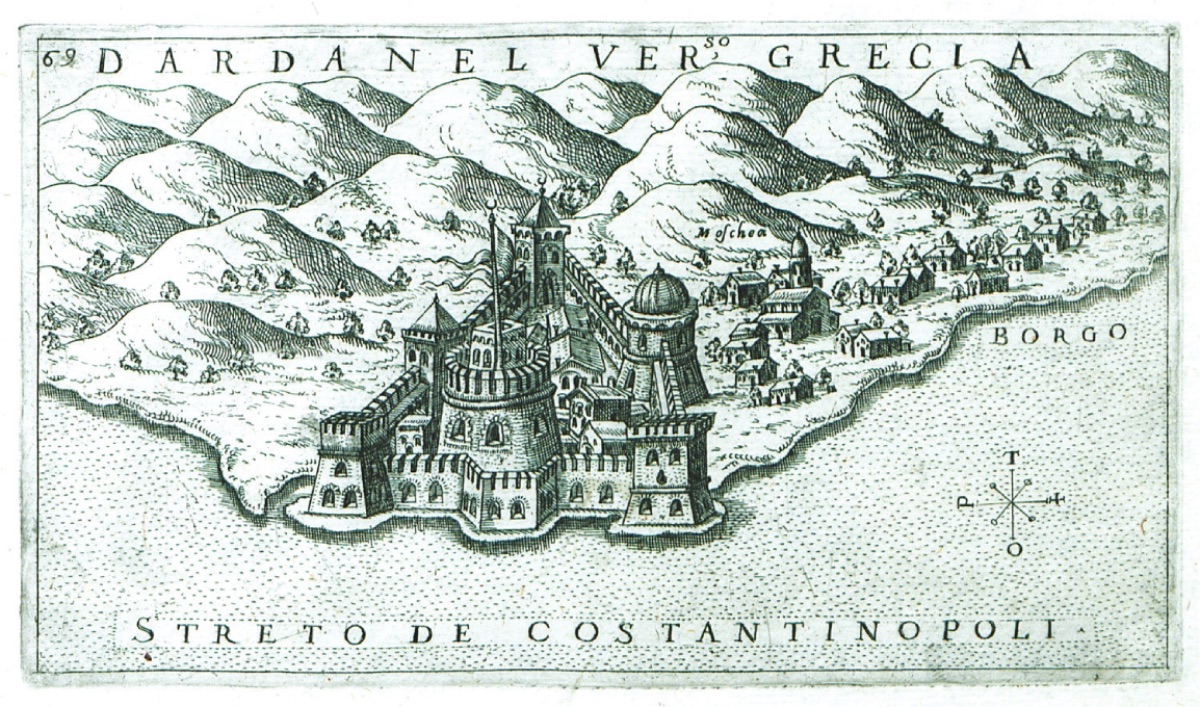
"On March 6, we set sail early in the morning and arrived by evening at the place where the castles of Sestos and Abydos are located. The Turks call these two strong castles, one in Asia and the other in Europe, Bogazhisar. This means the castle of the sea, and the castles or the port are the same as the Hellespont Sea for the Turks. The distance between the two castles is not very great. Both castles are situated on high hills and are protected by mountains, but they are not very solid: they are very old and require repair. All ships wishing to go down or up must anchor at the same place, wait quietly, and inform the Captain of their arrival. Whether Turkish or Christian, all ships are controlled by the Captain. At this point, King Xerxes built a bridge with 700,000 rafts to cross his army.
These castles are very famous for the two lovers, Leandro of Abydos and Hero of Sestos, in the poems of the poet Ovid...
...
On March 7, we passed through the Hellespont or the Strait of Gallipoli, heading towards the Aegean Sea (mare Aegeum), named after a very ancient German queen, Aigen/Aventineus. According to Plinius, it got this name from a rock resembling a bull, as the rocky area between Tenedo and Chio (Bozcaada and Sakız Adası) resembles a bull. The Turks call this place Ak Deniz, meaning white sea, while the Italians call it Arrcpelago (Peninsula). On our left, we see the old and famous city of Troy; however, since it has been settled for a very long time, no structures remain standing, only an old wall on top of a hill by the sea, but in ruins. As I mentioned before, the Turks take the stones from structures like churches and baths to use in building construction. This situation is not only the case for Troy, but they have done the same in Enzico (İznik?) located above Troy..."