
Scottish traveler and writer William Lithgow (1582-1645) embarked on long journeys from a young age due to his merchant father. After visiting northern countries and Central Europe on his first major trip, he set out for Paris in 1609, and from there to Rome and the East. It is estimated that Lithgow, who traveled for nineteen years, covered approximately 36,000 miles on foot just in Europe. Lithgow published his travel memoirs in 1632 and also has literary works. His observations on Islam are significant in terms of early European orientalist texts:
"We set out from Salonica. After the Sea of Marmara (Pontus or Propontis) and the Biga Peninsula (Troad), we arrived at Tenedos. There is a city named Tenedos built by Tenes, a very beautiful place with a castle and a harbor suitable for all types of ships. Very fine wine is produced on the island. It is said to be the best wine in southeastern Europe or perhaps in Asia. It is not very large, but quite fertile, located three miles away from Troy (Alexandria Troas R.A) as described in Vergil's Aeneid.
By chance, I met two Marseillais and two French merchants in Tenedos (Bozcaada) who were on their way to Constantinople. They had missed their ship in Chios while dealing with their newly chosen mistresses. Continuing their journey with a Turkish sailboat seemed to relieve their sorrow for a moment. I have witnessed many merchants and travelers who commit such follies during sea voyages but later repent. They and I wanted to see Troy; we hired a janissary for protection and a Greek as a guide. When we landed, we saw scattered ruins and old walls. As we headed towards the eastern part of Troy, the Greek guide showed us many tombs; these must be the tomb remains of Hector, Ajax, Achilles, Troylus, and other important heroes, as well as Hecuba, Chreisied, and other Trojan women (the remains of Alexandria Troas, R.A.)... He also showed us Priam's palace and the place where Aeneas's father lived. At the northern corner of Troy, in a place where the castles of the Dardanelles (Hellespont) can be seen, there is still a standing city entrance. There I found three rusted coins, which I later gave to the young brother of the Duke of Florence...
The place where magnificent Phrygia is located (an ancient term defining a region in northwestern Anatolia, R.A.) is a very beautiful plain, with grain, fruit, and very fine wine; it can perhaps be described as the garden of Anatolia (Natolia). Nowadays, not many people live there, only sparsely, with very few small villages. I estimated the length of the ruins of Troy to be about 20 Italian miles, which is approximately ten Scottish and fifteen English miles. Along the coast are the vineyards of Mount Ida (Kaz Dağı), and further east at the end of the area is the Simois river (Lithgow inaccurately locates the mountain and river to match the descriptions in the Iliad, R.A); the land here is no more than two miles: In this sparsely settled region, the majority are Greeks, with the rest being Jews and Turks.
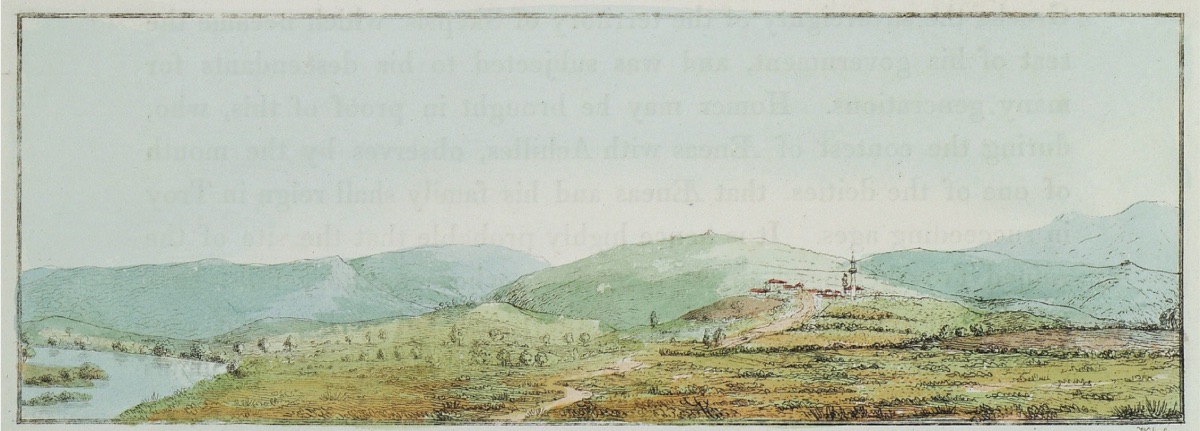
My seemingly ridiculous Turkish habits, like walking with a turban on my head, are quite appropriate here; I traveled all over Troy and Turkey in this attire: Before my eyes, on the right side, stands the only eastern gate remaining from this once wealthy city. A part of a high wall that has not yet been dismantled can be seen: Without a harbor, the Simios river (also the old Greek camp site) flows to the shore below, into the Sea of Marmara (Propontis Sea): A little further down in this fertile place are vineyards, and nearby, the ruins and fragments of Priam's palace, also known as Ilion, can be seen.
This region of Phrygia is filled with such remnants belonging to nobles: Right beneath my feet are the tombs of Priam and his queen Hecuba: beneath them, at the southern end of the city, rises Mount Ida (Kaz Dağı). On my left are delicious and beautiful olive and fig trees: To provide explanatory information about the content we have narrated here: Corinth's king Corinth, who fled here with his brother Iasus, first founded the city of Dardanie, and his son Dardanus founded Troy. Initially, this region was named Troas, hence the name Troy and Tros. It is also called Ilion because of Ilus, who built the palace of Ilium. This city was taken and destroyed by Heracles (Hercules) and the Greeks during the time of Laomedon, who committed suicide. According to ancient sources, in the end, Troy was defended by Priam against the Greek attack due to Paris abducting Menelaus's wife Helen. After a ten-year siege, the city was destroyed in the year 1783 from the creation of the world (Anno Mundi 1738)...
To the southwest of Troy is the three-headed Mount Ida (Kaz Dağı). Here, Paris, by turning away Juno and Pallas, gives the golden apple to Venus, thus beginning the tragic end of the entire region. These ruins are expressed in these poetic lines: "Nunc seges est ubi Troja fuit" (Latin lines from Vergil's Aeneid: Now a wheat field, where once was Troy. R.A.).
Later, with a small warship, we reached the place called Sestos and Abydos, where there are two opposing castles. Sestos is in Europe, where Thrace begins; Abydos is in Asia, only a mile away from Bithynia; both are four leagues (1 league approximately 5.6 km R.A.) away from Troy. Both castles are located at the beginning of the Hellespont and were built in memory of the commendable passionate love of Hero (Heiro) and Leander...
But these castles, now called the Gallipoli (Gelibolu) castles, are the power of Constantinople. No ship can pass here without the captains' knowledge; ships are searched very frequently in an unusual manner; surprises await Christians carrying men, weapons, or equipment for the army in the city. They must wait three days to pass through the strait on their return, as Christians wait for news to see if they have taken slaves elsewhere or committed a crime in the city...
Leaving the two Frenchmen here, I set out for Constantinople with a Turkish sailboat. The first noteworthy place I saw in this narrow strait is the ancient city of Gallipoli (Gallipolis). It was first built by Caius Caligula and was once inhabited by the Gauls: It is the first city conquered by the Turks in Europe by Orhan's son Suleiman."