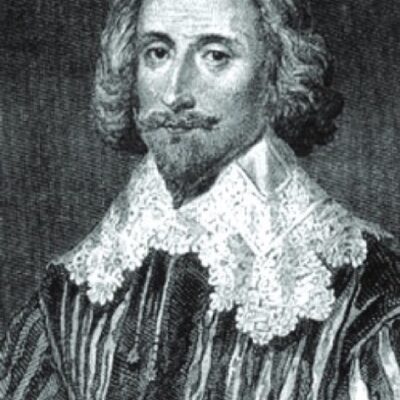
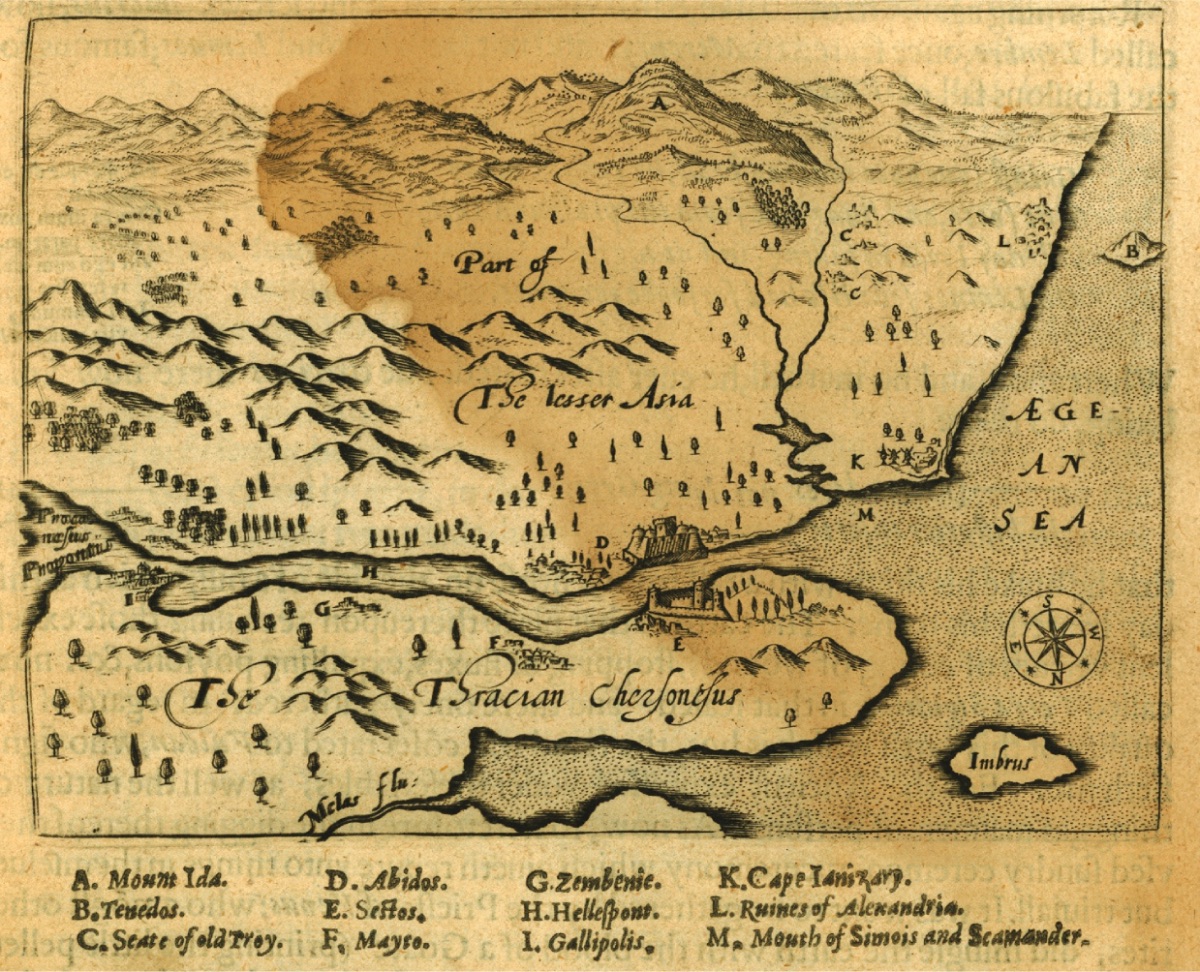
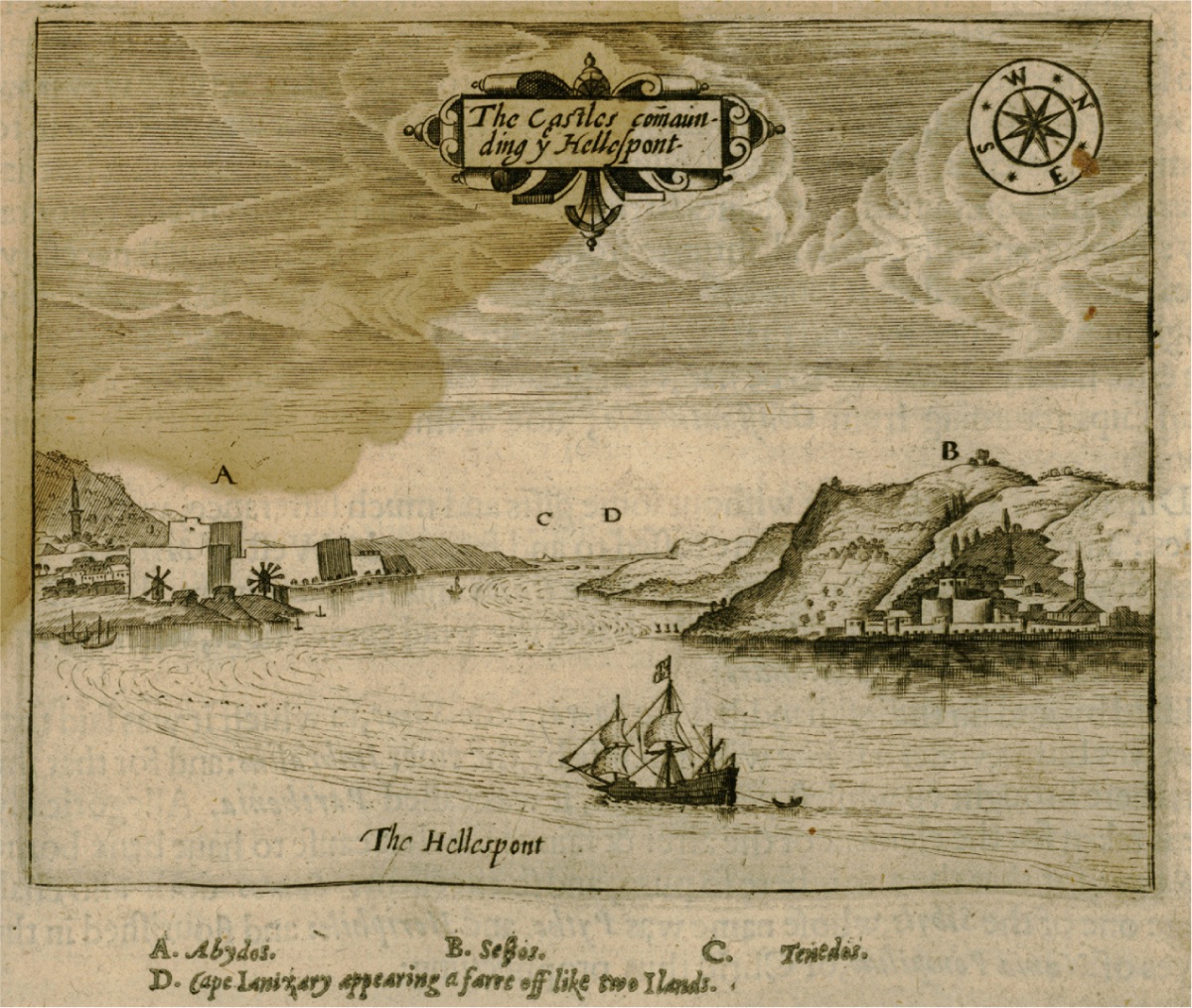
The Dardanelles and Surroundings (1610, George Sandys) A poet, writer, and colonist, George Sandys (1578-1644) was born in London and educated at Oxford. For a time, he worked as an accountant in an English trading company, focusing on agriculture and industry. However, when his translations of ancient Latin poets gained attention, he continued his work in this field and was considered one of the best authorities in England during his time. During his travels in 1610-1611, he sailed from Venice, stopping at the Aegean islands, southern Peloponnese (Morea), Chios, and Lesbos, passed through the Dardanelles, and arrived in Istanbul. From there, he traveled by ship to Egypt, Mount Sinai, the Holy Places (Jerusalem), and returned to his country via Cyprus, Sicily, Naples, and Rome. Compared to the travelogues of his time, he documented his experiences in more detail. His references to ancient writers are particularly noteworthy. His writings clearly show a great effort to convey his deep knowledge of antiquity to the reader. When Sandys' travelogue was published in 1615, it garnered significant interest and was immediately translated into German and Flemish. The interest in the work was so great that it went through nine editions in the 17th century. In the 1632 edition, philosophical sections and a translation of a part of Virgil's Aeneid were added, earning Sandys a significant place among European intellectuals and greatly influencing subsequent travelers. Another importance of Sandys is that he began to question the idea that Alexandria Troas was Troy. According to him, Troy should be sought further inland. Travelers following him continued this questioning, and it was accepted that Alexandria Troas was not Troy. After Sandys, who partially created the first accurate map of the region, travelers began to search for a new location for Troy:
"On the twenty-second of September, the contrary wind continued to blow, and our journey was somewhat interrupted. We thought the small sailboat coming towards us might be pirates, and we turned back from the headland as fast as possible. By evening, we returned to the place we had fled...
On the twenty-fourth, the sea was quite calm, and we continued our journey. Towards evening, we went to the same place on the Asian shore to get fresh water, and later that night, we arrived at Bozcaada (Tenedos):
Before the eyes of Troy stands a famous and wealthy island
Where noble Priam lived in glory and happiness
But now an unfortunate harbor (Vergil, Aeneas).
And the day passed thus: The island of the same name built adjacent to the not very important castle. The island's diameter is not even ten miles; it is only visible from the Sigeon headland; a round hill rises from the north side, producing extraordinarily strong wines; it was said that the inhabitants here were Greeks (Greeks). Initially named Leucophryn, it was later named Tenedos after Tenes, the son of Cycnus, who ruled a city in Troas called Colone (Kolonia). It is said that because he gossiped about his stepmother, his father put him in a chest and threw him into the sea; the waters carried him to the island, and Tenes, who liked the island very much, became its ruler. Because musicians (Musitian, meaning musician and flutist, R.A.) had made a secret pact with his mother, he enacted a law to prevent the sacred musicians of Chryses from entering the temple of Apollo Sminthius, which he built and consecrated to protect the island...
But before it was abandoned, it is certain that Tenes came here and settled. Tenes was killed by Achilles during the Trojan War. He was a valuable and renowned prince, so after his death, they honored him with sacrifices and a temple: but it was never as much as what was done for Achilles.
Kilitbahir and Çimenlik Castle (1610, George Sandys) In the morning, the sailors, rested, rowed towards the smaller sandstone shore of Phrygia. Now, we are opposite the ambitious and seemingly rewarding (though starting to become a bit dangerous) headland of Yenişehir (Ianizari) (once the glorious city of Asia, Ilium (Ilion/Troy), with my desire to see these praised fields, hoping to find at least a very beautiful argument). With their help, I landed on the shore. If two or three of them had not been with us, we would not have been able to climb the high plateau and see the ruined walls and ancient remains of the ruined city. Numerous vaults and cisterns built for water storage can be seen. The foundations seen here were built by Constantine the Great, who wanted to move his empire here and started construction, but later changed his mind and founded Byzantium. This famous Sigeum headland, where Alexander the Great (during his visit on the Asian campaign) ran with flowers and, due to the tradition of the tomb, ran around it naked, sacrificed in his honor, and was honored with the tomb of Achilles...
North of this headland is the city of Roetheum, famous for the tomb and statue of Ajax: This statue was moved to Egypt by Antonius (also known as Antoninus, the Roman Emperor Antoninus Pius from 138 to 161 AD, R.A).
Between these two plateaus is a very beautiful valley. Near Sigeum, the Greeks' ships were stationed. But the Dümrek Stream (Simois/now called Simores) near Rateum flows into the Dardanelles (Hellespontus). The river originates from Mount Ida (Kaz Dağları), the highest mountain in Phrygia... Famous for the judgment of Paris and its springs. From here, four famous rivers emerge; Gönen Stream (Aesopos) and the Biga Stream (Granicus River), known for Alexander the Great's victory, flow north: Dümrek Stream (Simois) and Karamenderes (Scamander) head towards the Aegean Sea (Aegeum). These rivers, flowing in different directions from separate valleys, once converged in the plain where ancient Ilium was located.
These rivers are not very strong, but (like all others have done for the ancient city of Troy, possibly he too may have confused them with others), they are not as weak as Bellonius (known as Pier Belon (1517-1546), a French researcher, writer, and diplomat who came to the Troas Region in 1547 and made a map of the region, R.A.) described...
West of these ruins, half a mile away, directly opposite Bozcaada (Tenedos), there are hot water baths, with magnificent structures nearby... However, now the ruins (Alexandria Troas, R.A.) do not show unity, because, as in Cyzicus (the ancient city of Kyzikos near the town of Erdek), here too, every day, the Turks transport columns and stones to Istanbul to build the Grand Bazaar. Once, where the visible remains of the famous city were, there was a small village of the People. After the destruction of the famous Ilium, the People constantly settled elsewhere. It is said that finally, on the advice of an oracle, they decided here, and when Alexander the Great came here, he built a temple dedicated to Minerva. Alexander the Great left his shield in the temple and took the other one there (later used it in battle); he offered rich gifts to the temple and honored the city with his name. He exempted the city from taxes, promised to build a magnificent temple upon his return, and to transform it into a great city by organizing sacred games. However, when Alexander the Great died, Lysimachus took over these tasks, built a defensive wall surrounding the city, and ensured that the city's name remained Alexandria...
And now we are entering the Dardanelles (Hellespont): Helle, the daughter of King Athamas of Thebes, and her brother Phyrxus, while fleeing from their stepmother Ino, Helle falls and drowns. The strait is bordered on the left by the Thracian Peninsula (Thracian Chersonesus). In popular language, this is called the arm of Saint Georges, and on the southwest of the peninsula, the tomb of Hecuba, who was turned into a dog by the gods due to her impatience, also known as Cynosesema, is visible...
About three leagues (1 league approximately 5.6 km R.A) from the entrance; at the narrowest part of the strait, there are the cities of Sestos and Abydos, built opposite each other, known for the sad love of Hero and Leander, who drowned in the raging waves, as poet Musaeus has versified. Here, Xerxes crossed the strait with his great army without getting wet and climbed the mountains; it is said that in the past, a bridge was made from ships in the Greek homeland...
Abydos, located on the Asian shore, was founded by the Milesians with the permission of the Lydian king Gyges, encompassing the entire region. During the reign of Orhan (Orchanes), the successor of Osman (Ottoman), the Turks conquered it due to the governor's daughter, who was caught between two bad choices. The governor's daughter, often seeing Abdurrahman from the castle battlements and enchanted by his heroics, threw a letter wrapped in a stone when he approached the walls one day. The governor's daughter promised in the letter to hand over the castle to them if he persuaded his commanders to end the siege and returned quietly at night to follow her. When the enemies withdrew, the soldiers in the castle, happy, drank and fell asleep; Abdurrahman came with his chosen soldiers and was let in by his lover who opened the door for him; he and his companions caught the castle commander in his bed while the guards were asleep and the castle was taken by the Muslims (Mahometans). Sestos on the European side, although new, was built strongly and was once the most important city of the peninsula (Chersonesus): later, however, the appearance of the castle was spoiled by adding extra spaces. Abydos is built on a lower place, Sestos on a high place descending towards the sea: the first with a square, the second with a triangular plan, both castles delimit the same region (Sandys, unlike some other travelers, does not confuse the Çimenlik and Kilitbahir castles with the old Sestos and Abydos. R.A). Numerous and large cannons, considering the vegetated area filled with water, are too close to the sea. Beyond that, strong garrisons with branches behind them and small castles towards the interior are the reason for its invincibility. Nowadays, these are called castles among the people. Every ship wishing to pass must report the number of passengers and where they are going. However, as we will detail in our reports, on the return, passage is not allowed without inspection and permission. A little further, we passed in front of the remains of a castle called Çimpe Castle (Zembenic), the first taken by the Turks in Europe, where small Turkish ships and boats still sail in front and salute with their cannons. Orhan's eldest son Süleyman (Solyman) made a great surprise: While crossing the Hellespont at night, with the help of a Greek (Greeke) who had previously climbed a wall, he entered with his weapons. The inhabitants here, as is a tradition in this country, worked in the vineyards and cornfields at night, and they could not even dream that they would cross to Europe, although some say small boats were used for this purpose, it is now generally said that the Turks were transported to Europe by the Genoese, who charged a gold coin per person... That night, we arrived at Gelibolu (Callipoly), about twenty miles away, and entered the harbor, suitable only for small ships, north of the town.
Gelibolu is a city on the peninsula, established just above the bay; so shallow that ships passing through Gelibolu (Hellespont) anchor there. Some believe the name Gallipoly comes from the Gauls (the Gallia people who lived in the region where modern-day France is located, R.A.), from the time of Brennus, a Briton (Brittaine) and brother of Bellinus (if our history books are correct). However, this Greek name does not support this view. Pausanias mentions Callipolis...
Gelibolu (Callipolis) looks very beautiful from a distance, but when you enter, you see that it is not so: a part of it is on the headland, the rest is mountainous, and there are neither castles nor battlements. Along the headland, there are many points for small ships: South of the city, there is a small plain, with various round hills; these are said to be the tombs of the Thracian (Thracians) kings (tumulus R.A.): an ancient burial tradition. The lands above are not barren, but fertile, yet not much settled. On the other side of the road, the places where Süleyman, mentioned earlier, took the first city from Europe in 1358, have been settled by the Turks for a long time. There is a boat here to cross to Asia. Greeks (Greeks), Jews (Iewes), and Turks live in a city: churches and synagogues are accepted. There is also a monastery of Romish Frierers of the order of Saint Augustine. Currently, one of them is serving as the French embassy. In his office, the goods of all Christian ships (except the goods of the Great Lord (Sultan)) cannot be sent elsewhere, loaded, or traded freely under the castles. I hoped to rest and relieve some of the fatigue of the journey at his house, but he was at home, and I had to return to my bed from the water..."