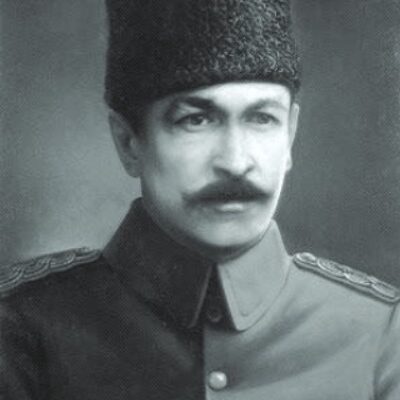
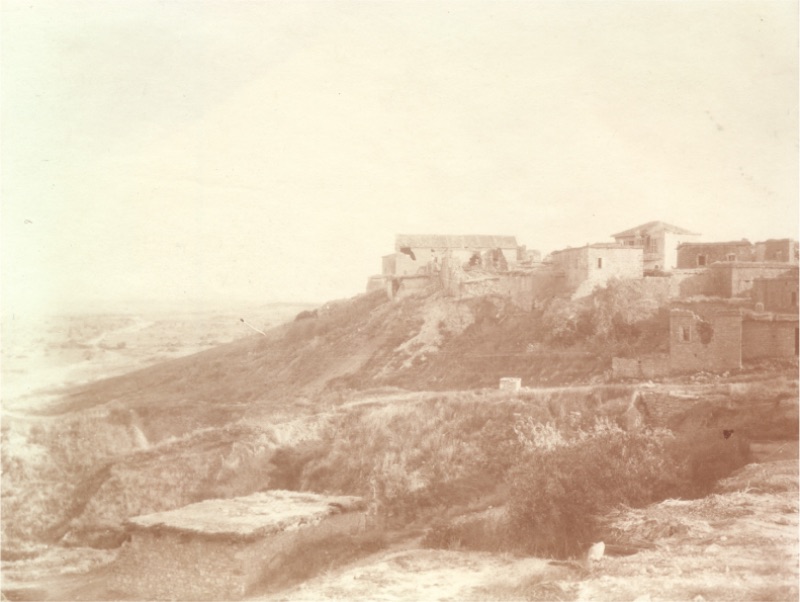
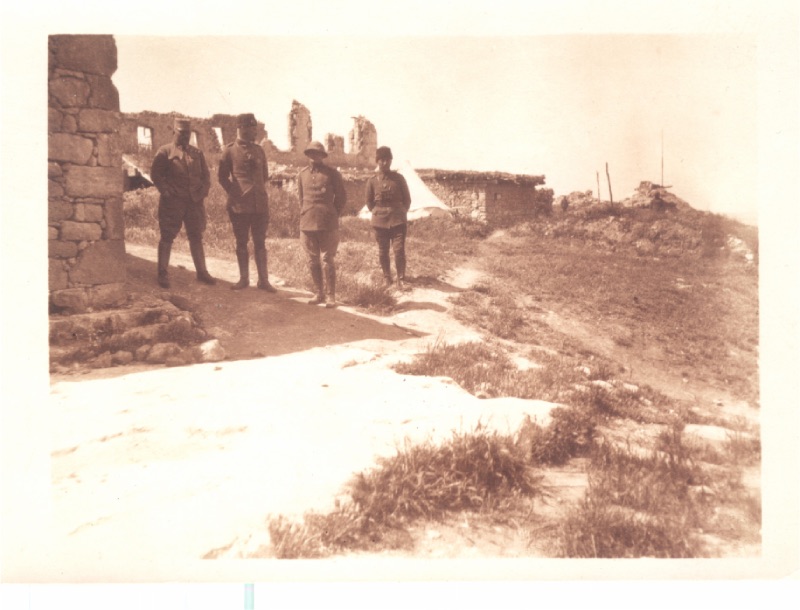
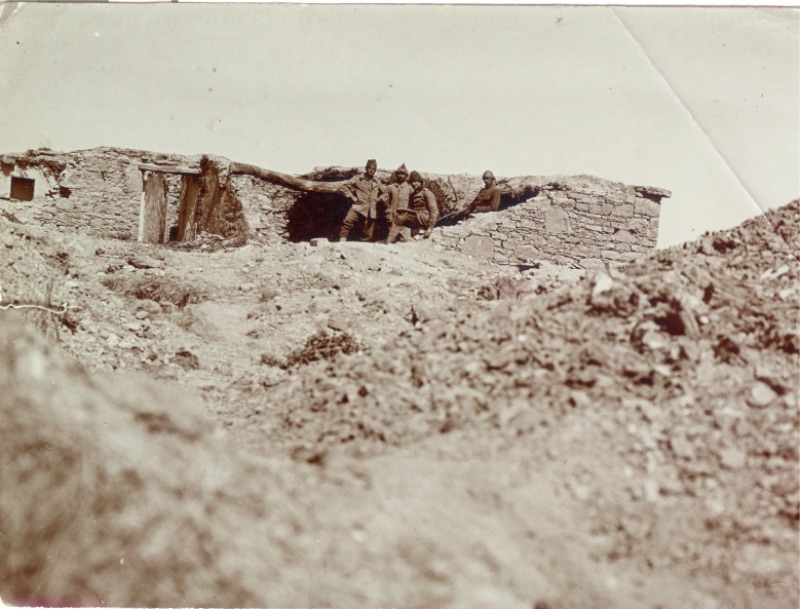
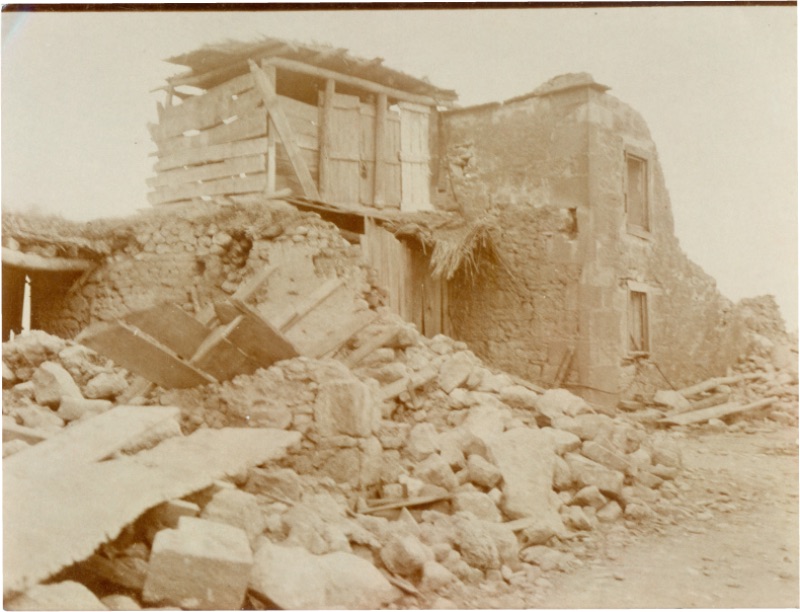
Yenişehir Village During the 1915 Çanakkale Wars (Ernst Krieger Family Album)-2 Captain Selahattin Yurtoğlu was born in Edirne in 1894 and died in Ankara in 1956. After attending the neighborhood school, he studied at Edirne Military School and entered the Military Academy in 1910. He began serving as an infantry lieutenant in the army from 1912. Due to his successes in the war, he was promoted to first lieutenant in 1915 and to captain in 1918. During the War of Independence, he fought alongside Mustafa Kemal. In 1926, he retired from his military duties at his own request. Captain Selahattin wrote his memoirs in fifteen volumes, which were published in two volumes by İlhan Selçuk in 1973. Captain Selahattin arrived in Çanakkale on August 15, 1912, due to his assignment to the Second Corps, which was protecting the Dardanelles against the Italians. In his memoirs, the significant part for the Çanakkale region is his memories from August 5, 1912, when he was sent to suppress the rebellion of the Bursa Redif division in Erenköy, Çanakkale. Captain Selahattin suppressed the rebellion and then stationed with his soldiers in Çıplak Village, right next to Troy, to prevent the Italian navy's harassment of the Dardanelles. His observations during the one or two months he spent there are the last observations of the Greek village Yenişehir (Sigeon), located at the entrance of the Dardanelles and described in detail by European travelers since the 16th century, before it was abandoned. The village, which went through different stages from the 16th century to the 20th century, began to be abandoned with World War I, which ended the 19th century, and was completely abandoned during the Çanakkale Wars before 1915. Captain Selahattin's observations are of great historical and cultural importance. Interestingly, Captain Selahattin did not mention the ruins of Troy. One possibility is that these sections were omitted by İ. Selçuk while abridging the memoirs:
"The place we arrived at was Çıplak village, above Kumkale (the tip of the Anatolian side of the Dardanelles). That evening we set up our tents and settled in.
And we learned from the order given by the battalion that tomorrow is a holiday.
1912 Sugar Feast, Çıplak village, and my first holiday as an officer.
I got up in the morning, dressed, and went to the prayer. The villagers were sitting around the mosque, waiting for the holiday prayer time. I entered the mosque. It was dark and there was no light. I performed the morning prayer and sat down. I was thinking about my homeland. A hand touched my shoulder. I looked, it was the imam.
-There is still time for the holiday prayer, let's go out and talk, he said.
We went out. The villagers surrounded me, looking at me in amazement. A young officer performing prayer. In their eyes, an officer, especially a schooled officer, is irreligious and an infidel. We talked, chatted. Then we performed the holiday prayer together. I walked from the mosque to the camp. On the morning of the holiday, I was thinking in Çıplak village, facing the enemy fleet: How dire was the situation of my country and me. A hundred thousand men were at arms at this moment and in this region. They all had homes, children, but today they were all downcast. Damn the enemy...
We celebrated the holiday with the battalion. We played games. Our day passed like this. Battalion Commander Major İbrahim Şükrü said nice words to the soldiers. My life now passed between the company and Çıplak village. I had a lot of books with me. Primarily, the most beautiful magazine of that day, Türk Yurdu. This magazine intensified my national feelings, creating a consciousness in me about Turkishness and the Turkish homeland. There was "Parvus" writing about the Turkish village economy, explaining very clearly that our villages were in a state of economic death. I read the poems of Mehmet Emin, expressing the sufferings of the Turk, with great emotion. On the other hand, I was reading ancient Greek history and religions. I was having all the newspapers (daily, weekly, monthly) published in Istanbul at that time sent to me. In short, I was in a feverish study. My captain was giving me French lessons twice a week. I was very involved with the soldiers. I ate lunch and dinner with them every day. I read the letters coming from the village, and I wrote the letters they would send to their homes. In the evenings, the regiment, seeing sometimes twenty or thirty soldiers coming to have letters written in front of my tent, looked at me in amazement. The letters from the village to my soldiers were so painful and distressing that I cried while reading most of them. The oppression of the tax collector, the oppression of the bandit, the oppression of the village lord...
I especially never forget a letter from a village girl to her fiancé. The girl pleaded, secretly having this letter written by the village teacher, the essence was:
"They will marry me to the lord's son. They told my father they would kill him if he didn't give me. If I knew I could find you, I would run away from the village to you, what should I do, teach me a way." The soldier, trembling, said:
-Commander, they are going to take my beloved, find me a solution...
1915 Çanakkale Savaşları Sırasındaki Yenişehir Köyü (Ernst Krieger Aile Albümü)-3 The soldiers' letters taught me the misery, hunger, ignorance, and oppression my country was in. I was slowly getting to know my country better. The soldiers I spent every moment with showed me the state of my nation. How ignorant these poor people were. They knew nothing about life. They didn't know the world. Born in their village, they ate whatever they found, wore whatever they found, and that was it.
Çıplak village became an example for me. Almost every night, I would go to the mosque for the night prayer. From there, we would go to the village coffeehouse. I would read newspapers to the villagers. I would talk to them. They all loved me sincerely. My tent was filled with yogurt, eggs, and dried fruits every day. I was also teaching the village children.
The child who got the book would come to my tent. The poor villagers... What they ate was barley bread and yogurt made from milk with the cream removed. Bulgur and eggs would appear on special days. They had no beds in their homes. There were no glass windows. They used oiled paper instead of glass. They had no lamps...
One of our battalion's companies was also stationed 10-12 kilometers away from us at the seaside in Yeniköy, guarding the coast. Every evening, the Italian navy would make a show by shining spotlights on these coasts and sometimes firing a few shots. They had already occupied Rhodes, Kos, and the Dodecanese on the Anatolian coasts. Towards the end of October, one day, we woke up to the sound of a loud cannon. And we saw the coast being bombarded from across. There was a possibility that the Italians might land troops on the shore. Orders were given. I was to go with my company to the company on the shore. Company Commander Cemal Bey was acting as the battalion commander since the battalion commander was ill. Lieutenant Hüseyin Efendi was appointed as the battalion's supply officer, so the company was under my command. Yenişehir Village During the 1915 Çanakkale Wars (Ernst Krieger Family Album)-4
By the time I reached the shore, the cannon fire had ceased, and the Italian fleet visible in the distance had disappeared. It was time anyway. We were ordered to change places with the company on the shore. The former Company Commander explained the coasts and the situation to me and handed over the duty. The place we were at was near a Greek village called Yenişehir along the coast south of Kumkale. There was also an order for the village not to light up at night. But the former Company Commander gave me his own advice:
-They say so, but don't mind...
I took over the duty. When night fell, the patrols reported. The Greek village was lit up from top to bottom. I immediately summoned the headman. I ordered the lights to be turned off. The headman said:
-Sir, please allow this for tonight, we have a wedding.
-It is the command's order. I cannot allow it. Close the windows, light the lights inside the houses.
The headman said okay and left. An hour passed. The patrols reported that the lights were still on. I then ordered them to bring the headman again. The headman came, and when I asked why the lights were not turned off, he said:
-Sir, I couldn't explain it, I was afraid something bad would happen, so I didn't say much.
I detained the headman in a tent. I ordered:
-Surround the village. Bring those with lights in their homes. If anyone doesn't come, shoot!
An hour later, the village lights were out. 20-30 Greeks were gathered at the camp. Only one had pulled a knife on a soldier, and the soldier had stabbed him in the leg with a bayonet. He was groaning.
I kept them waiting in the open around the camp until morning. Morning came. The village, with children, came to the camp. They promised not to do it again and left.
Yenişehir Village During the 1915 Çanakkale Wars (Ernst Krieger Family Album) In the evening, I entered the village. The village looked like a town compared to Çıplak village. There were 300-400 houses. A bath, a small hospital, a school, a church, a tavern, a coffeehouse... I was amazed. Seeing me wandering alone in the village, the young Greeks were very courteous. Just as I was about to leave, the headman approached and offered me wine. When I said I didn't drink, he offered tea.
-Okay, I said.
They took me to a house. They served tea with pastries in conditions that could be found in any house in Istanbul.
Finally, the headman said:
-The weather is getting cold, you are cold in the tent, let us give you a house, take care of you, be comfortable!
I would be comfortable in the house. They would also establish perfect contact with the Italian navy. The previous Company Commander had been staying in a pension in this village and had undoubtedly forgotten all duties.
The Greek village was a beautiful subject of study for me. Contrary to our villages, this place had the appearance of a clean city. The church was working very regularly. The priest was a Greek university graduate from Athens. In the evenings, there was almost a Beyoğlu life. Music, entertainment, dance... Joy and prosperity... The Turkish village and the Greek village, two hours apart... Ours was sinking, theirs was rising."