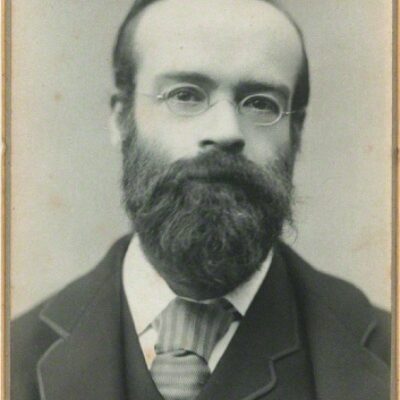
The Place Where the Pines of Kazdağları End and the Tents of Migrant Turkmens (1912, Walter Leaf) Born in 1852, Sir Walter Leaf was an Englishman who worked in banking but was also among the prominent classical philologists of his time. Until his death in 1927, his translations and interpretations of Homer, as well as his research in the Biga Peninsula, known in antiquity as Troas, attracted great interest. Educated in classical cultures and languages at Cambridge, Leaf was considered the foremost Homer expert of his era. Fluent in many languages such as German, French, and Italian, Walter Leaf traveled extensively in the Troas Region before the Gallipoli Wars, meticulously examining the similarities between the information in Homer's epics and the topography of that time:
"...
Transportation in Troas
For any Western visitor to Troas, the starting point is naturally the city of Dardanelles (Çanakkale), due to the steamships arriving daily from the east and west. The paved road from Çanakkale extends to Ezine, at the westernmost part of the Eren Köy and Bayramiç plain; this distance is about fifty kilometers. The first section of the road from Çanakkale to Eren Köy has been left in a very old and neglected state. Within a mile around the city of Çanakkale, all vehicles must be abandoned, and one must pass through the sandy fields along the coast. However, during our visit, we witnessed serious repair work being carried out on the roads. We saw many places being repaired by numerous workers and that various culverts had indeed been constructed since our first visit. The steep coastal slope leading to Eren Köy is in poor condition and can never be made into a good road. The section of the road between Eren Köy and Ezine was constructed with very fine workmanship only five or six years ago. The limestone pass between the Kemer Su valley and the Karamenderes strait is traversed by a zigzag road five hundred feet above sea level. The road surface is in good condition, and the entire distance can be covered without difficulty by motor. Indeed, this is the only well-positioned road in Troas. The best of the village roads in the region is the unpaved road passing through the middle of the Bayramiç plain from Ezine. For first-time visitors, it is one of the best starting points to see the beauty of Turkish village roads. It is possible to travel from Çanakkale to Bayramiç in a long day journey of about fifteen hours; thus, one can reach the heart of Troas from London in five days of travel...
A notable feature of the region is that when the site of an ancient settlement is truly identified, there is no other significant city settlement of the same size there.
A possible exception to this situation can be found in Lapseki, where the second most important city along the Dardanelles coast after Abydos, Lampsacus, appears to have been built directly upon the old city center; but Lapseki is nothing more than a large village with a few thousand inhabitants.
Other towns include Dardanelles (officially Kale Sultaniye, but generally referred to as Çanak Kalesi; located just east and west of the central Scamander (Karamenderes) Plain), Ezine and Bayramiç; Ayvacık, located in the upper basin of Satniois (Tuzla Çayı); Biga, where the Biga River (Granicus) flows down from the mountains; and Edremit, representing ancient Adramyttium. None of these settlements, as far as is known, were built upon ancient settlements. Çanakkale is the continuation of Abydos as the central settlement on the strait. The change in settlement here seems to be related to the discovery of gunpowder; the city developed around the fortress built by the Turks in 1470. The narrowest part of the strait is about 1370 meters, and thus the cannons on both sides have the power to stop passing ships. On the Abydos side, the strait is much wider, and the settlement has therefore shifted to Nagara Point, where anchoring is easier. The continuation of Assos is Behram, a miserable village... Yörük Village in Kazdağları (1912, Walter Leaf)
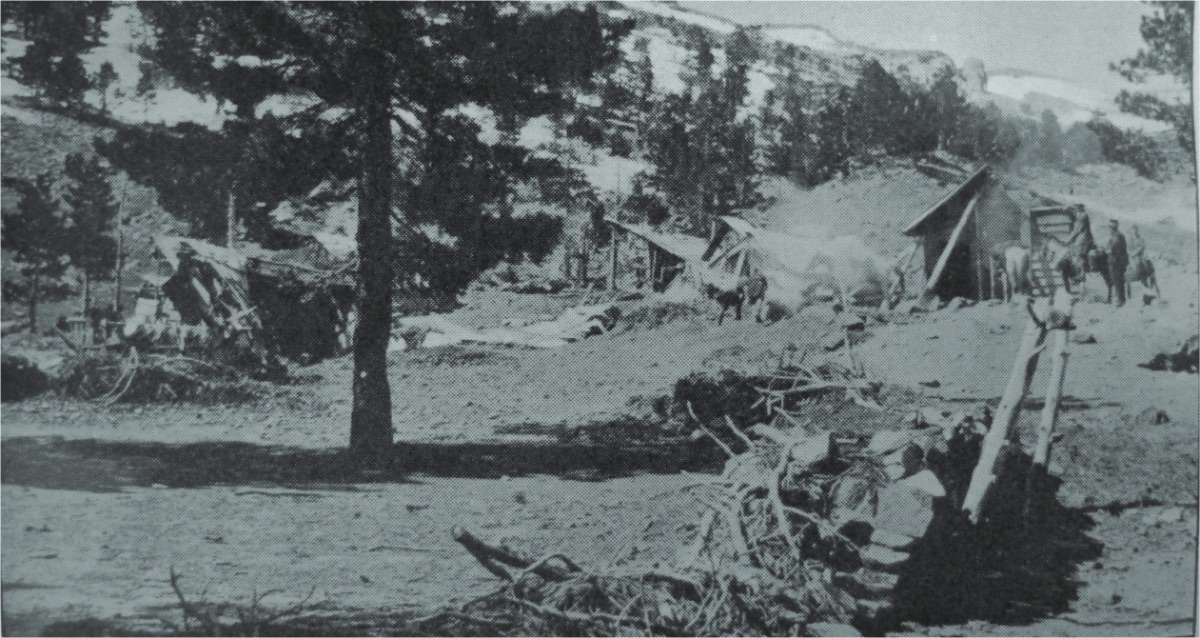
Mount Ida, as a whole, is a very beautiful and interesting place from different perspectives. During the hot summer months, the lands below dry out completely, and therefore many nomadic groups migrate with their sheep and cattle to the mountain elevations where the grass grows with the melting snow. We were there in mid-May, and there was still quite a lot of snow at the summit, but the nomads had begun migrating from their winter villages to the lower elevations of the mountain. It shows the encampment at the highest place before the summer settlement. The settlement consists of roughly made huts and the brown tents that can be reassembled, which are common in the region. The snow that falls in winter destroys these huts, and they are rebuilt every year. In the photograph, one of the huts being repaired for the approaching migration can be seen. The others are still in ruins. The height of this encampment is about 1500 meters, and as far as we could see, it marks the upper limit of the pine trees. We wanted to find a significant number of migrants from Epirus, known as "Karakatzani" or Kara Kaçanlar, among the nomads. We met one of these migrants in a soup kitchen in Ezine. He told us they were Greek, but it is not entirely certain whether they are of Vlach origin (an ethnic group in eastern Serbia. R.A.) who speak Greek or Epirotes (a settlement on the border of Albania and Greece. R.A). According to what he told us, about fifty families left their homes during the governorship of Ali Pasha in Ioannina (1788 R.A.) and came to the Troas region, and they have been living here ever since. By a strange coincidence, we met this man again on Mount Ida and visited him in his tent. It is generally known that most Vlachs still speak Valachian and claim to be Greek, but we found this not to be the case, as the children outside the tent were speaking only Greek to each other.
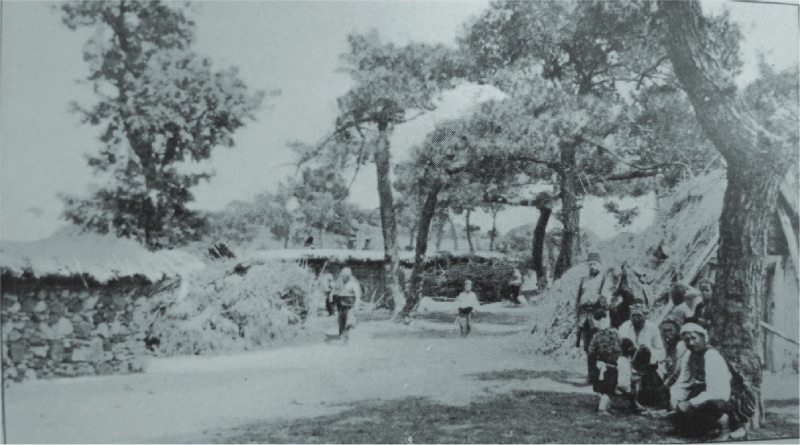
Another important group is the Yörüks of Turkmen origin, who have been living in this region for a very long time, undoubtedly for centuries, most likely after the Ottoman Turks took control of the area. As far as we observed, this group, which has largely lost its nomadic traditions, takes their cattle to Mount Ida in the summer months. Unlike the others, they work as foresters, manually extracting timber from the forest, and possibly the power of water forces them to rapidly change their settlements. For the Yörüks, Mount Ida is a sacred mountain, and they regularly hold ceremonies there every year. Despite being Muslim, it is quite strange that the day they choose for these ceremonies is August 15, the day of the Assumption of Mary in Christianity. While we were staying at the water mill; Mr. Hasluck found and brought the watchman left as a guard at the settlement, and we listened to many legends about the mountain from him..."