
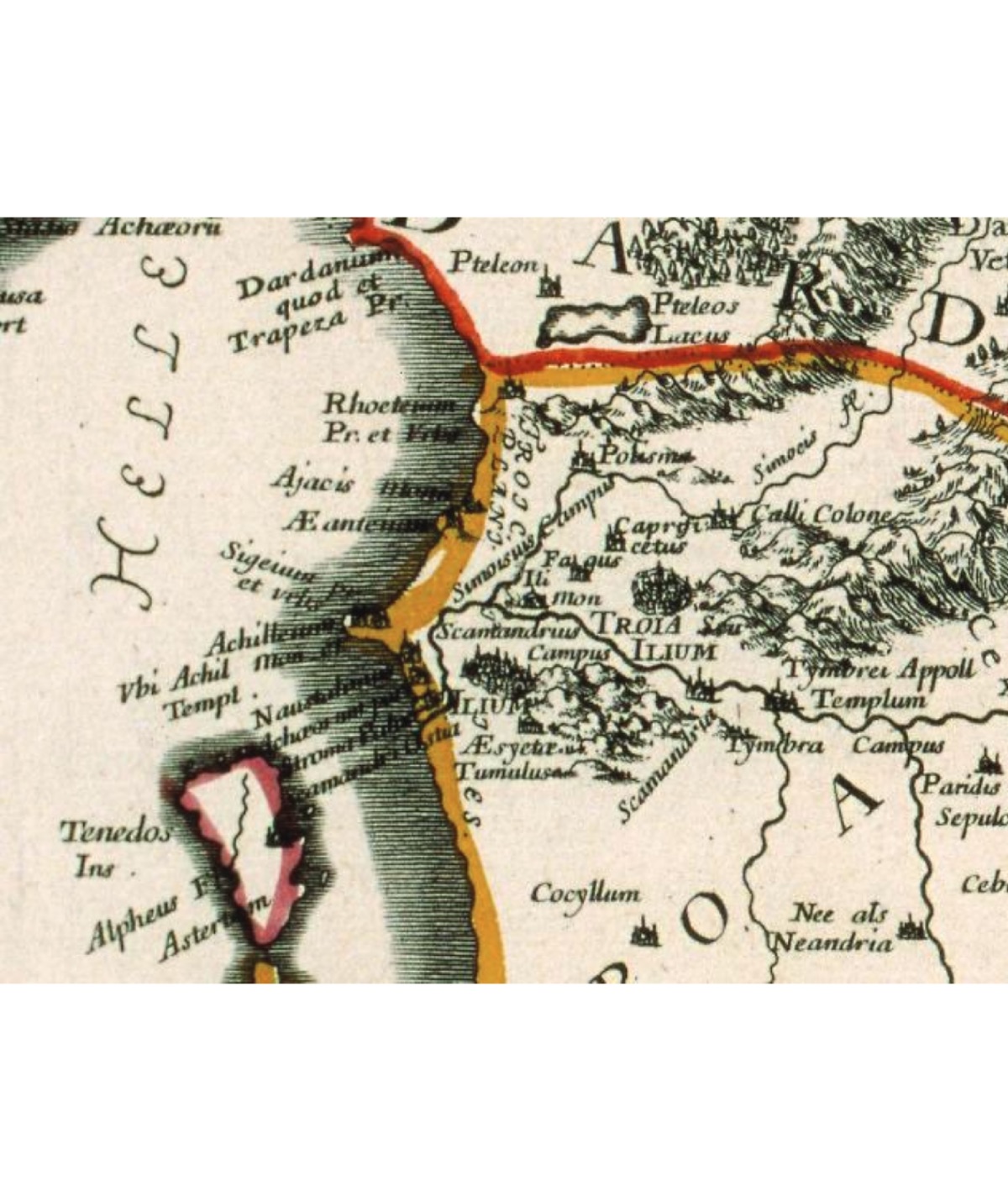
"However, because I very much wanted to see with my own eyes the things I knew from what others had written, I decided to go to the shore, and I wanted to do more than just witness a poor copy. Because a Jew I met in Portugal told me that more could be discovered on the shores of Troy than what was told. But the barbarism of the inhabitants there was so dangerous that it caused many to fear landing in this country.
The captain of the ship I was traveling with forced us to go with his own boat, despite the unfavorable wind. I also persuaded the Italian priest, who had been a missionary in Eastern countries for a long time and was now living in Padua, to come with me. We entered a very beautiful and orderly harbor. Most likely, in the past, ships coming and going from the Greek homeland were carrying soldiers and food here.
We walked up about three miles of land, the terrain continues with a slight elevation from the sea. But there are plants and shrubs everywhere. This situation continued for miles where the sea intersected with the shore. Thus, my first significant discovery in my Troy research was realizing that my deceitful old countryman had made a mistake in his calculations. We looked everywhere curiously, but just as we were in doubt about finding ancient ruins here, Francisco next to me accidentally discovered that the stone he stumbled upon belonged to an ancient building. It was a few centimeters above the surface, covered with plants and shrubs.
Upon closer inspection, we easily understood that these ruins were part of an old wall. We cut the grass with the machetes we had and discovered that the ruins were thirteen feet wide, narrow, and higher than the others.
The shrubs made it difficult for us to understand how the structure continued. Digging with the swords we had yielded no results. However, at a significant distance, about a quarter of a mile away, we discovered ruined walls belonging to an old structure with an irregular wall surface.
As we got a little closer, we saw that the parts belonging to the same structure, which we had lost track of, continued...
After examining the ruins and assessing their condition, since we were not children of today, and were likely old enough to be their fathers, we read the following inscription, which I remembered from the subject of Hector's death in Ausonius (a Latin poet who lived in France from 310-395, R.A):
"Hectoris je Tumulus, cum quo sua Troja
sepulta est, Conduntur parites, qui periere simul"This is the tomb of brave Hector,
Those who found his tomb in Troy
Both wanted to share the same fate
Both have a tombA little further on, there was a second tomb, which looked like the monument of Priamos. The inscription on it, as in the first and third, was also in Ausonius and expressed lament and sorrow worthy of rulers.
"Qui Tumulum Priami querit, legat Hectoris ante, Ille meus, nato quem prius ipse dedi..."
Now we know for sure that the English have come here. At least one of my countrymen left a mark after his visit here; with great difficulty, the poet of salty waters carved the following into the soft face of the marble block covering Hector's tomb with a knife:
"I do suppose that here stood Troy,
My name it is William a jooly Boy,
My other Name it is Hudson, and so,
God Bless the Sailors, where ever they do go."I suppose this was Troy...
My name is William, a jolly boy
My other name is Hudson and so
God bless the sailors, wherever they go,
I was here in 1631 and am wholeheartedly
devoted to old England, God save it.We lingered here for a few more hours with very pleasant feelings. These lands made us happy and also piqued our curiosity. However, we couldn't find anything more to talk about or examine, so we thought of returning and retraced our steps. We couldn't board the boat until a favorable wind arose and immediately set sail.
We passed Bozcaada (Tenedos), famous for being the place where the Greek fleet hid from Troy's view to make the besiegers believe they had left, and later opened the way for great destruction with the horse they brought inside. There is nothing to mention here, but the story we told above is important."