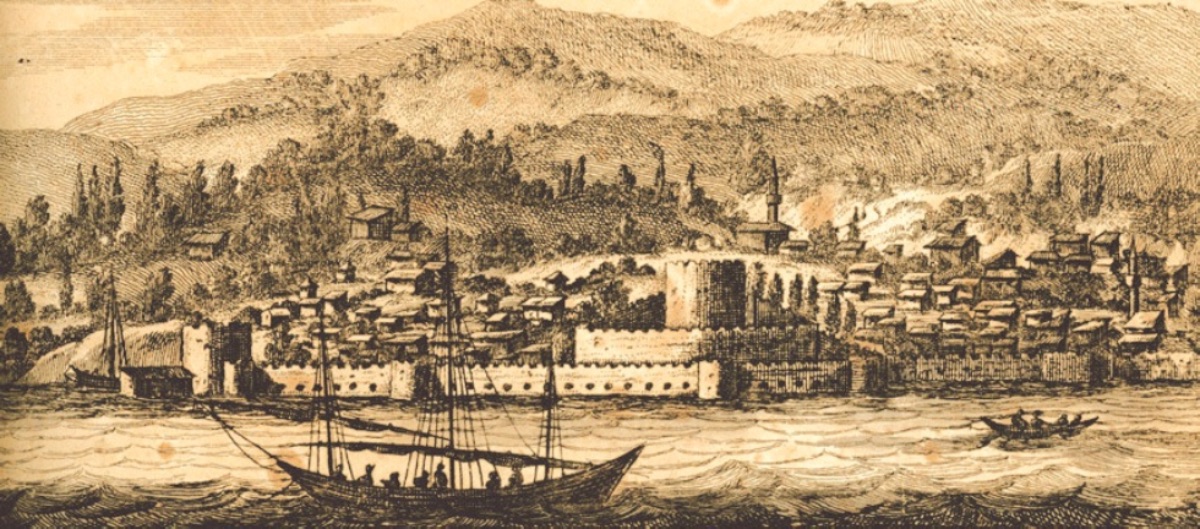
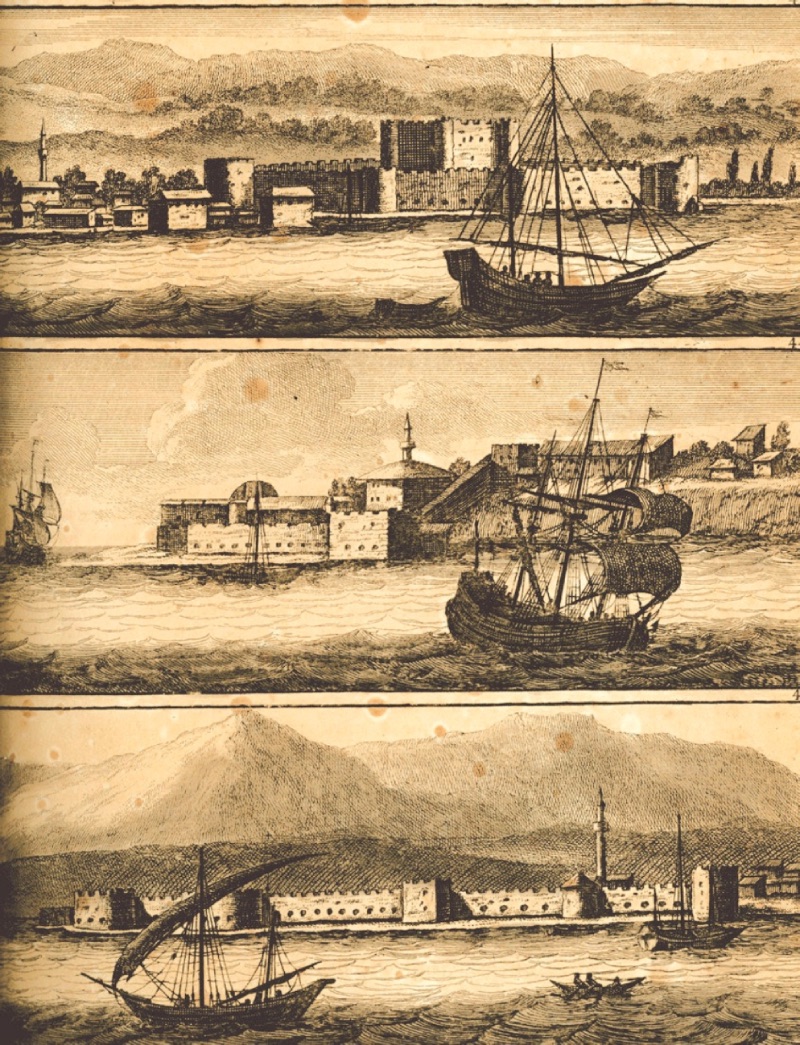
Kilitbahir in the Dardanelles, (1714, Cornelis de Bruyn) John Heyman, a professor of Eastern languages at the University of Leyden in the Netherlands, embarked on a scientific journey between 1700 and 1708. His diary, which describes countries important to Christianity along with their geography and traditions, was first published in Dutch in 1757. Shortly after, his impressions were translated into English and published in 1759 alongside the work of J. A. Von Egmont, who traveled much later. Heyman's path passed through Çanakkale shortly before his return journey. His references to ancient writers stand out in his narratives.
"A little distance from these islands, we passed through a strait separating the island of Lesbos from the mainland. The next settlement on this coast is called Baba Point by the Turks, due to a dervish or Baba buried there, and whoever advised the Turks, pirates are always in the neighboring seas. This point is very dangerous because sudden storm winds come from the mountains.
While passing here with a good wind, the Turks throw pieces of bread into the sea in respect to the dervish I mentioned above; these pieces of bread are immediately taken away by a type of seabird in this area: and such beliefs are offered as prayers for the happiness of his soul. Finally, a wind slightly less than a storm and a current against us forced us to anchor in the channel off Bozcaada (Tenedos) and the coast of Troy.
Bozcaada (Tenedos) is about ten leagues (1 league approximately = 1.6 km. R.A) in diameter and not far from the mainland and according to Vergil, only two leagues away from ancient Troy...
The center of this island is also called Tenedos, and the castle is established between two hills. The town has the appearance of an amphitheater and was once famous for its pottery known as Tenedos vases. However, today its most important trade is known for its truly exquisite muscat wine.
The mainland where the coast of Troy is located is quite low, but the greenery presents a beautiful view. As Ovid described, it is adorned with many tombs belonging to Troy...
However, the tumuli now seen were never part of that famous city of Troy. But some other cities and villages built these burial mounds much later.
The surrounding area is naturally very fertile, things necessary for life are quite cheap, and without a doubt, under a free administration, it would have great agricultural advantages. Here, there is also the production of acorns used in the making of ink and watercolor...
Later, the first island we passed (Samandrachi, known in ancient times as Samothracia and Gökçeada (Imbroz/Embra) as Semadirek; there are wild goats in the mountains on the island in an astonishing manner. From here, Mount Athos can also be seen from a distance, and shortly after, with a suitable wind, we entered the famous Dardanelles (Hellespont) separating Europe and Asia. Kilitbahir, Çimenlik, Nagara and Old Kumkale in the Dardanelles (1714, Cornelis de Bruyn)
We pass quite close to the walls of newly built fortresses on the European shore, especially from Asian Phrygia. Here we counted sixteen cannons, positioned towards the water level. However, without their carriages and firing furnaces, they seem like impressive large iron gates. On the opposite Asian shore, there is another fortress; the average distance is about four miles, and ships can pass between them with a suitable wind without fearing the cannons.
These fortresses are nothing more than thick walls and very few strong fortifications.
As soon as we arrived at the two old fortresses appropriately named Çanakkale (Dardanels), we saw that they had the same architecture as before, but the distance between them was not more than one or two miles.
These four fortresses are surrounded by small villages or small towns, and the weapons on the Asian side are astonishingly large. The cannons are twenty-eight inches (1 inch= 2.54 cm) in diameter; at the same time, the gray granite from which the cannons are made is quite interesting, although not as beautiful as those in Egypt. This granite is said to be extracted from quarries near the place believed to be the site of ancient Troy (this should be the granite quarry near Ezine/Koçali village, R.A.). The fortress on the European side, although not very strong, is built on the slopes of a hill.
The French consul living in the village on the Asian side receives an annual salary of four hundred and twenty piasters (kuruş), and at the same time, every French ship passing through this strait pays him eight piasters (kuruş). Christian ships coming from Istanbul (Constantinople) are looking for slaves at this fortress. The surrounding land is very beautiful and fertile but neglected. To the left of the fortress, there is a small stream, and coarse pottery is produced in the village. A significant amount of oil is also exported from here, but since the weather was not very good, we decided not to proceed further.
Four miles (1 nautical mile= 1609 mt. R.A.) from Çanakkale (Dardanels), we passed to Eceabat (Maydos/Meita), a small town built on a sloping hill by the sea; a large number of Greeks live here. This town is within the diocese of Gelibolu (Gallipoli). There are settlements on both shores of the strait. The villages are close to each other two or three miles inland from the coast, so the scenery is quite beautiful everywhere. As we entered the small port of Gelibolu (Gallipoli), on the south side, about seven miles away, there is a fairly large village called Lampei, established where ancient Lapseki (Lampascum/Lampsakos), once dedicated to the god Priapos, was located. However, nothing remains of the city's former glory. The area is filled with ruins, among which are some inscriptions that have been erased over time. The wine, however, is of ancient quality, like the one Xerxes sent as a gift to Themistocles from here. The ruins of the old fortress are still present here. In this region, dervishes surround you everywhere, hoping to receive valuable gifts from you. When we anchored at Gelibolu (Gallipoli), I saw the ruins of two arsenals built by the Genoese and also a magnificent fortress protecting the port and the city. There are about one hundred and fifty Armenian, three hundred Jewish, and a few thousand Turkish houses here. A few years ago, the ammunition depots of the fortress caught fire, and a major accident occurred in the fortress. In this accident, many houses were destroyed, and eight hundred people were buried under the debris."