
"On March 25, an hour past midnight, we set sail from the port of Petra and at dawn the next day, we found ourselves off the coast of Bozcaada.
Since the Trojan War, the name of Bozcaada (Tenedos) has not changed. Under the rule of the Roman and Byzantine emperors, it shared the fate of the other islands. Bozcaada, which the Turks took at an early date, is still in their hands: after the Battle of Çanakkale in 1656, the island, conquered by the Venetians, was immediately reclaimed by the Turks.
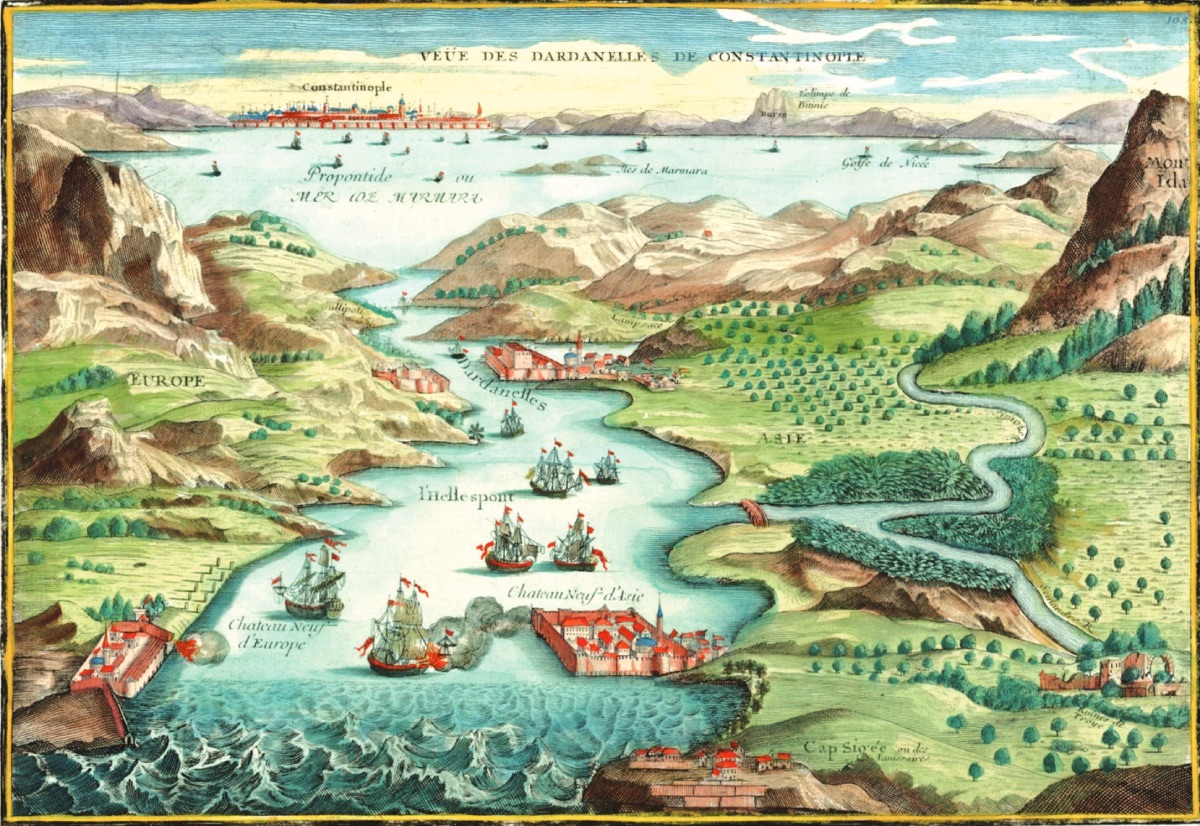
An Istanbul merchant traveling with us on the same boat said that there were no traces of Antiquity left in Bozcaada. Indeed, it had lost all its splendor along with the city of Troy. What really interested us was Bozcaada's muscat wine, the finest in the Eastern Mediterranean. But we found solace for our disappointment in this matter at the residence of the King's ambassador to Istanbul, Marquis de Ferriol. The best Bozcaada wine is drunk at Mr. Marquis's house, and the most sumptuous table in the East, from Istanbul to China, even Japan, is here. Gallipoli, at the mouth of the Sea of Marmara, is a large city located approximately 5 miles wide in a strait, 25 miles from Çanakkale, 40 miles from the island of Marmara, and 12 miles from Istanbul. Gallipoli is situated on a peninsula with two harbors, one to the south and the other to the north. About ten thousand Turks, three thousand five hundred Greeks, and slightly fewer Jews live in the city. The Bezistan, where goods are sold, is not surrounded by walls. It is only protected by a ruined fortress with a square shape, likely built by Bayezid, with an old tower. As in many cities in Turkey, we were told that the doors of the Greeks and Jews are no more than 2.5 feet high (1 foot = 30/48 cm). This measure was taken to prevent Turks from entering the places of Christians and Jews on horseback and behaving disrespectfully.
This is all that can be said about Gallipoli without seeing its interior. We anchored at a port 6 miles away. The north wind kept us here until holy Friday, and we were saddened that we could not approach Gallipoli, where we might have encountered more special things. As we passed in front of the city, all we could do was sketch a rough picture of it and enjoy watching it thanks to a calm sea."