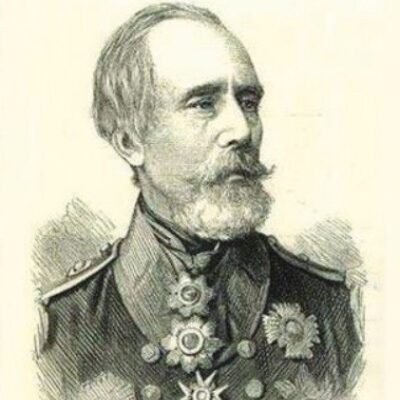
Adolphus Slade (1804-1877) was a naval officer who rose to the rank of rear admiral in the British Imperial Navy. Influenced by the Panhellenic ideology, which was quite fashionable in the 19th century, he visited the Ottoman Empire in 1829-30-31 to see the ancient Greek lands sanctified by the Anglo-Saxon bureaucracy, which was striving to create a new Byzantium. In 1829, during the continuation of the Turkish-Russian war, Adolphus Slade lived among the people whom Europe defined as "Barbarian Turks" and tried to describe what he saw objectively. In his memoirs, Slade, who eventually became a friend of the Turks, expresses both the prejudiced European perspective towards the Turks of that period and the troubled situation in the Ottoman Empire. During the Crimean War between 1853-56, when the Ottoman Army allied with France, England, and the Kingdom of Sardinia, Slade served as an advisor to the Ottoman army. In his book recounting his war memories, his pro-Ottoman stance is more noticeable than the Ottomans themselves:
Dardanelles, Seddülbahir and Old Kumkale (1804, William Gell)
"The Turks practice agriculture with very primitive methods. Nevertheless, there are hundreds of miles of coastline around the Bosphorus and the Marmara, and the produce from the lands can easily feed the city of Istanbul. With these data, despite my respect for Admiral Collingwood's professional experience and skills, I believe that the Dardanelles can be easily blockaded.
Throughout 1828-1829, Istanbul suffered a great food shortage. The reason for this was that the Sultan had prohibited free trade for merchants on the coasts and merchant ships coming from those regions. When the Sultan changed his order, abundant food came to Istanbul, and the shortage was alleviated.
Anyone who watches the entrance of the Dardanelles is filled with great excitement. While the left side shores rise with rocks and steep hills, the Anatolian shores consist of sandy and flat areas at the beginning. The Turks have built fortresses at the mouth of the Dardanelles and on both sides. On the European shore, there is the Seddülbahir Fortress, meaning "the one that prevents the sea." This fortress is very well constructed, and its lower bastions embrace the sea. On the Asian side, the fortress was built with the personal wealth of Pertevniyal Sultan and is called "Kumkale." Although this fortress is entirely built among sands and on a steppe terrain, it has a well that provides ample drinking water for its 600 guards. It is not surprising that the Turks could dig a well and find crystal-clear sweet water in such an arid place.
Entrance of the Dardanelles from the North, Yenişehir Village and Tumuli (1804, William Gell)
There is also a mosque inside the fortress. I believe there is no other similar place of worship in the world. The mosque is a rare example showing the Turks' understanding of worship and duty. That is, instead of windows, gun embrasures have been made in the mosque, and there are places to hang rifles on the walls. Let's say the moral of the story; if attacked while in worship, one can find the opportunity to defend oneself from the mosque.
The Dardanelles narrows in front of the town of Çanakkale, and Kilidbahir Fortress and Çimenlik Fortress seem to look at each other as if hand in hand. In this section of the strait, the currents become stronger. Sailing ships heading to the Marmara must wait for favorable winds to cross the strait. The Turks have settled both shores with cannons and military units.
It is difficult to compare the Dardanelles with the Bosphorus in terms of natural beauty. I think God has shown excessive favoritism to the Bosphorus. Nevertheless, the appearance of the Dardanelles is majestic and reminds one of a proud soldier.
Thank goodness, as the weather was very pleasant and the wind favorable, we crossed the Dardanelles and reached the Sea of Marmara. As we set out from in front of the town of Çanakkale towards the Marmara, we passed in front of a fountain called "Paşa Çeşmesi," about a mile north of the town and by the sea. According to legend, in a period whose date I do not know, on a Christian ship sailing in the Dardanelles, the crew killed their captain and, to escape punishment, threw themselves into the sea and swam ashore. Once among the Turks, they immediately converted to Islam. Being a very capable man, he eventually rose to the rank of pasha and had that beautiful fountain built where he first set foot on land."