
"(Wednesday, September 20 - 1673)
After spending the day passing through the Marmara islands strait and traveling along the coast, which offers a pleasant variety with its bare mountains, small valleys filled with vineyards and trees, and seaside villages, we arrived in Gelibolu around nine in the evening. The next morning, we anchored to allow the captain to procure the hardtack needed for his crew, which he did not obtain in Istanbul because it was more expensive there. Gelibolu has more of a pier than a harbor, where ships are exceptionally protected against the north wind. This city is very old, and since it is located on a moderately high hill, its view is quite beautiful, and its houses rise in an amphitheater shape. Since the lands of Asia and Europe approach each other at this point, it is generally accepted that the Hellespont, which extends to Capo Iognicheri, known as Siegeum in the past (Yenişehir Burnu R.A), begins here. Opposite this city, in Asia, is Lapseki (Lampsaco), which is the midpoint for crossing from one continent to the other. The Genoese, during the first attack of the Turks on Europe, took a sekino per person to cross them from here. To reinforce the Sultan's armies, the Anatolian forces generally cross from here. Lampsaco is the ancient Lampsacus, shown as the homeland of the god Priapus by the ancients, and for this reason, Virgil gives it the name Hellespontiacus, as this city is located on the Hellespont. Venus gave birth to her child here when Bacchus, the father, returned from India. The rest of the tale can be seen in detail in the Flemish editions of Petronius' commentaries. Before leaving Gelibolu, I will note that a year ago, this place was the scene of an Italian priest's martyrdom for the sake of religion. After converting to Islam, this Italian repented of his crime shortly after and confessed his sins to two passing Jerusalem priests, and because he shouted that he had returned to Christianity and hated Islam, his head was cut off by order of the judge.On the twenty-second Friday, after the captain had procured enough hardtack and offered fish, grapes, melons, and watermelons to the customs officer of the place who did not disembark, we set sail around ten-thirty in the morning with a rather strong wind. Thanks to this wind, we soon saw the merchant ship that had set out from Istanbul eight or ten days earlier and had been ordered to wait for the Ambassador until he arrived, in front of the old Asian Castle.
As soon as the captain recognized our ship from its white flag and the pennants it carried at the tops of its masts, he immediately prepared and fired seven cannon shots as we approached. His Excellency responded with a single cannon shot as a thank you. While the sergeant went to the Anatolian Castle to show the imperial decree given by the Sultan to facilitate the Ambassador's journey, the captain of the merchant ship came and paid his respects to His Excellency. An agha on board the captain's ship, who was to take the orders of the Sublime Porte to Tunis, also sent a sheep and some watermelons. Upon the sergeant's return, he informed the Ambassador that the agha of the Asian Castle and the commander of the European Castle, whom he encountered there, had received the decree with respect and agreed to salute according to the request made to them. After this, we weighed anchor, and since the merchant ship saluted again, the salute was returned in the same manner. The Ambassador had the castles saluted with six cannon shots from the catapult, and they responded with six cannonballs from their large cannons. Additionally, both fired one more shot. The Asian Castle fired a cannonball weighing four hundred livres, which bounced eight or ten times over the sea, raising the water extraordinarily high, and a very thick layer of dust rose over the mountain. The European Castle achieved the same effect by firing a cannonball weighing five hundred livres in the same manner, and the cannonball crossed the entire strait and reached the opposite land. Although the cannonballs were not aimed to reach from one land to the other, it was a great pleasure to see the other cannonballs bouncing on the water. After this, we did not sail for a long time because we stopped in front of a fountain located a mile below the European Castle. When the ships that had brought the Ambassador to Istanbul three years earlier were forced to anchor, they took water from here. It is understood from the inscription on it that this fountain was built by a captain pasha named Celil. Before the new castles were built, the Venetians and pirates used to come here to get water. The Ambassador spent the night here, in a tent.
On the twenty-third, Saturday, the merchant ship set sail and departed, and as it passed, the agha it was taking to Tunis saluted the castles with a cannonball each, and the castles saluted each other with cannons. Because His Excellency had been busy until this time with the collection he sent to the palace along with the renewed capitulations with his secretary on land. As we passed in front of the new castles, the commander of the European Castle had just received the decree from the Sublime Porte regarding the Ambassador and saluted him with five cannon shots, and the Asian Castle joined in the same manner. However, since the distance was very great, it was not seen here that the cannonballs crossed from land to land. After the Ambassador responded to each of the castles with five catapult shots, he took his chief secretary, whom he had sent to the castle with the sergeant, back with him and reached the merchant ship that had stopped to wait for him. After the captain received the Ambassador's final orders and took the secretary and priest who would make a journey to France and some parcels sent to the palace, the two parties parted ways, and before setting off, the captain bid farewell by firing five cannon shots, and His Excellency responded with a catapult shot.
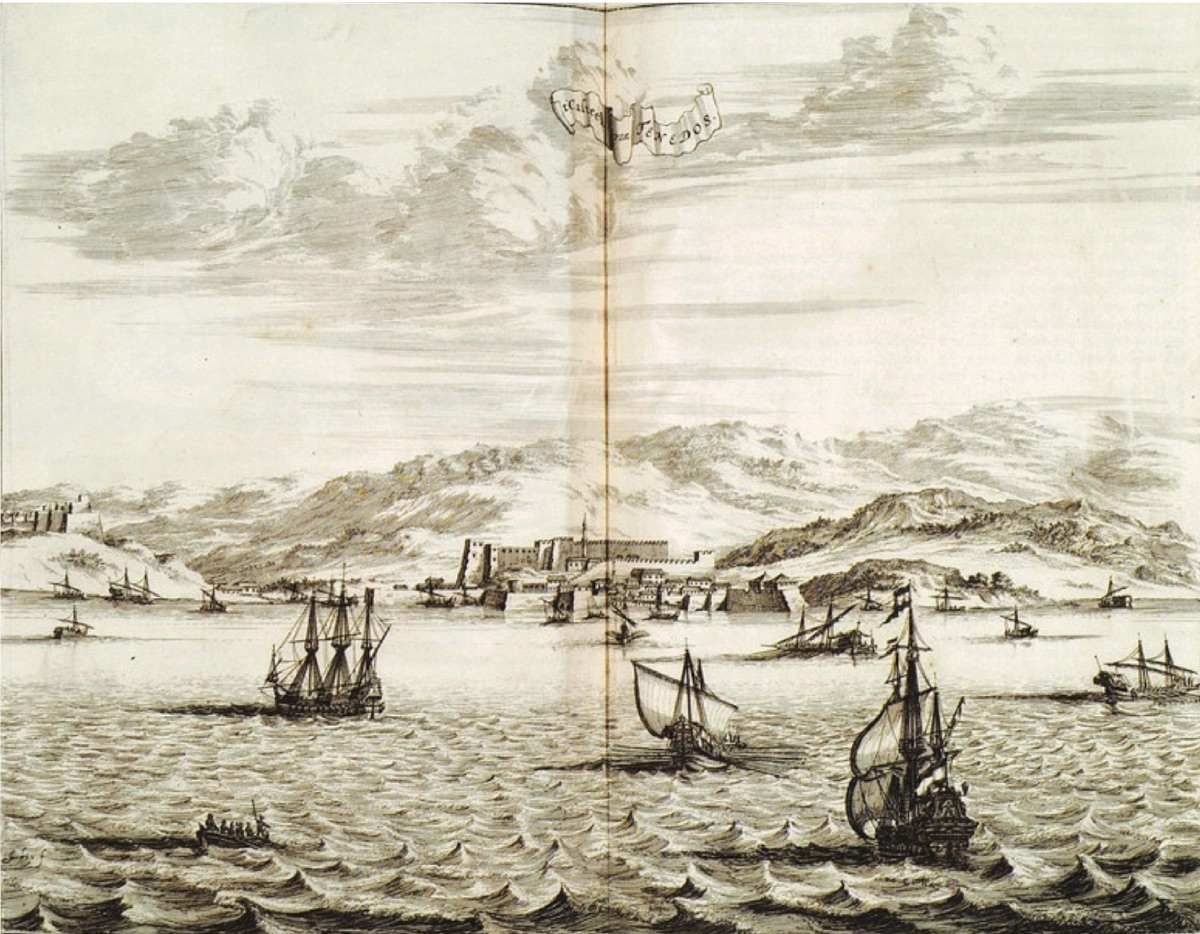
After this, we proceeded towards Bozcaada. As we approached its harbor, we were surprised to hear a cannon shot from the castle. We later learned that this was fired to indicate that we would be saved by taking refuge in the harbor, as the merchant ship was thought to be a pirate ship following our ship, and although they never intended to fight, the fired cannons gave rise to this suspicion. By the time we anchored in the harbor, it was about four o'clock, and when the Ambassador saluted the castle with all the ship's cannons, the castle and the fortifications created by the Venetians responded to this salute by firing fifteen cannons heartily. The agha himself came to pay his respects to His Excellency and invited him to come ashore and be a guest at the castle, which the Ambassador gladly accepted. This castle is not very regular, but it is very small and still defends the harbor, which was once and still is a statio melefida carenis, very well. It has a barrel-shaped pit on the land side. When the Venetians captured it in 1646, it defended itself for a while. If the governor had not sold it to the impossible later, this place would have been quite useful for them. It is filled with houses where those assigned to guard the castle reside. Since a lot of muscat wine is produced on this island, this wine was sought first, but since the harvest was fresh, the best could not be found. Towards evening, I went to the church of the Greeks and found this church quite beautiful and adorned with good paintings. It is subject to the bishopric of Mytilene. The guard force of the castle and fortification shouted to each other all night, "Allahu akbar, there is no god but Allah," and in a very loud voice. In fact, as soon as night falls, the gates of the castle are closed.
On the following twenty-fourth Sunday, the Ambassador did not listen to a mass, not because there was no priest, as he had his own priest and the venerable Jesuit Sauger was ready to perform the ceremony, but because the Greeks caused some difficulty in having it performed in their church, and since a suitable place could not be found, the ceremony could not be held. Therefore, His Excellency spent the morning hours hunting and took pleasure in seeing fourteen quails shot in a very short time. Quails are extraordinarily abundant here. Moreover, since the mountains are not very high and steep, the land is suitable, and there are vineyards in the pleasant plains where grapes with a very good taste are grown. In the afternoon, around two o'clock, we set sail and headed towards the land of Troy, and when we approached the shore, the Ambassador went ashore in a boat in the hope of finding some ruins. However, since there was nothing but large plains filled with bushes and sand that made it difficult to walk, he soon returned to the ship and ordered the journey to continue. There was very little wind at night, and the next day, on the twenty-fifth Monday of the month, we reached Bababurun with the help of oars. The reason this place bears this name is due to the sight of a stone tomb of a dervish, and like our priests, dervishes also take the name baba. Since there was no wind for more than half the day, it was not possible to advance in the Mytilene strait, and the wind that arose in the afternoon was so unstable that it was with great difficulty that we anchored in a kind of harbor near Mytilene around seven in the evening."