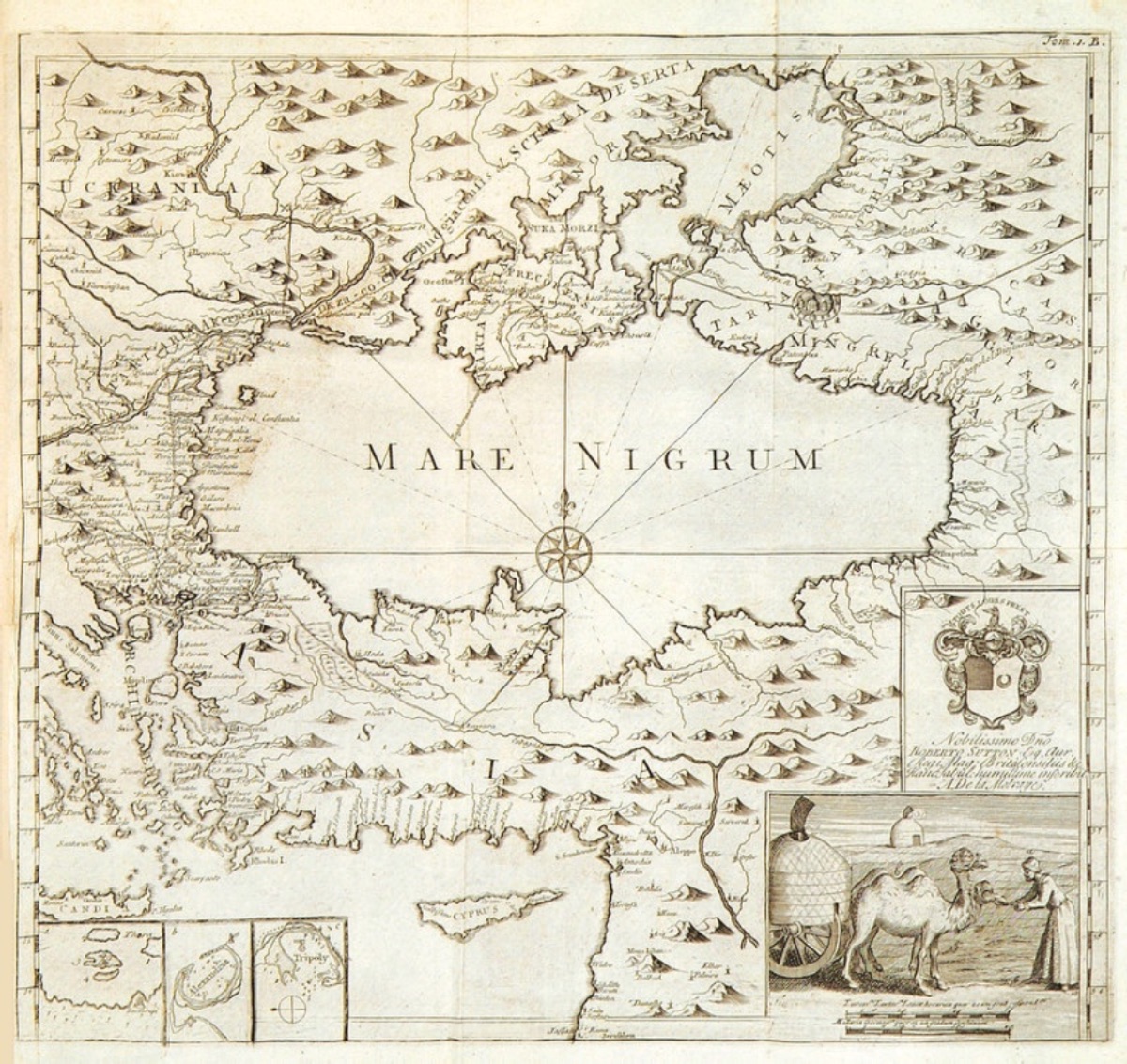
Anatolian Peninsula and Important Settlements (1699, Aubry de la Mottraye) La Motraye (1674?-1743) is a French-born Englishman who settled in England. After receiving a good education in London, he began traveling in 1696. Due to his consultancy and attaché roles to various statesmen, he visited many countries from the Northern Countries to the Near East. The notes he took during his travels are a significant source for understanding the daily life of the period. La Motraye made his first journey in 1696, from Paris to Rome, Alexandria, Lisbon, and then to England. On his second journey in 1698, he set out by sea on an English ship to Izmir, passing through the Strait of Gibraltar and reaching the Aegean islands. He stayed in Izmir for 5 months and described Izmir and its surroundings in great detail in his travel memoirs. In every place he visited, he especially purchased coins. At the end of May 1699, when he left Izmir, he took with him a considerable amount of coins he had acquired from Lesbos and the ports of the Dardanelles. During his time in Istanbul, he penned interesting observations about the city. Until 1710, he visited the Aegean islands and Troy via Istanbul. His observations about Bozcaada and the ruins on the opposite shore are particularly interesting. Despite being aware of what previous travelers had written shortly before, he accepted the ruins of Alexandria Troas as the ruins of Troy, albeit with contradiction:
"(1699):
On June 2, as the wind turned in our favor, we set off cheerfully on June 3 to reach the Dardanelles. The point where Asia and Europe are closest to each other seems to be the strait, as if one could reach out and touch the other shore. This strait, as people with even a little interest in geography know, is thought to prevent the waters of the Black Sea from mixing with the Mediterranean, which Easterners often use instead of the Mediterranean. As you know, we give different names to different parts of the Mediterranean. The captain anchors near the second fortress on the Asian side. This fortress and the small village adjacent to it are believed by many to be built on the remains of the ancient city of Abidos. However, there is nothing visible to prove this situation. The ruins a few miles above the Thrace ruins I will mention later should be the ruins of Sestos, but it is said that there are other ruins besides Abidos far from the fortress I mentioned. Early on June 4, when the wind blows from the south and turns west, we pass between Gelibolu and Lapseki around ten o'clock. Eventually, we cross the Sea of Marmara and reach the famous city called New Rome, where Constantine's two great empires united, the next day...
(1710):
...
After spending a night at the monastery, I returned to the village of Caratasal in the early morning with a boat belonging to the monks, and from there I set off on horseback towards Gelibolu. The entire peninsula, which the ancients called the Thracian Chersonese, was extremely fertile. Here, apart from some coins, I did not encounter any other ancient remains. On the sixth day of the month, around nine or ten at night, I reached Gelibolu. I stayed at the house of a Jew who ran the English consulate. This Jew, like his co-religionists in Çanakkale, had no other advantages besides being exempt from some taxes and duties. He made a living from small gifts given by ships of the English nation anchoring at the port. The next morning, after having my coffee, I took a tour of the city. It was a large city with a crowded population consisting of Turks, Greeks, Jews, and a few Armenians. The ancient columns adorning the beautiful mosques were obviously taken from the surrounding ruins. I bought a gold coin from a jeweler, and found quite well-known copper coins with a Jew. On the eighth of the month, I crossed to Lampsakos before noon with a boat. The Greek I settled with told me that the Gelibolu consul had left a message to see me. I was warmly welcomed there. I wandered the streets of the city, which had about three hundred houses. Around the city, there were remnants reflecting its former glory, such as columns, column heads, and bases. For example, a very beautiful red Egyptian marble column supported the entrance of a mosque. Seeing these remnants, I thought Gelibolu was very rich in ancient remains. I did not come across any records other than those uncovered long ago by other travelers. The Turks probably did not use these remnants because of the inscriptions on them, as they do not like writings they do not understand. However, the public was using a round ancient altar...
... What really surprised me was how this stone was left here by antiquity-expert Franks; because the Turks, who do not like such remnants with inscriptions, would dispose of them for next to nothing. I bought the bust for a very small price. The man who sold the bust said that if I paid a few more coins, I could also unearth the statue buried in the ground belonging to the bust. Meanwhile, my helpful host, although not very curious himself, did his best to pique my curiosity. When he understood that I was more interested in old coins and similar things, he took me to winemakers he knew.
A winemaker he said had recently died had found a small bronze statue and figures that were greatly revered in the island's old religion, placed over the hearth in homes or in the main place in temples, which we consider obscene. So, things that are not even pleasantly mentioned today, seen as not fitting politeness and courtesy, were once greatly respected and admired... The woman was only aware that what she sold was not gold and silver, the rest did not concern her.
...
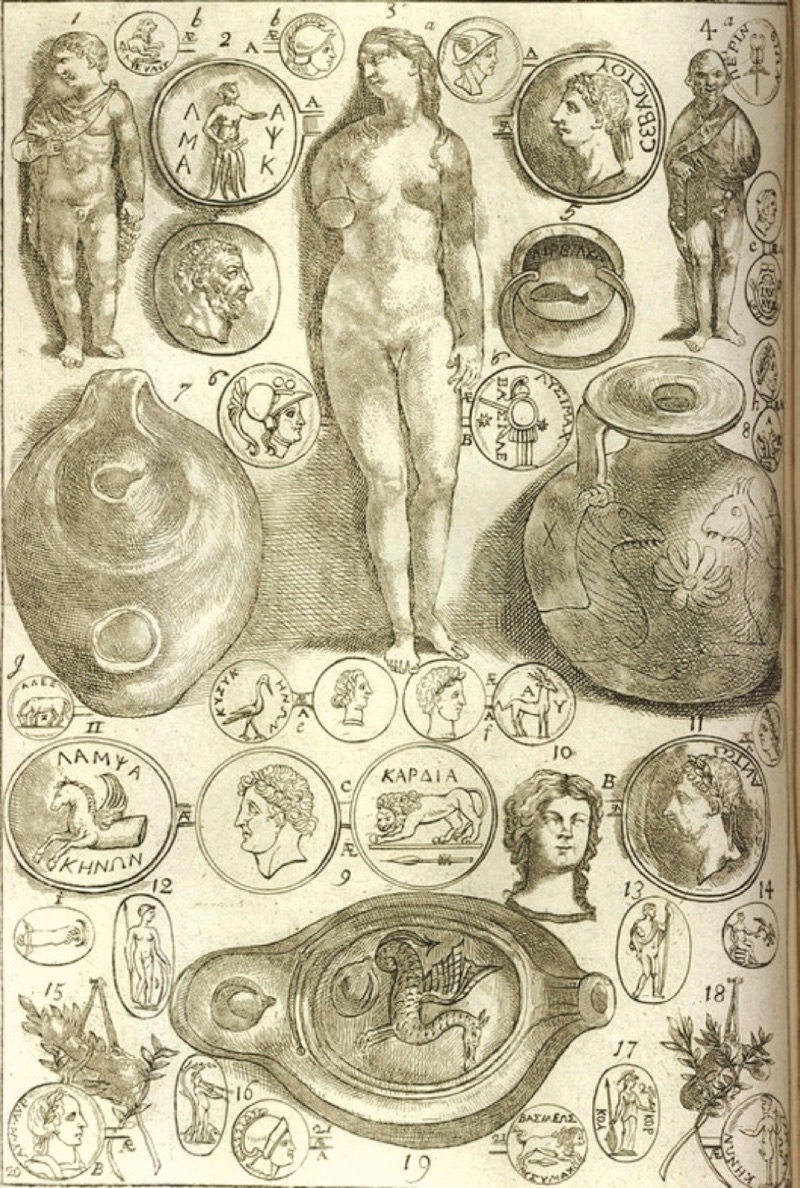
Examples of Small Artifacts Purchased and Taken by Travelers (1699, Aubry de la Mottraye) The surroundings of Lampsakos are completely green. Everywhere is covered with fruit trees like figs, pomegranates, and cherries, and vineyards with very beautiful wine. The wonderful wine I drank at my host's house reminded me that I had read in history that this city was once gifted to Themistocles by Xerxes to drink its wine. However, considering that the history and geography of the city are well known, I will avoid going into lengthy details on this subject.
On our return journey, from a Greek jeweler we visited, I bought two Julia Augusta, two silver Faustina, other silver Latin coins, some Greek coins, a gold Alexander the Great coin, coins minted for the city of Lampsakos, and a coin minted for the city of Cisique (Kyzikos).
After staying in Lampsakos for a month and satisfying my curiosity, I boarded a ship with the bust I purchased and returned to Gelibolu. I left the bust with the consul to send it to the place I stayed in Istanbul at the first opportunity, and I toured this city again but saw nothing new beyond what I described above...
As I approached the sea, I noticed the ruins of the famous city, which many claim to be the city where the unfortunate lovers Leandros and Hero lived. The ruins, which I found in a much more ruined state than what was told to me, seemed more like the remains of a tower built to hold the Hellespont Strait than belonging to a city.
In the evening, I reached the fortress said to be left from the old city; rather than being evaluated as remaining from the old city, it is claimed that the fortress on the Asian side of the strait, directly opposite, is also from Abidos. Next to the fortress I came to, there is a settlement area that I could call a large village rather than a city. The houses are few in number and very poorly constructed. The fortress, built in the form of a large tower, is surrounded by solid walls, and on top of the walls are placed enough bronze cannons to protect the strait, capable of firing at water level.
The other fortress I passed with a boat was also built for the same defensive purpose. It had the same features in terms of structure and weaponry. The settlement adjacent to the fortress truly deserved the title of a city with the abundance of its houses, its spread over a wider area, and the quality of its structures. I settled in the house of a Jew named Abraham. The next morning, I set off with a boat towards the fortresses at the entrance of the Dardanelles, in the direction of Tenedos, that is, the archipelago. Two English warships were waiting just below the point of honor. I had explained in the Izmir Gulf section why English ships could not pass the point of honor in Turkish territorial waters, if you remember. The larger of the ships was named Winchelsea, under the command of Captain Eaton. I visited it first, then the other, and was warmly welcomed on both, spending the night on the larger ship. Indeed, I was close enough to the ancient settlement Ptolemy called Dardanum that I could not avoid visiting it.
The Captain, with whom I shared my curious topics, arranged for me to land at the foot of a mountain where the Turks called a village Gavur köy. The entire population of this village, built on the old Dardanum, was Greek. Among the very poorly constructed village houses, some old remnants and wall ruins were noticeable. I asked the villagers for old coins but could only find a coin with the head of Augustus Caesar on it, and on the reverse, a depiction of Aeneas carrying Anchises on his shoulders, along with some other coins.
Another name for the mountain the village leans against is Yeniçeri Burnu. This mountain is probably what the ancients called Cape Sigee. Here, whether you look in the direction of the land or the sea, you see the most beautiful view in the world unfold before your eyes. Looking towards the land, you see olive forests among fertile arable lands as far as the eye can see. Behind the lush green plains is the famous Mount Ida. Looking towards the sea, you see a series of islands and directly in front of you, Thrace.
The next day, I cross to the island of Tenedos on the deck of the Wichelsea...
Bozcaada (Tenedos), despite its small size, is a very fertile island with plenty of wheat, fruit, and wine. The majority of the island's population is Greek, and they seem to make good use of the island's lands; I don't think there could be another match for the island's muscat grape. The island's peaches and figs are famous as the best peaches and figs in Turkey. The island obtains what it cannot produce from neighboring islands or from the Asian and European coasts, which are not very far away. For example, firewood comes to the island from the place directly opposite, where the ruins of Troy are located. Indeed, when we look from the island, as Vergil said in the following lines, you see these ruins:
"Est in conpectu Tenedos, notissima fame Insula etc."
The wood coming to the island is not expensive at all, almost only costing the cutting and transportation expenses. Because the forests are open to everyone without any ethnic distinction. The real owner of the forests is the Sultan; he has given permission for anyone to cut as much as they want. The island has only one city with a population of Turks and Greeks, but Greeks are in the majority. The city also has a fortress under the administration of a pasha. Some of the 26 cannons defending the fortress have the inscription St. Marc on them; they either fell into the hands of the Turks when the archipelago was conquered or were left to the Turks by the Venetians as per the peace agreement after losing the war.
A Subaşı, with the title of Bey, supervises the city. When the Subaşı's men saw me in Greek clothes, they approached, thinking I was a Greek subject, and addressed me in Greek. They asked if I had paid my annual tax and requested to see my receipts. I showed them the firman I always carried with me, which not only proved I was a Frank but also explained why I was in Turkey. They still took me to the presence of the Pasha, but honestly, I did not see any annoying behavior from them, they treated me very politely. The Pasha offered me coffee and kept me for dinner. The Bey was also with us. When the servants withdrew, leaving only one trusted man with us, two pitchers of wine appeared; one of the pitchers contained a wonderful wine made from the island's muscat, the other was again a wonderful red wine from the island, drunk fresh. Thus, I can say we commemorated Bacchus as he deserved. They explained the wine prohibition in their religion in the way I had previously explained to you; si non sobre, saltem caute; because during the day, those who flog their own kind wandering drunk in the streets; at night, they themselves drink regularly, and in considerable quantities. Honestly, they made me drink more than I wanted. Since I was unable to stand, I spent the night at the Pasha's mansion. I promised the Pasha and the Bey to offer them our sherbet on the decks of our ships and curled up in a corner of the room.
The Subaşı woke me up early in the morning, invited me to have coffee, and did not forget to remind me of my promise. I naturally shared my invitation promise with Captain Eaton, who immediately invited the Pasha and the Subaşı to his ship. The Pasha regretfully informed us that he could not attend our invitation due to the charitable works he had to be engaged in. But the Subaşı sent a message that he would come for dinner after the evening prayer. The Captain offered us a Ponche Royal. Of course, a significant portion of the drink went down the Bey's throat, who became more cheerful and beautiful as he drank. The next day, he praised this English sherbet to the Pasha, invited me to dinner again, and requested that I bring this sherbet with me. I attended this invitation with my sherbet in hand, and the atmosphere became very cheerful again. I taught the Subaşı how to make our sherbet.
Two days later, I was invited to the wedding of a Rum captain who worked with me and a girl of the same nationality. The captain wanted me to be the godfather at his wedding. More openly, he expected gifts from me, and I did not disappoint him. It was a full Greek wedding, meaning after the marriage ceremony, we first ate, then drank very well, sang songs, and danced.
I finally managed to arouse curiosity about the ruins of Troy in the two English captains, and we landed together. We landed at a place that seemed like the city's port, or rather a place resembling a pool completely filled with the remains of a structure whose foundations are still visible. The main parts of the structure had fallen into the sea. The grandeur of the structure could be understood from the column pieces, bases, and capitals of different colored marbles in the sea. A few steps forward from this pool, we encountered a richer remnant consisting of large granite columns. However, the columns were broken into several pieces, lying on the ground, half-buried in the sands...
When we moved about forty steps east from the shore, a very well-polished monolithic granite column, about thirty-nine to forty feet long and at least four and a half feet in diameter, emerged. Among the bushes, we saw marble sarcophagi, some white marble, some porphyry, some very well-preserved as if newly made. These sarcophagi, like those I saw in Lampsakos, consisted of two parts, namely the main case and the lid. However, their lids were triangular, distinguishing them from those I had seen before. These sarcophagi, as I mentioned earlier, are a kind of family tomb, places where those who come in turn are buried. When a family member died, they were buried in this sarcophagus by pouring quicklime over them, and when no one from the family was left, the main case and lid were riveted shut.
We are very curious to see what is inside the sarcophagi. The captains run the sailors following us to bring iron bars from the boats we came on. When they tried to open one of the sarcophagi, the iron bar bent on the first attempt. The sailors then managed to open the lid with joint effort. Inside the sarcophagus, there were two intact skulls, a few bones that turned to dust when touched, and nothing but a pile of white dust. From these, we conclude that these sarcophagi do not belong to the Trojans, because the Trojans cremated their dead, placed the ashes in jars, and either kept these jars in their cellars or buried them. Such small mounds where the jars were buried are still encountered here and there.
A very ignorant peasant herding his animals among the ruins of Troy, which Ovid said "Jam seges est ubi Troja fuit," gave me two small lamps, a vase or a tear bottle as a gift, and said he found it from one of the mounds where I said the jar was buried. I gave him a few coins, and he was at least as happy as I was with the gifts I received...
...
As for the sarcophagi we said we opened; I think the antiquity of the sarcophagi goes back at most to the Roman or Byzantine Empire, because during that period the city of Troy must have been rebuilt, but I do not want to delve into this subject full of contradictions here. Returning to the ruins of Troy; it is seen that the city walls are still ten to twelve meters high in places, built with solid mortar and good quality stone resistant to the ravages of time...
As we advanced to the east of the city, we encountered marble seating places adjacent to each other, and next to them were again wonderful marble steps, which were nailed to the vault of a cellar. The vault was well supported with cross beams in good condition. I don't know what the seating places we saw belonged to, but I think they could be the remains of an amphitheater...
...
As we continued our walk towards the south, a road led us out of the city. From the surrounding ruins, I think this was one of the city's gates. We entered among olive groves, fruit orchards, and cotton fields. We encountered two peasants and asked them if there was a village nearby. They said the nearest village was about two miles away, and since we had been wandering quite a bit since we landed, we didn't feel up to this road. In the middle of the plain, about a quarter mile from the walls of Troy, we saw a large granite column about four feet in diameter lying lengthwise on the ground, lying at the foot of a tree. Seeing a column there made me ask the peasants if there were any other remnants in the vicinity. One of the peasants said that about a mile from where we were, there were two hot springs that were good for rheumatism, nerve weakness, and many other things, and we learned that there were many remnants near the hot springs. Of course, our curiosity was piqued again, and we asked him to take us to the place he mentioned, of course adding that we would pay him.
Around the hot springs, there were high, well-preserved, beautifully vaulted buildings. I think these were temples from ancient times. The dome of the first hot spring had collapsed, and the local people had tried to repair it as best they could...
After satisfying my curiosity in this way, I returned to the ruins of Troy with my entourage, which had grown with the two Turkish peasants and the hot spring attendant we first encountered. Our last guide showed us a very beautiful statue without a head as we passed through an underground cave about seventeen in diameter that we had not seen when we came. The Turks, who are enemies of human figurines, had lifted it and thrown it here. I asked the peasants about the head of the statue, and one of them promised to find it, and a few days later he kept his word. We concluded our walk at four in the afternoon, a little below the place where we landed, under a tree a little north of the ruins of Troy. By the captain's order, a very nice meal was prepared, and we returned to the ships at sunset..."