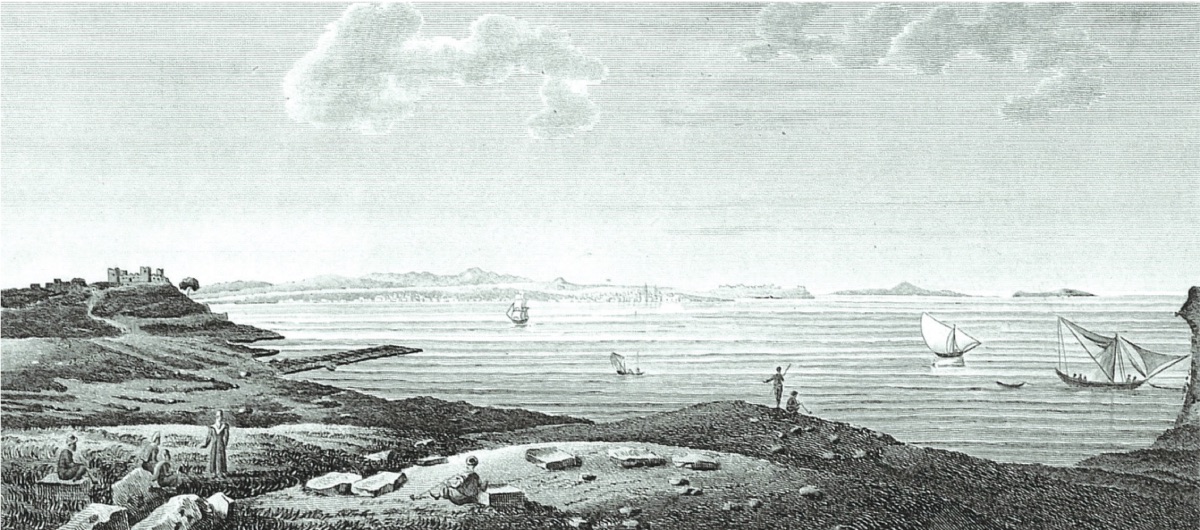
Gallipoli Peninsula, Akbaş Bay and Fortress (1784, Aguste de Choiseul-Gouffier) Coming from an educated family, Carl Bernhard Stark was born in 1824 and died in 1879 in Heidelberg, one of Europe's most important university towns. Stark, who was among the leading classical archaeologists of his time, studied Ancient Philology between 1842-1845. He earned the title of professor in 1850 and began teaching at Heidelberg University from 1855 onwards. His most important work is considered to be the book he wrote on the history of the city of Gaza. He published his travel impressions of Greece and the East in 1874. He was one of the first academics to visit the Çanakkale region and the vicinity of Troy during the period of Schliemann's first official excavations. From his impressions, we understand that Hisarlık Hill was not yet fully accepted as Troy. Hisarlık Hill, Yeni Ilion, and the ruins above Pınarbaşı Village were marked as Old Troy on maps. Bernhard Stark's impressions of the Troas region indicate that he was well-versed in the debates concerning the location of Troy that interested European intellectuals at the time, and he believed, based on his observations, that Ballıdağ was Homer's Troy:
"At the Dardanelles and the Ruins of Troy
... The rising sun forces me to wake up early. We enter the Dardanelles (Hellespont), with Marmara Island gradually disappearing behind us to the south. On our right, there are sloping, treeless, fragmented shores; we stop at the beautiful ancient city with two suitable harbors on its east and west, perhaps truly the city of Kallias, Gelibolu. In front of us, there are many ships, and our ship also needs to unload and load goods. While the southern Asian shore takes on a richer appearance with its sweet, harbor-like coast, some valley exits, and rising mountains, the steep-sloped European shore continues unchanged. Finally, we round the corner where Abydos once was, where Xerxes built a bridge, and in front of us, Çanakkale stretches out with its charming castles in a deep indentation to the left; on the European shore, where the sloping shores continue, a smaller settlement with similar castles is visible. After waiting for hours for a word, finally, without any greeting, the customs officers gave our French captain permission to pass. Naturally, after being held up a bit at customs, we found the opportunity to rest by leaving our loads at a Greek coffeehouse on the shore. After long negotiations for renting horses for the Troy trip and accommodation in Çanakkale, we decided to waste no time, rent a boat, go by sea to the coast of Troy, then proceed on foot by ourselves, and move quickly to the first place we wanted to visit in Asia Minor, avoiding the deceitful Turks and false bargains.
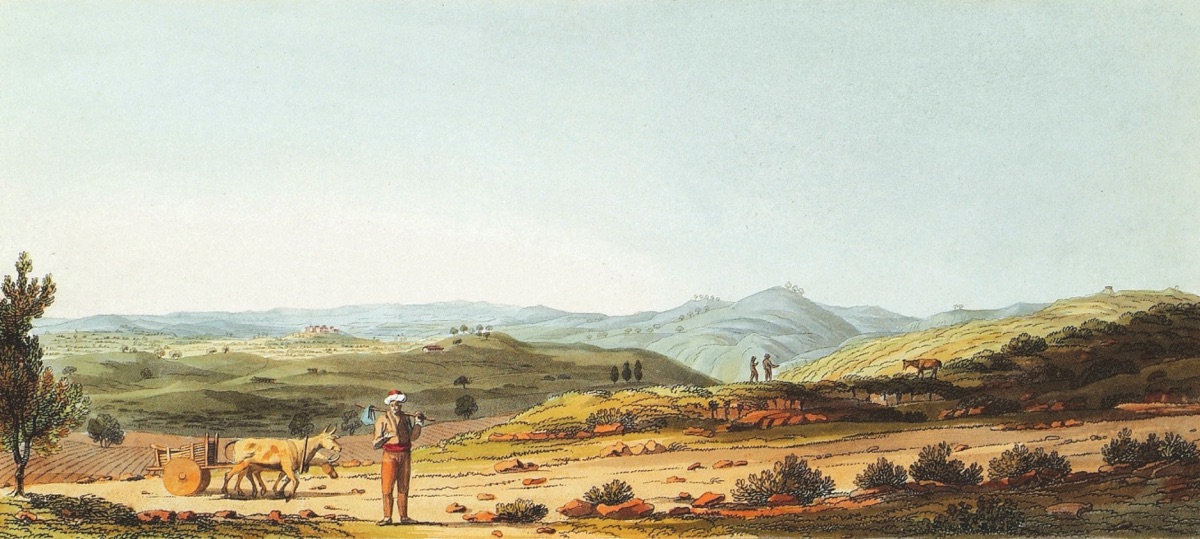
The Turkish boat (kayık) with a belly was prepared in a short time; our captain, with a white beard and a green turban, of strong and burly Turkish build, sat confidently and calmly at the helm at the back of the boat. His companion calmly held the sail, which was strongly inflated by the east wind on the other side, while we five sat in the middle. Our interpreter, Lazzarian, held our light load on the deck of the boat. The boat began to advance in the Dardanelles with the wind and current; we were moving in the beautiful wind and the glimmers of the afternoon sun; on our left were pleasant-looking hills, then small bays and slopes descending steeply to the sea; in the distance, the Ida Mountains were visible. In the distance, the hospital and quarantine from the Crimean War (the English Hospital and Quarantine built in Güzelyalı in 1856. R.A.) shone white, and settlements with minarets were visible on the much further elevations. The European side was more barren, or more sloped and monotonous; almost all the settlements on this side were established on the plateau. We see Teke Cape appearing at the very end of the same shore, with another bay with houses on the opposite shore before it; Kumkale, one of the outermost castles of the Dardanelles, seemingly floating in the water. Before that, the coast curves slightly inward, quite flat, with very few bays; from here, a wide plain opens up, surrounded again by mountains from afar. The geography of Troy, that's where we aim to go. But we cannot take our eyes off the spectacle of the afternoon glimmers directly to the west. Yes, we salute the Aegean Sea; white sailboats are visible everywhere at the entrance of the Dardanelles, where non-steam ships often couldn't pass for weeks. Right in front of us stretches Gökçeada (Imbros); right behind it is Thracian Samos with its peak; further south, individual elevations are visible. It was like a preview of the islands that would appear with their mountains later. Pınarbaşı Village and Surroundings, Ballıdağ with Tumuli in the Background (1801, William Gell)
The small boat gradually approaches the point where Kumkale Cape is located. We see the main delta where the Menderes River (Karamenderes River. R.A) flows into the Troy Plain, and shortly after, as in Homer, we land on the walled Turkish coast on the shore. They grasp the loads and people with strong hands. Thus, we land at the westernmost harbor where the Achaeans' ships landed, the place of Achilles' city. The boat owner and his assistant are very pleased with the shining gold they received from us and immediately set out to return the entire way with difficulty, leaving the strong current.
The Turkish soldiers look at us, curious and harmless, as we suddenly appear. Their commander speaks a little French, but there is no place to stay overnight in the Turkish settlement, only an empty courtyard and a ruined, dirty, monotonous castle. Ancient remnants are scattered everywhere on the sands; among them are very beautiful, fluted Doric columns. In the castle walls, there are quite a few pieces of ancient structures. We managed to find a donkey to carry our loads, and the small caravan began to move along the cultivated rising shore with the setting sun.
The plain, a little lower, and hours later, the salt lagoons stretching through the bushes with a single bridge over the Menderes River are visible.
One is cut in half, the other was scattered 80 years ago; but the next point we aim to reach is the two tumuli attributed to Achilles and Patroclus, which remain intact with their inner wall structures and dome, near the sloping sea shore. Here Hector accepts the Achaeans' request for a dual duel (Iliad VII. 80 ff). "But I will bring his body to the well-benched ships and give it to the long-haired Achaeans to bury him and heap up a mound of earth over him on the wide Hellespont shore. And in the future, when someone sails by in a ship with many oars over the wine-dark sea, they will say: 'This is a tomb, where once a hero was buried, whom Hector killed.' Much harsher words come from Achilles' mouth:
"Thus will it be said, even after death,
Your fame and honor will never perish, Achilles."
Climbing the steep and windy hills at the back is not easy, but the magnificent view from the 200-meter-high rocky cliff by the sea amazes us. Windmills stretch along, with the blue sea extending to the Thracian shores and islands behind. Before dark, we hurry to reach the village of Yenişehir, densely populated by Greeks, built entirely from ancient remains. The village, established on the old city of Sigeion, looks like a solid castle when viewed from the plain. The Greek coffeehouse owner, after our hopes of lodging with the village priest (Papaz) and then the teacher (Diaaskalos) were dashed, welcomes us quite hospitably. There were only watermelons (karpuz) and gathered fruits; all the spaces were filled with stacked crates. The coffeehouse owner prepared a place for us on the carpets laid in a corner where melons were piled, in the simple, wind-swept house's storage; but first, he served a freshly cut, well-cooked chicken and rice on wooden plates, accompanied by sweet Greek wine. The luxury of a table and chairs had not yet reached the village. We were spending our first night on Asian soil in a strange setting!
The next day was Sunday, and the impression given by the women dressed in colorful clothes walking towards the small, almost inconspicuous church in the village was strange. The ancient cities we walked through seemed mountainous, but the drogman (interpreter/host R.A.), unfamiliar with the region, finally found the horses he requested from the villagers there. We started walking from the elevations towards the sea across the Troy Plain, on foot beside the horse. In the distance, two more tumuli, then the Greek village Neochorion or Yeniköy comes; further, the terrain becomes bushy, rising southward.
They want to take us through the middle of the plain to Kalafat and the ruins of Hisarlık (Troy, R.A.), where a foreigner (Heinrich Schliemann, R.A.) discovers new treasures every day. But we head straight south to the mountainous place in Pınarbaşı village, our goal, going to the very end of the Troy Plain. During our four-hour walk in the hot weather, we first passed through vineyards, then proceeded through harvested corn and watermelon fields, crossing sandy and burnt grass areas, and completely dried stone wells. Yet, along the old Scamander, or Menderes River, a yellow wetland stretches through the middle of the plain, with meadows, poplars, tamarisks, and mastic trees. Smoke rises in the distance; bright flames from the burning dry grasslands are visible. It seems as if the fires of burning Troy are rising before us. On the right, the previously described coastal elevation continues, with the Pınarbaşı stream flowing from a wide artificial channel, over rock-carved tombs, then the high ridges where the Yerkesikköy settlement is located, and Üvecik Tepe on the elevation, still standing as a large tumulus with its hundred-step height. Turkish women work in the field in front of us with their faces covered; we eat the watermelons we picked in the morning sun. Ox carts with wooden wheels move through the sandy barren lands.
We had to climb an enclosed elevation with numerous ancient remnants, and finally, by noon, we reached the entirely Turkish Pınarbaşı village, identified by Lecelhavalier in 1785-86 as the city of Troy or very near it.
I must say we were tired when we arrived here: the long and monotonous road, the wide plain, the Menderes resembling the rivers of Central Germany, and the bushes along the water, and the barely visible elevations before us, with only mountains visible in the distance as a whole. Pınarbaşı is a settlement where wall remnants and piles of stones are scattered haphazardly. An official minaret and a castle-like ruined tower are visible. The courtyards are filled with huge cows released to the pastures the previous day, but not a drop of milk for us yet. Many camels are also grazing; turkeys, a symbol of true Turkish village life, roam freely. The inside of a rather dilapidated coffeehouse is full, and right across is the so-called shop run by the coffeehouse owner's wife, selling tobacco, paper, charcoal, matches, and thread. Even the mastic schnapps called rakı, often offered to us during our walks on hot days, is not available here; there is no trace of wine. The Turks attacked the house of the previous shop owner, a Greek, who wanted to sell wine to us foreigners. The shopkeeper, the only Greek and Christian here, approached us shyly and quietly. After entering the shop and sitting at the shop table, which was also a sleeping corner, and starting to eat chicken and rice, the woman, whose face revealed she was from Lesbos, began to speak. She told us about her vineyards on the beautiful island, the terrible earthquake on the island, and her migration. With tears in her eyes, she pointed to her only child, who was growing up here without learning anything and without being able to go to church. She mentioned teaching him to read herself and showed the small Catholicism book next to the prayer book published by the Evangelist community in Izmir. The concern of not being able to educate her child, normally silent in the laziness of Asia, was like a divine fire. If only we could take him and provide education! Indeed, in these cities of Homer's epics, the only remnant of the once glorious and literary cultural life being a few pages of a Greek prayer book is a magnificent contradiction.
There are many black people in the settlement as well. Finally, when the carpets laid behind the coffeehouse were spread like a stage, until midnight, the villagers, whose only pleasure was to brew coffee and smoke hookah again, watched our uncomfortable faces with curious eyes. Ancient remnants are everywhere and have become part of the houses. Due to the scarcity of chairs, we sat like chairs on the granite columns lying sideways in front of the coffeehouse and read Hahn's excavation report.
Immediately afterward, we would set out for a visit to two settlements quite important for the topography of Troy, first to the water sources, then to Ballıdağ on the hills."