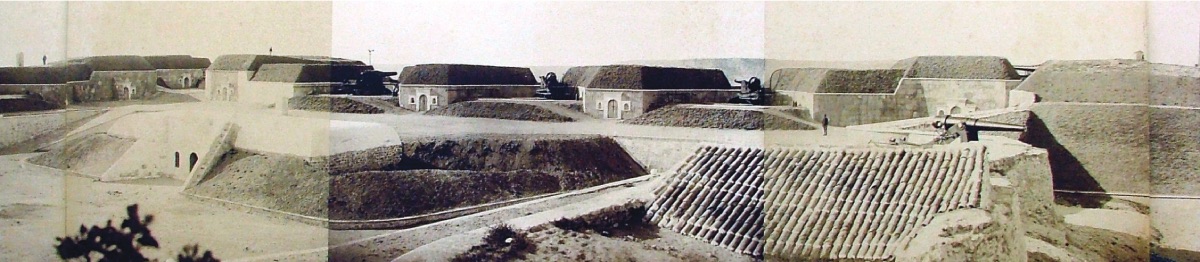
Old Kumkale Fortifications (1902, Sultan Abdul Hamid II Album)
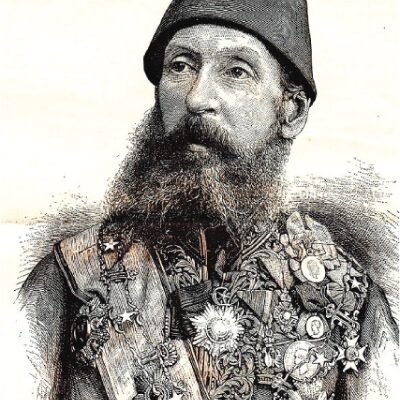
Born in Vienna in 1836 as Franz von Werner, Murad Efendi fled from his unit in Galicia to seek refuge in the Ottoman Empire while on his way to join the Crimean War. The reason is unknown, but perhaps he reacted to the execution of two soldiers. He was accepted into the Ottoman army with the rank of lieutenant and took the name Murad Efendi. He joined a unit known as the "Gâvur Alayı," mostly composed of Polish nationalist officers, but did not change his religion. In early 1858, he left the army and worked within the Ottoman foreign service, eventually rising to the position of Ambassador in Berlin. Murad Efendi, who had a circle of friends interested in literature and art, published a poetry book in 1869, followed by a tragedy named "III. Selim" in 1871. In 1877, when all of Europe was focused on the Eastern Question, "Türkische Skizzen" (Turkish Sketches) was published. Murad Efendi left Istanbul in June 1877, never to return. On the morning of September 8, 1881, he was delighted to hear that he would be transferred and promoted to the Berlin embassy, but he died on September 12, 1881. Despite his short life, Murad Efendi, a versatile writer, produced 18 works in various literary genres. Thanks to his exceptional language learning ability, he mastered Turkish so well that he translated divan poetry into German. "Turkish Sketches," a two-volume travelogue, is the only work he wrote in the travel notes genre. In this work, the author tries to convey his impressions of the Ottoman society he was part of as impartially as possible. He aims to introduce the almost unknown "Ottomanism" to the European reader. "Turkish Sketches" is different from travelogues written by foreign travelers because it is written from an insider's perspective and comes from someone who has comprehensively understood Ottoman society, from its philosophy of life to its literature, administrative operations, military, and political life:
"When I went up to the deck the next morning, Tenedos greeted me, shining with the first light of the day, while the Troas shores stretching to the right seemed painted in blue. Tenedos; the place where the Greeks launched fierce attacks on Ilion on the opposite shore and eventually left that cursed wooden horse on its shores, winning a victory through cunning. You deceived, doomed Troy, woe to you! Long live you, Ilion blessed by the gods, a cunning trick and the flames of fires wiped you off the face of the earth in one night, but even thousands of years later, you still stand before us in all your grandeur. Troy, yes you fell, but you fell to exist forever! Nineveh and Babylon also fell, and no hearth ever smoked over them again, what remains but dead names? Oh Troy, thanks to Homer's genius, you are far superior to them...
Long live Ilion!
Even though the cold rigidity of reality sees the Trojan heroes always in the realm of legends, for us, they lived, and through the power of literature, they still live as Homer created them...
The Troas shores are now behind us. We must look ahead. For me, this journey along the coast is like flipping through the pages of the past, renewing my youthful enthusiasm.
We see the first Ottoman fortress on Tenedos. The settlement adjacent to the fortress is entirely made of wood. Two white minarets rise above the wooden houses, we are now in Ottoman waters. From the sea, no fields or vineyards where those famous wines are made can be seen. All cultivated areas on these islands are in the interior, in the safe areas between the hills along the coast. And we are in Hellespontus! We pass Khersonesossos, once ruled by marathon champion Militiades. Fortresses and earthen bastions follow each other at short intervals on both sides of the strait. Many of the fortresses were built under the instructions and arrangements of the famous General Baron Tott. The earthen fortifications, built opposite each other and of great importance for defense even on their own, are much more recent.
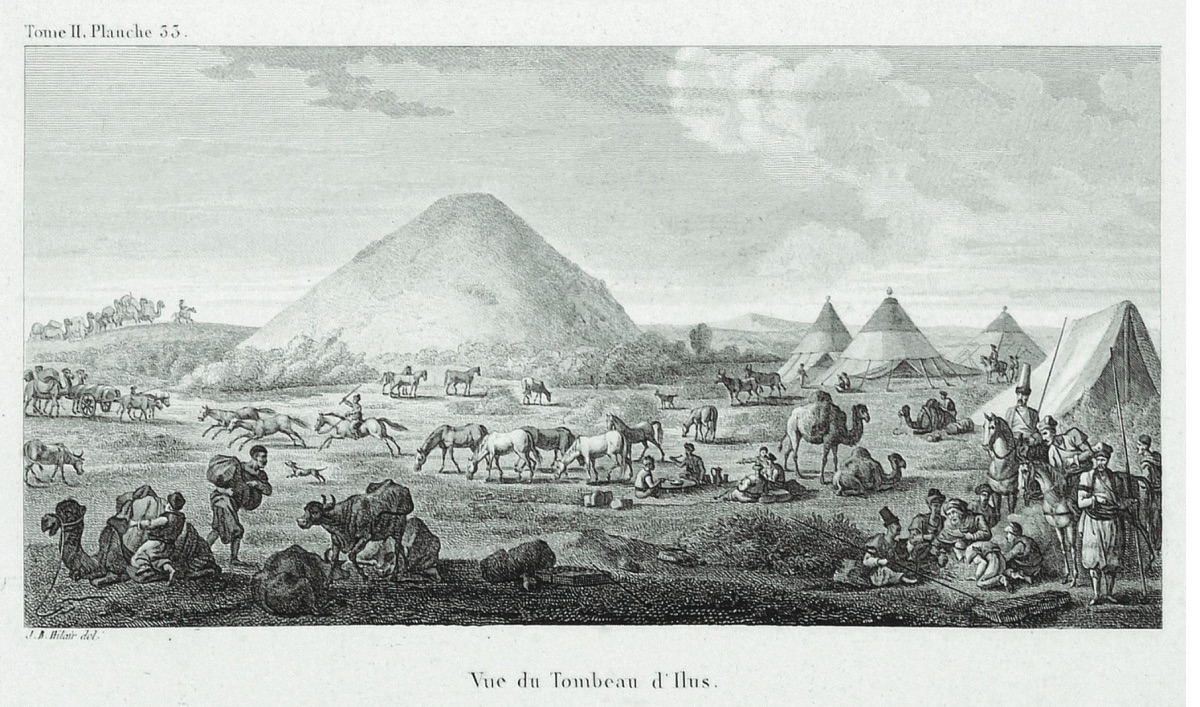
As we enter the Dardanelles, the soil cover of the European shore takes on a completely different appearance; the hills are covered with scrub and the ground is covered with clay soil, where the famous Dardanelles pottery is made. After a while, we come to the place where the two fortresses known as the Dardanelles fortresses are located. On the European side, it was built in the form of a sultan's monogram, this lock fortress. On the opposite shore is the city and fortress that Europeans call the Dardanelles, Kavak fortress. This is considered the central city of the strait. A few years ago, the old city was reduced to ashes by a fire and was later rebuilt towards the sea. With its beautiful houses, among which the palace-like British consulate building immediately stands out, it has a very charming and sympathetic appearance. Üvecik Tepe Near Yeniköy Defined as Ilıus Tumulus (1784, Aguste de Choiseul-Gouffier)
A camel caravan slowly advances along the shore. Asia lies ahead of us. We anchored in a bay about fifteen minutes away from the city to serve our six-day quarantine sentence. The deck passengers were disembarked and placed in the quarantine hospital. This is also a large building with a single floor, with windows and doors opening to a neglected courtyard. The shade under a stunted fig tree is the only shelter in this desert. Inside the building, there is nothing but bare walls and bare ground. Local passengers are accustomed to staying in any condition and anywhere as they carry all their belongings with them. The grocer sells them all the food they need through the bars of his hut, grapes, bread, dried fish, olives, and cheese...
The view of the bay where we anchored was not too bad. A poet with a sufficiently developed imagination could dive into the natural beauty before him and imagine Sestos and Abydos, two fortresses facing each other with their cannons turned towards each other, and visualize one of the most beautiful love stories of the ancient world. On the first night, I managed to do this. This story, which I love very much, came to life in my memory with all its clarity, and I received a little support from the view in the part about what happened to Leandros. Our hero called out from the lighthouse, whose crimson light reflected on the sea:
Asia tore him from Europe
But he never parted from love.
...
Finally, the sixth day arrived, and the preparations for the journey brought life and movement to the silent ship...
Before sunset, we pass by Gallipoli. This was once the headquarters of the Captain Pasha and the meeting point of the Ottoman navy before naval operations. The Ottomans first crossed from Asia to Europe at Gallipoli. Opposite Gallipoli, on the Asian shore, lies Lapseki, famous for its wines since ancient times. As darkness falls, we enter the Sea of Marmara, formerly known as Propontus."