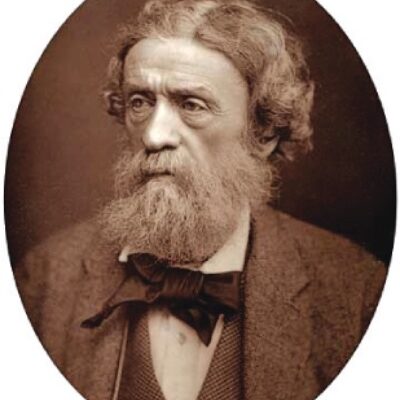
Sir Charles Thomas Newton (1816-1894) was a British archaeologist. After completing his education at Oxford in 1840, Newton began working as an assistant in the antiquities department of the British Museum, despite his family's objections. During his assistantship, he increased his knowledge of ancient objects. In 1852, he was appointed as a vice-consul on the island of Lesbos, and shortly thereafter served as a consul on the island of Rhodes from 1853 to 1854. During this time, he searched for artifacts for the British Museum's collection not only on the islands but throughout the region. With the support and financial aid of Lord Stratford de Redcliffe, he conducted excavations in Kalymnos in 1854-1855 and took many important inscriptions he found there to London. The following year, he discovered the mausoleum of Halicarnassus (Bodrum). From 1856 to 1857, he conducted excavations at the mausoleum, one of the Seven Wonders of the World, which was the most important archaeological work of his life. He smuggled many significant artifacts he discovered during these excavations to London. As a result of his research in Western Anatolia and other important archaeological sites in the Mediterranean, he sent the majority of the artifacts he found to the British Museum. During these works, Newton passed through Çanakkale in 1853. He conducted intensive studies on where Troy should be located and published his impressions of his journey in 1865. In 1863, he corresponded with Frank Calvert, who wanted to be the first to excavate Troy and archaeologically prove that Hisarlık Hill was Troy. Although Calvert sought financial support from Newton to conduct the Troy excavations on behalf of England, he did not receive a positive response, thus paving the way for Heinrich Schliemann's excavations, which began in 1870:
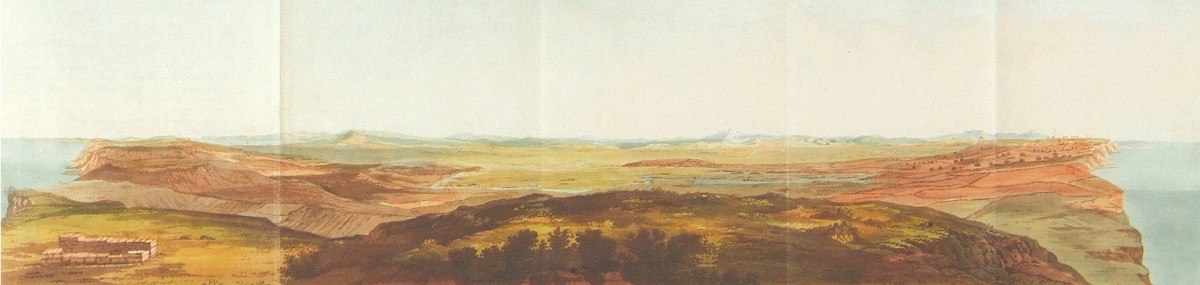
Entrance of the Dardanelles (1801, William Gell)-2
"After leaving Thessaloniki, we went to Gallipoli, where we were quite comfortably hosted at the house of M. Sitrides, the British consular representative and a very kind person. He showed me his house and some interesting antiquities in the city. Among these, the most interesting was a high relief sculpture made of white marble, associated with M. Sitrides. The relief consists of a Pan figure sitting on a rock to the right, playing a syrinx, within a cave. Below him is an altar in front of which Hermes and three nymphs are dancing.
This relief sculpture gives the impression of belonging to a good art period, made boldly and freely without any hesitation. Some parts of the sculpture's hands and arms are broken, but otherwise, the sculpture is in very good condition. M. Sitrides showed a spoon that belonged to him, which I immediately recognized as part of an interesting silver collection found a few years ago in Lapseki (Lampsacus), a portion of which is now in the British Museum...
M. Sitrides also showed two cylindrical gold brooches, twisted in shape and ending with two lion heads, found in a tomb. In the middle of this twist is a Medusa head set in a diamond shape: it seems to belong to the Greek period.
In the city, I found an inscription consisting of epic and short long syllabic verses, placed upside down at the entrance of a mosque.
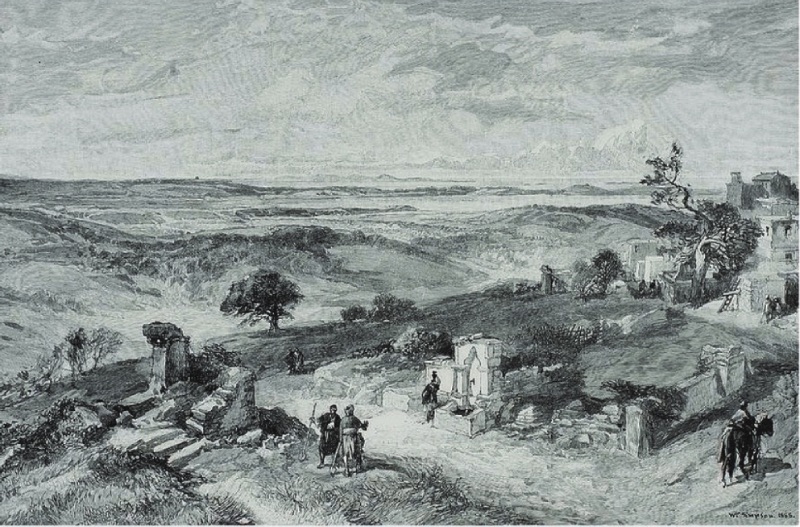
The Turks had carefully placed the column upside down. I attempted to change the position of the inscription under the control of the consular representative's dragoman (a common name used until the Tanzimat period for interpreters, often from minorities, considered state officials, R.A). However, immediately after the first pickaxe strike on the ground, a green-turbaned fanatic came rushing towards us, shouting with all his might; as a result, I had to read and copy the entire inscription with my head between my knees. This rather uncomfortable position continued for three days, surrounded most of the time by an official sent by the Pasha for control and a dense crowd. I was told that a statue with an inscription, showing the ancient city of Callipolis, had been found here a few years ago; the Turks used this statue, as they did in the Middle Ages, in the wall of one of their fountains. The Dardanelles from Erenköy (1890, W Simpson)
Since the weather was not suitable for a tour of the peninsula, I decided to go to Çanakkale (Dardanelles), where we were welcomed by Mr. James Calvert and his brother, who were consuls there.
We set off to go to their farmhouse in Erenköy (Renköi), very close to the coast, about three hours away from Çanakkale (Dardanelles). This house was built by Mr. Lander, the current consul's uncle. Here I found some pieces of European civilization; alongside family portraits from the beauties of the George III period, there was a gloomy portrait of Sir Thomas Maitland, a piano, a billiard table, some new books published in England last year, and some other small luxury items from Lesbos.
The Calverts are quite significantly involved in the acorn trade. Acorns (Quercus Aegilops) are widespread in the Troas region and are mainly used for dyeing and tanning in England. The acorns are given to pigs, but they are also used as fuel. The Calverts have two farms, where they use two or three English plows. Turkish farmers have been using wooden tools for centuries in Asia Minor without destroying the rich subsoil. The Troas region has been a wild area left neglected for centuries, but the Greeks are now beginning to cultivate it. They are advancing in many places along the coast of Asia Minor, while the Turks gradually make way for them, abandoning their lands because they lack the energy to look after them.
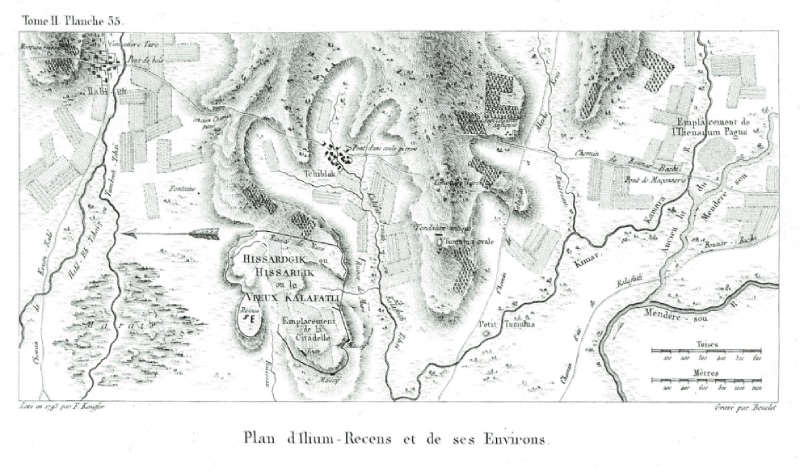
Hisarlık _Troy and Its Surroundings (1784, Aguste de Choiseul-Gouffier) The area between Çanakkale (Dardanelles) and Troy is generally covered with brushwood, with not a single village and almost no cultivation. Nothing breaks the monotony of the horizon, but there are large tumuli (burial mounds) seen intermittently on the skyline, indicating the tombs of some Homeric heroes. As we wander these lands, we see very few people. Instead of the fat and greasy citizens of Lesbos, who travel on paved roads used for all kinds of travel between densely populated villages, riding their mules home: on the roads of the plain of Troy, there are camel caravans heading to distant regions and sometimes a horseman armed to the teeth. All we see of human presence is this. Only a Slav shepherd, advancing with his large flock of sheep and goats, with a weapon in his belt and dogs wilder than himself, as in the time of Horace (a Roman poet living between 65 BC and 8 BC, during the reign of Emperor Augustus, R.A)...
We made a trip to the site of the Troy settlement; at midnight near the location of the Calverts' farmhouse (on the road to Pınarbaşı village, near the Hanaytepe settlement also known as Thymbra Farm. R.A.). From here, we proceeded to Pınarbaşı (Bounarbashi) and examined the rocky hill surrounded by the Menderes (Karamenderes River), which Chevalier claimed to be the Troy settlement. If this hill was once an acropolis, then we should be able to find early pottery, which was first noted by Mr. Burgon, abundant in the Homeric settlements of Mycenae and Tiryns. I could not see such pottery in the soil. Also, I could not discover anywhere here the traces of house foundations, which are generally seen in early Greek fortresses and settlements, and whose marks on the cut bedrock never disappear.
After leaving Pınarbaşı, we went south to Kemallı (Chimenlai), a small village marked as no. 1608 in military documents. Here, we were very hospitably received by a lady whose husband sold acorns to the Calverts. It was my first time staying in a Turkish house. Everything was quite clean and comfortable. A naturally very black gentleman attended to us. Turkish servants, especially black ones, are very good attendants with silence and ease in their movements. Despite the superior wealth of Europeans in the Levant, they are not served as well as the Turks, because no one deigns to serve a Greek or a Latin Christian. In the morning, the lady of the house, who had not appeared until we were about to leave, showed herself at the window and unveiled her face, expressing her regret that we were not staying another day. Such behavior is unusual and entirely forbidden according to the general rules of Turkish traditions; however, the woman was neither young nor beautiful. The Calverts were friends of the family and bought their acorns, so we were received as enfants de la maison (children of the house).
The mosque in this village was clearly built from large square stones belonging to some ancient structures. In this mosque, there is a Latin inscription dedicated to Emperor Claudius as "Sodalis Augustalis." Above the window jamb stone, there is another piece of a Latin inscription, with the name Nero mentioned as a name and title. In front of the mosque, there is a Doric-style column capital and a plain marble chair.
The next day, we went to a village called Koushhibasi (Koçali?) in the mountains, one and a half hours south of Kemallı and three hours from Alexandria Troas. Near here, there are seven extraordinarily large granite columns cut from the quarry and left as they are; as if cut from cheese or cheese-like. Their lengths are 37, 38 feet (one foot is 30.48 cm, R.A), and their diameters are 5 feet 6 inches (1 inch is 2.54 cm). They seem to belong to the Roman Period and were roughly worked to be polished later for a distant temple. Not all of them are the same length. The quarry from which they were extracted is located northeast of the columns. The chisel marks are placed vertically on the granite surfaces in parallel grooves.
On the road from this quarry to Alexandria Troas, there are these granites, abandoned on the road to the sea. It is quite impressive that these seven sleepers lie so quietly where they were extracted.
South of Koushibasi, our path turned into a rocky and barren area until we reached the most interesting fortress, Çığrı, nestled among the mountains. In military records, this place is 1648 feet above sea level. It is two hours south of Koushibashi village and is recorded in military documents, but I think travelers have not mentioned it much. The walls are perfectly built everywhere with cornered granite blocks. The fortress is diamond-shaped and can be compared to a kite with holes. It extends in a southeast-northwest direction. It takes twenty minutes to walk along its long side, which is about a mile long. There are numerous towered city entrances...
The mountains around here are famous for their bandits. Captain Spratt, along with another officer, was waylaid by three armed ruffians while conducting a hydrographic surface survey, but they managed to escape with great cleverness.
On the way from Çığrı to Alexandria Troas, we passed through a place called Lisgyar (Kestanboun Hot Springs), where there are hot springs. Here, there are remains of baths built with masonry technique, probably from the Late Roman period. A small bronze mouse, now in Mr. Calvert's collection, was found here. Near this find spot is Sminthium, where Apollo Sminthius was worshipped. There is no doubt that this mouse was dedicated to the god holding a mouse on a coin of Alexandria Troas. This place is marked as no. 1608 in military documents as "hot springs" but has no name. Pococke noted this place and said the baths were sulfuric. He saw a female figure made of white marble with a broken head here.
When we arrived at Alexandria Troas, the weather was so bad that we looked at the Roman period remains without dismounting our horses. I heard that there were no inscriptions or statues here. The main ruins are quite magnificent, consisting of a large structure with many arches in the field. The large blocks are built with isodomos wall technique. Chandler guessed this place to be a gymnasium.
The marbles have been taken away by travelers or those living in neighboring villages, and nothing remains, but the strong Roman walls and the main structures of the buildings remain. Nearby, we saw an arched underground passage, and we passed under the steps of the amphitheater. Towards the sea, where the harbor was, there are scattered house remains for about a mile. To the north, we passed the ruins in the direction of Geyikli, and many sarcophagi appeared in the land behind the walls; these must have been placed on both sides of the ancient road. On the way back from Alexandria Troas, we stopped at Kalafatlı (the village adjacent to Hisarlık/Troy, R.A.) near the Menderes (Karamenderes). Here, a coarse pavement with usual patterns was recently uncovered. As we passed, Greek villagers were cutting the pavements into squares and laying them in the church squares like a waterproof layer. In this few-hectare area, there are marble pieces and coarse Roman period pottery on the surface. East of the pavement, terrace walls with foundations made of coarse stones can be seen.
One of these walls is 60 steps long, and the other wall, making a right angle, is 50 steps long. Next to this wall, three or four square blocks are just lying on the surface. North of this pavement, there is a small hill with a leveled area on top; the land slopes gradually towards the plain to the north. There are pieces of black-painted Hellenistic pottery on the surface. From Kalafatlı, we went to Ilium Novum (New Ilion/Troy, R.A), where the visible remains on the surface are insignificant; the irregularity of the surface made me think that large remains might be hidden underground. Later, we returned to Erenköy (Renkoi) via Halileli, where I took copies of some inscriptions.
After returning to Erenköy (Renkoi), I visited the place half northeast of the village, which Mr. Calvert believes to be ancient Ophrynium. This place is now called İt Gelmez, perhaps because this name describes that it is surrounded by deep valleys on the inner sides, except for the east, which is connected to the higher places above by a narrow connection. Southwest of this platform, Mr. Calvert found good quality red clay pipes in the stepped slope passage to the harbor. They give the impression of being made in ancient times to channel water downwards. On the surface of the platform, there are wall foundations, marble pieces, and pottery fragments. Here, two copper coins of Neandria and one of Ilium were found. Southeast of this platform, pipes descend from the other side's surface with terraces. On the surface of the sloping platform above these terraces, there is a lot of Hellenistic pottery. On this upper platform, the wall foundation is perhaps terraced in a northwest-southeast direction for 170 feet (1 foot= 30.48 cm; R.A.), and when it turns, it is 146 feet long in an east-southeast direction. This outer cladding wall made of travertine blocks is filled with rubble. Fourteen coins from different periods of Ophrynium were found here. Two of these are Siegeum, three are Ilium Novum, and one is a silver coin from Magiste, a small island near Rhodes (Rosso Castle). It is a very rare situation for the last coin, which is quite rare, to have come this far from where it was minted. The surface of the slope here seems to have been changed by landslides that often occur on the edges of deep valleys. Below this platform, there are remains of an ancient pier.
It is clear that the Greek city was established here: as Strabo described, the location and the large number of coins found here increase the likelihood that the city was established on this platform.
While examining the coast south of Erenköy (Renkoi), I saw red pottery and building stones near a fountain forty minutes away.
The headland, where ancient Rhaeteum (where Çakal Tepe is located, R.A) is thought to be, with not much visible remains, must have been used as a Hellenistic period burial area. When we examined the approximately 8 feet (1 foot= 30.48 cm; R.A.) surface on the slope side, we identified small pieces of vases, bones, and ashes. It seems that the dead were buried in large coarse vessels made of red clay. There are many pottery fragments on the surface of the land. The surface rises slightly towards the headland; the shape of the elevation suggests that there was once a tumulus here, but later it was terraced.
Southwest of Erenköy (Renkoi), an hour away and a few minutes' walk from the coast, there are the remains of an old Byzantine church named Agios Athanasi. The foundations of this church are 66 feet long (1 foot= 30.48 cm, R.A.); the width is 57 feet. Among the remains here are pieces of Roman period column capitals. Siegeum coins have also been found here.
Near where the small stream Kemar (Kemer Dere) joins the Menderes (Karamenderes River); five hours south of Çanakkale (Dardanelles), near Akçaköy (Atshik-koi), the Calverts have a farm. Here, there are two tumuli marked as Harman Tepe (Herman Tepe) and Hanay Tepe (Khani Tepe) in military documents. During our visit to Erenköy (Renkoi), Mr. Frank Calvert opened a gallery and a well at Hanay Tepe (Khani Tepe). Nothing was found inside except for an ash layer near the base; however, no definite result was obtained because the excavations did not go deep enough. Therefore, the most important finds here were found at the base of the Greek tumulus.
The investigations at the terraces of the Kemar (Kemer water) river, where these two tumuli (burial mounds) are located, revealed a Hellenistic tomb here. While Mr. Calvert was conducting excavations, I was with him. The dead were buried here in large vessels or red-colored pottery. These vessels were called pithos in ancient times. As is generally known, Diogenes lived not in a barrel but in such a pithos. These vessels are still used by Greeks today for water storage purposes. These large vessels are buried up to their mouths in front of their houses and are called cupas. This name seems to be related to the Arabic word koub. The pithos in our excavation were just a few inches (1 inch= 2.5 cm, R.A.) below the surface; the plow almost reached where they were. Their sizes varied, but the largest was 4 feet 6 inches high (approximately 134 cm, R.A.). The ones we found were lying sideways, and their mouths generally faced southeast. The mouth of each pithos was covered with a flat stone. Inside each were one or more skeletons and many painted vases. In one, there were eight small vases mixed with bones. Some of the vases had figures painted black on a red background; others were painted red on a black background: they all seemed to belong to very late periods.
Just below these jars, we reached the bedrock, which proved to us that there were no earlier burials in this cemetery.
In Erenköy (Renkoi), taking advantage of a break, I reread the scenes describing the natural features in the Iliad. Someone who has not seen that magnificent silhouette on the horizon of the plain of Troy cannot take that magnificent view home with them in their memories, as much as the readers or listeners of the poet Homer. We either imagine the scenes in the Iliad in our minds or we don't; we don't bring to mind the nature of Homer, where the war scenes of Homer are conveyed. The background is empty like the surface of a Greek frieze. However, for Homer's listeners, the names of the rivers and mountains in the epic retell the real natural environment, and for all ancient poets, there is a Greek natural environment that is more than a Greek narrative, something that researchers who have not traveled and seen cannot imagine.
While in Çanakkale (Dardanelles), I observed a strange feature of the Greeks. The Calverts' agent suffered a loss of 40,000 piasters due to a robbery at his house. The thief was tracked to this village, and a few days later, the village priest announced that he would have a game in the church that would identify the thief without any error. This game involved a wolf's foot bone boiled with a plowshare inside a column; the bone, when burned, had an extraordinary feature of showing the thief's foot: as soon as the bone was thrown into the fire, the thief's foot would immediately become paralyzed. The priest announced this game in the morning and also stated that he would not burn the wolf bone until the next day. That same night, all the stolen items were thrown into the real owner's garden in a bag, thus avoiding the punishment prepared for him.
I think behind this display of power by the priest lay a more realistic and concrete threat, namely that the Pasha of Çanakkale (Dardanelles) could hold the entire village responsible for the stolen items. Thus, the priest, as always, became an instrument of the government."