
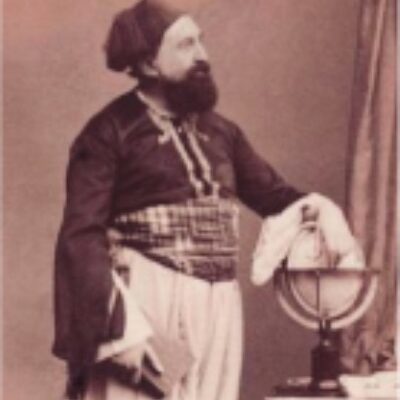
The famous Russian naturalist, geographer, and traveler Prince Pierre de Tchihatchef, whose real name was Pyotr Alexandrovich Chikhachyov, was one of the most renowned geologists of the 19th century. This adventurous scientist traveled across Anatolia between 1847 and 1858, and at the end of his research, he published his monumental eight-volume work, Asie Mineure (Asia Minor)... In the book he wrote after this work, he examined Istanbul and its surroundings, the Islands, Thrace, Bithynia, and the Aegean coast in terms of animals, vegetation, waters, and soil structure. Enriched with interesting stories and legends he quoted from ancient writers like Strabon and Homer, the work is an invaluable source on 19th-century Istanbul. Tchihatchef worked as an attaché at the Russian Embassy between 1845-48. During this period, he learned Turkish with its dialects and devoted himself entirely to the study of Anatolia. Tchihatchef was the first naturalist to examine Anatolia in detail through the eyes of a modern geologist. He made similar observations during his visit to the Çanakkale Region:
"Can a foreigner be imagined who, seeing these numerous steamships constantly traveling between Istanbul and Izmir, stopping at many points along the beautiful scenic coasts they pass, such as Çanakkale, Bozcaada (Tenedos), the coast of Troy, Chios, etc., would not join this very pleasant journey and visit the classical sites of the Troy peninsula along the way? I have no intention of guiding him in Izmir or in the fields that were once Troy. Because everything that might interest the simple tourist has been sufficiently described in Izmir to this day, and the immortal places of the Iliad have been the subject of so many studies that one might find it difficult to choose among these works. Among these works are those written by authors such as Choiseul-Gouffier, Lechevalier, Clark, Rennel, Morit, Dubois, Sibthorp, Hunt, etc. What I intend to do here is to point out some places that might escape the foreigner's eye. These places, which are very striking in terms of great physical events, have either been studied a lot or never visited. I have tried to highlight these places so that the traveler, who gets lost in the memories of the past in the middle of Troy or near Izmir, can add the pleasure of observing natural works, which cannot be thought of separately from the charm of historical memories, without even needing to change his pre-planned route.
Therefore, I will start by pointing out some places on the Troy peninsula, especially the hot Tuzla springs and the Akpınar and İnova sources...
Those who want to take advantage of the ship to visit the classical Troy settlements while traveling from Istanbul to Izmir disembark at Çanakkale, because in this small town where the consulates of foreign powers reside, horses and guides, which are indispensable helpers for these interesting trips, can be found. As I said before, I have no concern within the framework of this book to follow the traveler on the mentioned trip. After dreaming as he wishes in the tumuli, stream beds, and the revived stone blocks of the Iliad, he will approach the coast and examine the ruins of Alexandria Troas (known today as Eski İstanbul). I will then reappear to take him to a narrow valley nearby, watered by Ilıcasu. From the cracks in the somaki rocks on the right slope of this valley, hot waters can be seen seeping. These waters are collected in two square-shaped structures serving as baths. This valley with hot water sources is merely an introduction to a much more impressive view offered by another valley located about ten kilometers further south. The name of this second valley is Tuzlasu.
The mountains surrounding this valley near its entrance first strike one with their white colors in which blues, reds, and yellows are seen. When examining the slopes facing the valley, it is seen that they are scattered with numerous salty water streams seeping from the cracks; these waters flowing towards the plain have covered the slope with a cracked crust. Hot waters also seep from within this crust. Therefore,
When passing through the plain northeast of the village of Tuzla, whenever you step on one of these almost invisible springs gushing from everywhere in the ground, you feel your heels burning. Because the water temperature is 78-90 degrees. Small pools have been dug at intervals to collect the water and allow it to evaporate in the plain. This evaporation occurs at an astonishing speed, leaving behind a fairly large amount of very clean salt piles.
The numerous salty water fountains gushing in the Tuzla valley can provide a large amount of salt that can be used for commercial purposes. In Asia Minor, in the infancy stage of that industry, this source of wealth had just been discovered. In 1848, when I traveled, only 18-20 tons of salt were taken annually from the Tuzla natural salt mine. In Tuzla, the okka (1.284 grams) of salt was only 6 para (approximately 0.30 francs) in 1848; but when transported to Çanakkale, Balıkesir, and other coastal settlements where this commodity was loaded, it was sold at 10 para (approximately 0.50 francs) per okka. The right to operate the Tuzla salt belongs to the state; the state has transferred the operation of the mine to intermediaries who give 15,000-20,000 kuruş (approximately 18,000 francs) annually. This situation shows that these very large natural riches constitute a very small source of income for the Ottoman government. However, the Tuzla salt mines were also famous in ancient times under the name "Tragase saltworks." In fact, the name of today's Tuzla valley is nothing but a direct translation of the name "Haliseon" used by Strabon. As for the stream now called Tuzlasu, we find it in Homer under the name "Satnioeis waterfall"; the sections mentioning this stream have been quoted by Strabon; because Strabon never misses an opportunity to mention his favorite poet, Homer. No ancient or modern writer has been able to influence Strabon as much as Homer. After observing the remarkable events seen in the Tuzla region in front of the traveler, there are two ways to return to Istanbul: the first and shortest way is to board the steamship stopping at Baba Burnu (Lectum promontorium) near Tuzla. The ship will quickly take him to the Ottoman capital."