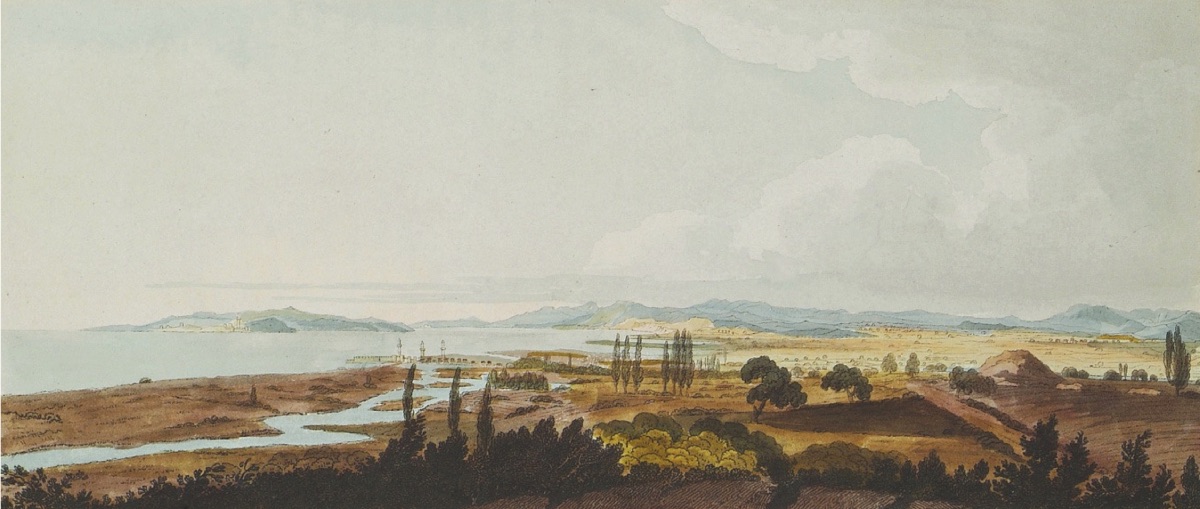
Old Kumkale and Surroundings from the Sea (1801, William Gell)
Dr. William Wittman, an English surgeon, served as the doctor of the military unit sent by England to assist the Ottoman Empire following the Ottoman-English-Russian rapprochement that emerged with Napoleon's invasion of Egypt in 1798. During the war, he took on the role of the Grand Vizier's doctor. Wittman's travelogue is a collection of his experiences, starting in England and continuing through the Mediterranean and Aegean to Istanbul, then to French-occupied Egypt, and ending back in England after the liberation of Egypt. William's realistic yet impartial observations were quite beneficial in helping Europe understand the Ottoman Empire of that era. From Wittman's accounts, we learn that a reformist sultan of the Ottoman Empire like Selim III consulted fortune-tellers and astrologers for the launch date of a newly built warship, and that the Ottoman Grand Vizier strongly opposed the idea of the world being round. Like almost all European travelers, the influence of Troy and Homer is strongly felt as he crosses the Dardanelles. Wittman visited Çanakkale and its region three times. His first visit began on October 23, 1799, from Istanbul and continued until November 26. Wittman returned to Istanbul due to an order he received. During this visit, he explored Kumkale at the entrance of the Dardanelles to the Aegean Sea and the Greek village of Gavurköy (Yenişehir) built on the ancient city of Siegeun. An important historical research aspect here is that despite the order from Captain Pasha in 1786, the famous Sigeon inscription, which the French ambassador to Istanbul, Count Choiseul Gouffier, could not take to his country, was sent to England by Wittman upon the insistence of the British ambassador Lord Elgin and the order of Captain Pasha. His second visit to Çanakkale occurred in 1800. On his way to Jaffa, Wittman stopped by Çanakkale once more and visited Bozcaada and its surroundings in 1801 on his return:
"1799-October
On October 23, the wind had calmed. We set sail from the port of Istanbul... For the next three days, we had to remain stationary between Marmara Island and Gallipoli. Meanwhile, one of the artillerymen of the unit contracted dysentery.
On the 28th, we were at Çanakkale (Dardanelles). We anchored directly opposite Mito (Maydos / Eceabat) in Nara Bay. We were quite close to the Asian shore, only about five or six kilometers from the ancient city of Abidos. We were also three kilometers short of our main destination, the fortresses of Çanakkale (Chennecally). The point where we anchored was truly a classic spot because, if the poets were telling the truth, Leander swam across the strait from here to Sestos to meet his beloved Hero. On the ancient medallions of the city of Abidos, there are images showing him swimming to reach the tower, and later a torch was erected in memory of Hero. The remains of this tower, which was later used as a lighthouse, can be seen on a rock by the sea. An ancient medallion showing him swimming?
Two hours after anchoring, our ship began to drag anchor, posing a danger of drifting towards the opposite shore. To prevent this, we had to cut the rope and set sail. Shortly thereafter, we anchored near Captain Pasha's fleet, three kilometers beyond the city of Çanakkale.
While anchoring, we saluted Captain Pasha with a seventeen-gun salute. The salute was returned, and then Captain Pasha came alongside our ship in a very beautiful boat. There were many people rowing in the boat.
Captain Pasha invited General Koehler to his ship. The invitation was accepted; during the meeting, it was decided that all the officers in the delegation would be presented to Captain Pasha.
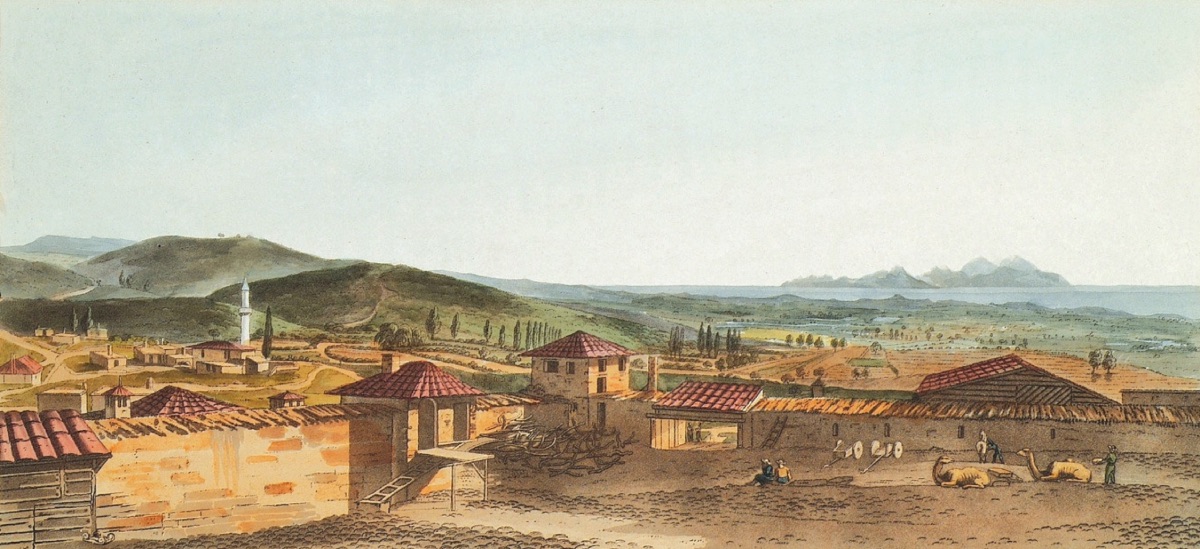
Old Kumkale and Surroundings from the Site of Orhaniye Tapyaları (1801, William Gell) On the morning of the 29th, the generals, officers, and the flagship carrying one hundred and thirty guns went to Sultan Selim. Everyone was presented to Captain Pasha and was received with great interest and courtesy. They were then entertained with hookahs, coffees, and various refreshing drinks. In addition to the usual ceremonies, they were served English tea with an extremely elegant tea set. While Captain Pasha personally showed them around the ship, they examined everything carefully. Then Captain Pasha ordered his soldiers to practice with the mid-deck cannons. This was done with verbal commands, and every step was carried out with great precision and order. When complimented on the ship's order and excellent discipline, they did not hesitate to say that they owed it all to Captain Samauel Hood of Saturn. Before Sir Sydney Smith's arrival, Hood was the commander of the camp outside Alexandria. Captain Pasha would later repeatedly express how much they owed to this talented and intelligent officer; he had made the necessary improvements in the fleet thanks to him.
Captain Pasha, or Küçük Hüseyin, who had taken on the role of Captain of the Sea, was actually a Georgian slave. Since the Sultan, with whom he spent his childhood years, did not particularly like him, he was elevated to his current position during the reform of the navy, despite having no prior service in the Turkish navy, and managed to exhibit great energy and talent there.
It will not be difficult to remember that the Turkish navy was in a very bad state during the last Turkish-Russian war. After that period, Küçük Hüseyin made great efforts, which were effective, and raised the navy to a much more respectable level. This man, being free from the prejudices that Turks generally cling to strongly, with the support of the Sultan, introduced and implemented every innovation that would bring improvement, and tried to learn everything related to advanced maritime science from the European countries that were advanced in seafaring...
On November 2, Captain Morris arrived in Çanakkale with the Phaeton frigate. On board were His Majesty's ambassador to the Sublime Porte, Lord Elgin, his wife, and entourage. All the officers of the General and the delegation immediately went to the ship to pay their respects and welcome Lord Elgin. The Phaeton saluted Captain Pasha with a nineteen-gun salute, and he was answered with the same number of gunshots. His Excellency, accompanied by Lady Elgin and Captain Moris, paid a visit to Sultan Selim to present their respects to Captain Pasha. During this journey, they were saluted by both ships, and then His Excellency accepted Captain Pasha's invitation to dinner.
On the morning of the 3rd, the Phaeton frigate set sail for Istanbul with the aforementioned dignitaries...
On the morning of the 7th, I set out with the general towards Kumkale, arriving there between 10 and 11 o'clock. We paid our respects to the Bey, Adamoğlu (Hadımoğlu R.A.), who was the governor of the four fortresses and the Çanakkale region. He received us very civilly. He provided us with horses to go to the hill overlooking the plain of Troy, at the promontory of Gavurköy or Janizari (Yenişehir R.A.), where the ancient Sigaeum was located. Our purpose for going there was to obtain a peculiar relief and the famous Sigeaum inscription for Lord Elgin. Lord had seen these works and was eager to take them to England. To achieve this, a firman had been obtained from Captain Pasha, granting special permission. It did not take long for us to reach these valuable antiquities. They were standing at the entrance of a small Greek church. Only Greeks lived in the village. They were opposed to the removal of the works. The reason was their belief that touching those stones cured malaria. However, we were luckier than Count Choiseul Gouffier, who had tried to take the Sigaeum inscription a few years earlier.
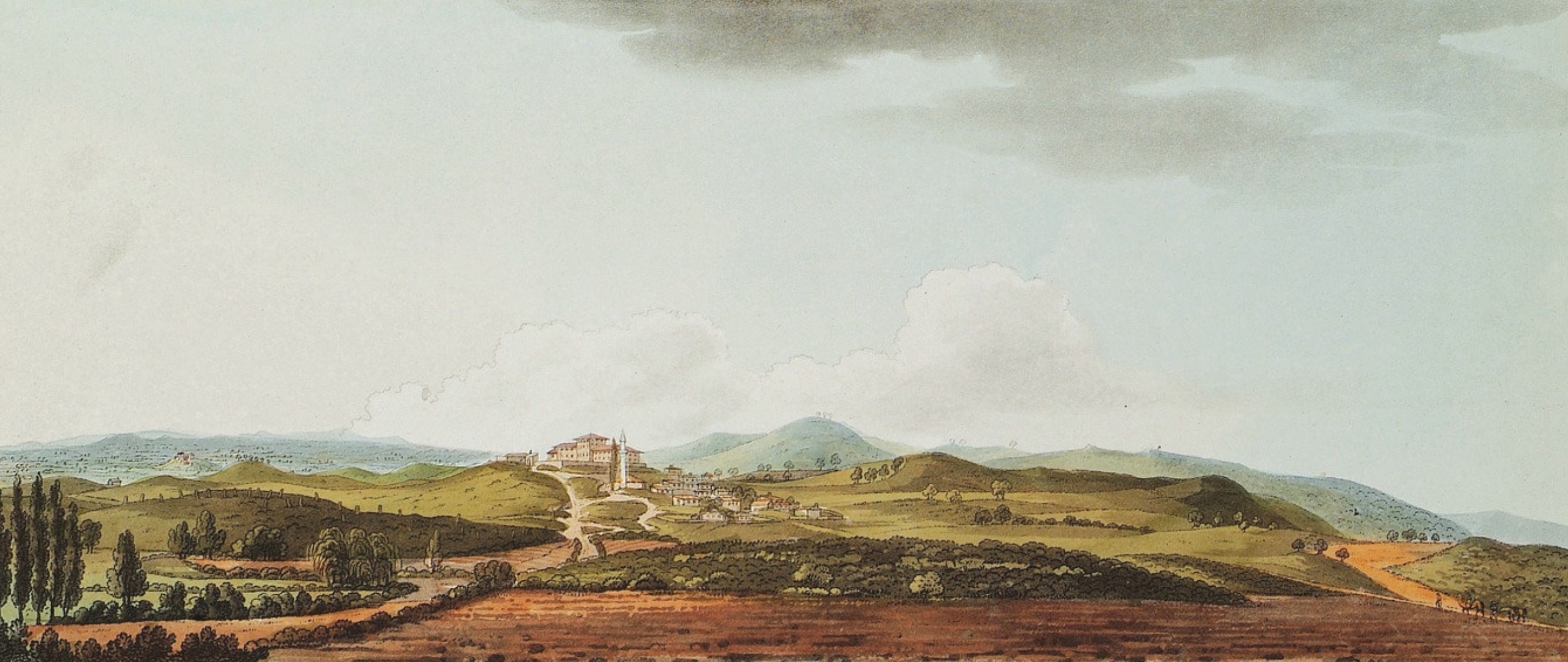
Mehmet Ağa's Mansion in Pınarbaşı Village (1801, William Gell) Despite the firman he brought from Hasan Pasha to overcome the objections of the Greeks, he could not take the marble. However, the firman we showed from Captain Pasha worked. The marble block on which the Sigaeum inscription was found was once part of a hermetic column, cut and separated. The letters of the inscription were written in reverse in some places and in normal direction in others, indicating that the marble was a highly valuable ancient artifact. As for the relief, there were five finely carved figures, but unfortunately, the heads of four of them were broken. Since this work, along with the Sigaeum inscription, was eventually taken to England, there is no need to provide more detailed information on this matter.
After this, we visited the mounds traditionally described as the tombs of Achilles and Patroclus. As we approached, we saw another mound nearby, said to be the tomb of Ajax.
The plain of Troy we passed through was a very wide plain. It was about twenty kilometers long and ten kilometers wide. It was a fertile plain, and the crops were in very good condition. A large part of the land was set aside as pasture, where countless herds of cattle grazed. The Karamenderes and Dümrek rivers meandered through the middle of the plain. At their confluence was a village called Pınarbaşı (Bourna Bashi). It was said to be the site of ancient Ilium. The ruins a little beyond the village were the remains of the Temple of Apollo. There was another small village visible in the vicinity. The Karamenderes river flowed through there, but its water was not much. In some parts of the riverbed, cattle were grazing.
From Gavurköy, we could see Mount Kaz (Ida), and the tomb of Poletes, the son of Priam, who evaluated the Greek forces, in all its splendor. We had to postpone our planned trip to Alexandria Troas, or as the Turks call it, Old Istanbul, to a more convenient time. That night we slept in the house prepared for us by the Bey.
On the morning of the 8th, we paid a visit to Adamoğlu (Hadımoğlu R.A.). Since he had received a message from Captain Pasha summoning him to Çanakkale, he accompanied us on our return. He seemed quite distressed during the journey. It was as if he believed that something unpleasant would result from his meeting with Captain Pasha. He did not hesitate to express these concerns to General Koehler, asking for his support. The General was successful in this regard, but the Bey was still very worried due to the conditions he perceived as against him.
Previously, he had told some people in our group that he had ten thousand soldiers under his command and could gather forty thousand men in as little as three days. Despite having such a large force at his disposal, the system in Turkey is such that a message from the vizier or an authorized person is enough for Adamoğlu (Hadımoğlu R.A.) to see himself in danger.
Pınarbaşı Village and Surroundings (1801, William Gell) In the afternoon, I took a short trip inland for a few kilometers. Çanakkale is a place of several kilometers in length, established on flat land on the southern shore of the Dardanelles. The settlement ends where the high hills leading to Mount Kaz begin. To the east and southwest of the city, there are marshy areas. Therefore, it is almost certain that the residents here will experience intermittent fevers. To the east, there is a beautiful grove of plane trees. About eighteen months before the period I described, the plague had spread to Çanakkale, causing the death of thirty or forty residents. According to the prevalent belief here, the plague does not break out in Çanakkale unless it reaches an unprecedented severity in Istanbul. There is an even stranger rumor: the inhabitants of the town of Mito (Maydos/Eceabat, R.A.) on the northern side of the strait opposite Abidos are never affected by the plague, and even patients secretly brought there recover.
The water in Çanakkale is brackish. When drunk, it leaves an unpleasant taste in the mouth. Therefore, the residents have to obtain their water from nearby springs. The plain surrounding the city is fertile; in addition to fields where cotton, celery, and various grains are grown, there are many vineyards. Camels and buffaloes are used both in agriculture and for other purposes. The city is extremely dirty, its streets very narrow, and its houses, as is always seen in Turkish towns and villages, are in really poor condition.
Çanakkale is very suitable for hunting. There are also turkeys, geese, ducks, and various birds. The sheep are of good breed. Excellent vegetables are continuously available in the markets. Fruits are also abundant when in season. We have not yet understood whether there is a local market for fish. The wine made in Çanakkale is also good and cheap.
Pottery is manufactured here, and leather is processed. These leathers eventually become the universally respected red, yellow, and black Turkish leathers. Captain Pasha brings his ships here once a year to anchor and collect the annual taxes on behalf of the state from the nearby regions. He is expected to return to Istanbul in a few days.
There are four fortresses to defend the strait. Numerous cannons have been placed in these, many of which are of rare large calibers. Some have a bore diameter of at least seventy centimeters. As our group passed by, we saw a Turk sitting inside one of these cannons, eating his meal. One of the fortresses is in Çanakkale, another on the opposite shore in Kilitbahir. As for the other two, they are at the entrance of the strait: one on the European side in Seddülbahir, and the other on the Asian side in Kumkale.
While Lieutenant Colonel Holloway and Major Hope were touring these fortresses and the shore, the Turks conducted a ricochet exercise with mortars in Çanakkale, intending to show the English officers that the huge marble and granite cannonballs could reach the opposite side of the strait. Indeed, they proved this in a rather painful way. One of the shots killed three people from a family sitting in the meadow on the opposite shore...
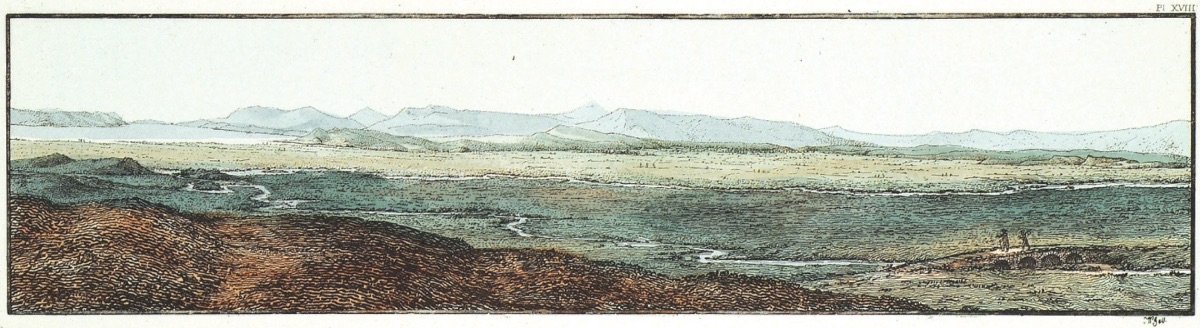
Plain of Troy and Its Surroundings (1801, William Gell)
On the 11th, it rained heavily from the previous night, thunder roared, lightning flashed, and when the storm continued until morning, we saw that the weather had changed. The wind was now blowing from the north. Since we had no fire to warm ourselves, the sudden onset of cold became very uncomfortable. I mounted my horse and went to the point indicated as the site of ancient Abidos. There I found scattered bricks, stones, and similar things. It was clear that this place was filled with the remains of an ancient settlement. Nearby, one of the former captain pashas had built an ornate mansion. He had also constructed a beautiful fountain and a mosque. The mansion was at the top of a bay. During the winter months, Turkish warships anchored there. Therefore, that mansion had become the favorite place of the current Captain Pasha.
On the morning of November 12, I went to a Turkish village about five kilometers outside Çanakkale. It was no different from the villages I described earlier. The recent rains had put the villagers to work. Some were pruning vines, others were plowing their fields and sowing barley.
On the 15th, Captain Pasha, who had moved his fleet to Nara near Abidos, promoted one of his captains to vice admiral. We were told that the reason for this promotion was that a Turkish admiral had been beheaded for neglect of duty. The man had allowed Bonaparte to escape from Egypt by sea. The new admiral was saluted by the cannons of the Turkish ships.
On the 18th, Dr. Rıza, the physician of Captain Pasha, came to visit me. We had met the night before at the Russian residence. After accompanying him to the general's house the next day, the two of us went together to see the Turkish captains who had fallen ill. The news confirming Bonaparte's escape from Egypt reached Çanakkale that day.
On November 24, I walked to Abidos. This time I had more time to examine the place. In addition to numerous brick fragments, there were also huge piles of stones and debris. They were all scattered everywhere. The remains of a very dilapidated wall of a tower caught my attention. This was probably the only standing remnant.
The weather had been cold, rainy, and stormy for several days. The temperature was around eight to ten degrees. On the 25th, the weather cleared, and I took a pleasant horseback ride to the site of ancient Dardania. There, too, I saw scattered brick fragments. When combined with the stones and other debris mixed in, this again was evidence that there must have been buildings here in the past. Nearby, I saw the remains of an old castle.
On November 26, I took a trip towards the mountains, where I had the pleasure of witnessing one of the greatest beauties imaginable. Behind me was Mount Ida, in front of me the Dardanelles, Imroz, Samothrace, and the Gulf of Saros. Bozcaada, Lesbos, and the Aegean Sea were to my left. The sun was shining brightly. The snow accumulated on the peaks of Mount Ida and Samothrace was glistening...
On the 30th, the Phaeton frigate arrived from Istanbul, bringing letters. According to the news we received, the members of the delegation were expected there in preparation for an important service. Upon this, the general ordered us to be ready to board our ship early in the morning. But since the wind was blowing from the north, there was a possibility that we might be stuck in Çanakkale for a few days.
On December 1, I took my luggage and boarded our ship, and the next day the officers and soldiers boarded. The general would come to Istanbul on a Turkish ship. That morning I went to Mito (Maydos/ Eceabat, R.A.) on the European side, bought a case of wine for ninety-six paras. In our money, this means a little less than three pence per bottle. In the afternoon, we set sail for Istanbul. The weather was beautiful, and the wind was gentle. Late in the evening, we passed in front of the town of Gallipoli. On the 3rd, with a fresh wind, we entered the Sea of Marmara, and at noon on December 4, we entered the Golden Horn in Istanbul...
1800;
The wind was not at all favorable, but the Sublime Porte's determination to set us on our way was so full of concern that, in a way, we were compelled to set sail on June 15...
On the 16th, we set sail again with a brand new wind. When the wind continued, we reached Gallipoli at nine in the morning on the 17th. There we saw the wreck of a Turkish warship. It had been abandoned there some time ago, lying in the harbor. At one-thirty, we anchored opposite Mito (Maydos/Eceabat, R.A.) in the Dardanelles, near Abidos. We would stay there for two days to take on new provisions and supplies for the ship. An English merchant ship named Southwold also came and anchored beside us during its journey to England. It reported that a Royal ship coming from Alexandria was anchored outside Çanakkale because the plague had broken out on board. The captain and some of the crew were also ill. Therefore, all communication between the shore and the ship had been cut off.
On June 18, we paid a visit to Adamoğlu. He was also in Çanakkale at the time and invited us to dinner the next day. In the evening, a Tatar came and brought messages from Lord Elgin to the General.
On the 19th, we set out for the dinner invitation. Most of the officers went by sea, while some went on the ornate horses sent to us by the Bey. We were received very politely. Shortly after our arrival, as usual, hookahs and coffees were served. At noon, meals similar to those I described earlier were eaten, and we were also offered wine. There were about fifteen dishes on the table. These showcased the variety of Turkish cuisine. The last one, according to tradition, was a kind of pilaf. Before starting the meal and after finishing it, soap and water were brought for us to wash our hands. The Turks never neglect this cleanliness tradition.
Of course, hookahs and coffees came again, and then fourteen or sixteen wrestlers appeared before the Bey. They were naked, and their bodies were oiled according to the country's tradition. Before the show began, a crier announced the rules, introduced the opponents, and praised each one's wrestling achievements. This entertainment, which the Turks love very much, actually requires considerable strength and skill. The moment a wrestler pinned his opponent's back to the ground, he received a ten kuruş reward from Adamoğlu. We stayed with the Bey until about four o'clock, then asked for permission, went down to the beach at Abidos, and boarded our ship.
While we were making our visit, Mrs. Koehler was in the harem. We later learned that Adamoğlu's wife was dressed in a very elegant and rich outfit, adorned with numerous diamonds. Mrs. Keehler was entertained by the Bey's wives and female relatives.
At night, a strong wind began to blow from the south, thunder roared, lightning flashed, and rain poured down. On the 20th, at eight in the morning, we set out, saluting the fortresses with cannon fire as we passed through Çanakkale, and they responded in kind. A light wind from the southwest carried us past Kumkale between nine and ten o'clock. By eleven-thirty, we were passing in front of Bozcaada (Tenedos)...
1801;
The stormy weather continued without interruption until May 10, giving us the opportunity to occupy ourselves in the town of Kastro and its surroundings. On that morning, finding the weather pleasant and the wind calmed, we quickly set sail. But in the evening, the wind from the starboard side strengthened, and our small boat began to struggle with the waves in the swelling sea. There is a rock on the mainland side between Lesbos and Cape Baba; it was quite frightening for the Reis. Around eleven at night, we estimated that we had passed the rock and proceeded. Before dawn, we passed Cape Baba on the Anatolian coast, and at daybreak, we saw Bozcaada (Tenedos) about thirty miles ahead.
On the morning of the 11th, as the wind was blowing from the north, we could not continue our course towards Bozcaada and turned towards the mainland. Finally, we anchored almost directly opposite the island, a little beyond Old Istanbul (Alexandria Troas), where we saw the ruins of a huge palace. The building's facade faced the sea, with a wide entrance gate with a round arch. We went ashore and saw many dwarf oaks among the trees. There were vast meadows here where cattle could graze excellently.
On the morning of May 12, we set sail at around four-thirty, and within two hours, we reached Bozcaada. We disembarked and toured the town, heading towards the nearby high hills. Apart from those hills, the surface of the island was flat and level. In the valleys, there were vineyards and fewer scattered wheat fields. But apart from one or two fig and mulberry trees that seemed to be lonely, there were no trees or shrubs. Despite its rather barren state, the island had a pleasant appearance, and the rounded hills contributed to this effect. A few scattered houses were visible in the interior. The houses in the town were small and not very beautiful. They were made of wood and had tiled roofs. The island's population consisted of about a thousand Turks and four hundred Greeks. Their main trade was wine export.
There were two castles on Bozcaada. One was the main castle, located on the northwest side, and it had a solid and significant appearance. It resembled Venetian architecture. The eastern castle was small and not very strong. However, due to its position, it would be more effective against ships attempting to enter the harbor in case of an attack.
We paid a visit to the English consul. He was of Greek descent and did not know English, French, or Italian. According to the little information we could get from him, the ship Mutine had come to the island on March 8 and stayed for two days. Then it had set sail for Antina, following Lord Elgin's ship during his trip to Athens.
We saw beautiful flocks of sheep on Bozcaada. There were nice meadows for them to graze on towards the hills. Mutton was cheap. The local wine was also cheap but of very good quality.
When the wind turned to the northwest, we set sail at noon and passed in front of Tavşan Island around three o'clock. At seven in the evening, we anchored near the town of Siegeum on the Biga Peninsula, but since the wind had died down, we could not enter the Dardanelles.
On the morning of May 13, we set out, but soon after, the wind died down. At seven, it began to blow from the northwest, and we managed to reach Seddülbahir. It was a fortress on the European side of the strait. At ten o'clock, we anchored south of the fortress. When the wind improved later, the Reis was eager to cross the strait, making several unsuccessful attempts, and finally, the strong currents caught us and dragged us to the Asian shore, forcing us to anchor between the fortress and Seigeum. Since the wind was not favorable for passing through Çanakkale, there were other ships in our situation. We went ashore in Kumkale to make some necessary purchases, visited the plain of Troy along the famous Karamenderes shores once more, climbed to Patroclus's tomb, and then returned to our ship.
Kumkale was a poor town inhabited by Turks. It owed its little importance to its position at the mouth of the strait. It had two castles on either side. These castles seemed strong enough to trouble ships attempting to force their way through.
On the morning of the 14th, at six, we set sail with an east wind, but soon after, the crew had to take to the oars again, trying to bring us closer to the European shore. At eight, the wind began to blow from the northwest, and we tried to head towards Imroz, finding ourselves about six miles off the island an hour later. We then turned back and headed once more towards Seddülbahir. At around one-thirty in the afternoon, we anchored in a beautiful bay. It was about two miles from the northern fortress of Seddülbahir. At the northern end of the bay we entered, there was a fortress with twenty-four cannons. We had anchored right beneath it. We were waiting for the first suitable wind to carry us to Çanakkale. For twenty-four hours, we had been drifting back and forth between the European and Asian shores.
But at two-thirty, a good wind arose, and we set sail, finally reaching Bababurnu on the Asian side, six or seven miles from Çanakkale, at seven-thirty in the evening, where we dropped anchor.
On the morning of May 15, we set sail at nine-thirty and reached Çanakkale at eleven-thirty. We anchored and went ashore to visit the consul, returning to the ship at one-thirty, and sailed under a gentle south wind. At six-thirty in the evening, we passed Lapseki, a small town established on fertile lands on the Asian side. At eight, we were passing Gallipoli on the European side. It was also covered with fertile lands, with wheat being harvested on the gently sloping hills starting right from the shore."