
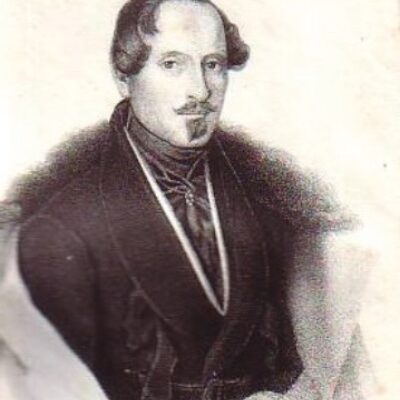
Born in 1805 in a village in the Saxony region of Germany, Döbel started his life by apprenticing in carriage workshops after primary education. In 1830, he embarked on the "journeyman's travel," which was mandatory at the time for gaining experience and seeing other workshops. Initially planning to go to Vienna, Döbel's journey extended to six years and reached the "Holy Lands." Working in each place he visited to cover travel and accommodation expenses, Döbel experienced many interesting events during his travels from Vienna to Edirne, Istanbul, Izmir, and the Near East. Döbel, who wrote letters to his family from the places he visited, was believed to have died since his last letter was from 1833, but he returned to his village in 1836. He published his memoirs of this interesting journey in Germany in 1837. The book, which became very popular, had two editions in the Netherlands in the following years. During his adventure-filled journey, Ernst Christoph Döbel passed through the Dardanelles in November 1832. Being of rural origin and not having received an intellectual education, Döbel's memoirs do not contain traces of Homer and his epics, which we see in other travelers of the period.
"Since the sea around Yenice is not very wide, we reached the opposite shore by evening, and the captain took on a new load, mostly consisting of walnuts. The shores were covered with forests of olive, pomegranate, and walnut trees, their colors ranging from light to dark green, resembling a painting. We set sail early the next morning, passing through the shelters of the archipelagos and around numerous rocks where only small ships could safely navigate, and on the third day of our voyage, we reached the entrance of the Dardanelles. From our ship, we could easily see the cannons of the forts on both sides. The sea was filled with ships, some heading towards Istanbul, but most, like us, were coming from Istanbul. On the side of the two islands, a town whose name I forgot was visible, and to the left, a mountain rose, its peak lost in the clouds, blocking the horizon.
We were surrounded by rocks rising from the sea in various shapes, and since we had moved quite far from the mainland, it was only on the eighth day, at two in the morning, that we entered the harbor of a fairly significant small town (possibly the town of Ayvalık opposite the island of Lesbos) to seek shelter from a storm that had arisen at night. I thought we had arrived in Izmir, but the captain corrected my mistake. There were many ships anchored in the harbor of this small town, and almost all nations had consulates here..."