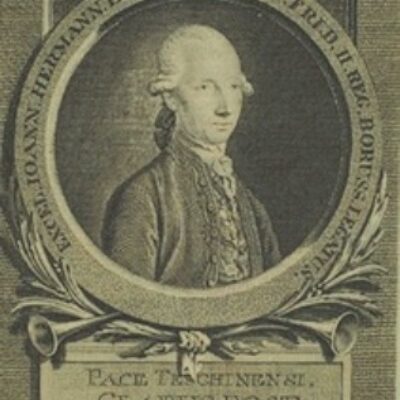
Chimenlik Castle on the Asian Side (1784, José Moreno) Born in Germany in 1740, diplomat and travel writer von Riedesel died in Vienna in 1785. Educated at home by a private tutor, von Riedesel studied law in Erlangen, Germany, from 1858 to 1860. Unable to become a soldier due to physical disabilities, Riedesel traveled to France and Italy with Enlightenment thinkers he met. During this period, his interest in classical cultures increased. He was greatly influenced by the scientific methods and aesthetic views of Johan Joachim Winckelmann, whom he met in Rome in 1763, and they maintained regular correspondence. In 1767, von Riedesel embarked on a journey to Italy to see classical works, and he published his impressions from this trip anonymously in 1771 under the title "Journey to Sicily and Malta." This book became his first significant success. In 1768, von Riedesel traveled first to the Mediterranean, Anatolia, and Greece, and later to Spain and Portugal. After returning to Europe, he rarely left Altenburg Castle, which he inherited, and in 1771, he took on the role of Prussian representative in Berlin. In 1773, he became Prussia's ambassador to Vienna. He died in Vienna in a horse accident:
"Description of Bozcaada (Tenedos):
This very small, fertile island covered with vineyards is famous for its wine, which is much loved in Istanbul (Constantinapol). There is only one castle on the entire island, situated on a rock, controlling the entrance to the harbor. Information about the origin of its name can be found in Pausanias's work (Book 1, Chapter 14). Some column remnants and some ancient monuments can be seen around. On the opposite Asian shore lies the ancient city of Alexandria Troas, and a little further on is the promontory of Siegeum, the first castle on the Asian side of what is now the Dardanelles (Çanakkale Boğazı). Here, on a plateau, a beautiful marble with an inscription was found, described along with other monuments from Asia in England. Unlike other travelers who run around the ruins, I did not set out to search for Troy: "Et Campos ubi Troia fuit" (These fields were once Troy/Vergil). I was told with certainty that there are a few Roman-era tombs and the ruins of an entrance or a passage gate here. Seddülbahir and Kilitbahir Fortresses on the European Side (1784, José Moreno)
The Simois and Xanthos rivers, which are not very large and dry up in the summer, would have been forgotten, like many other events that took place in these lands, if not for Homer's immortal poems. Alexander the Great was pleased that the immortality of this famous city's heroes was narrated by poets and artists. He wept because he did not have a poet to immortalize his future deeds...
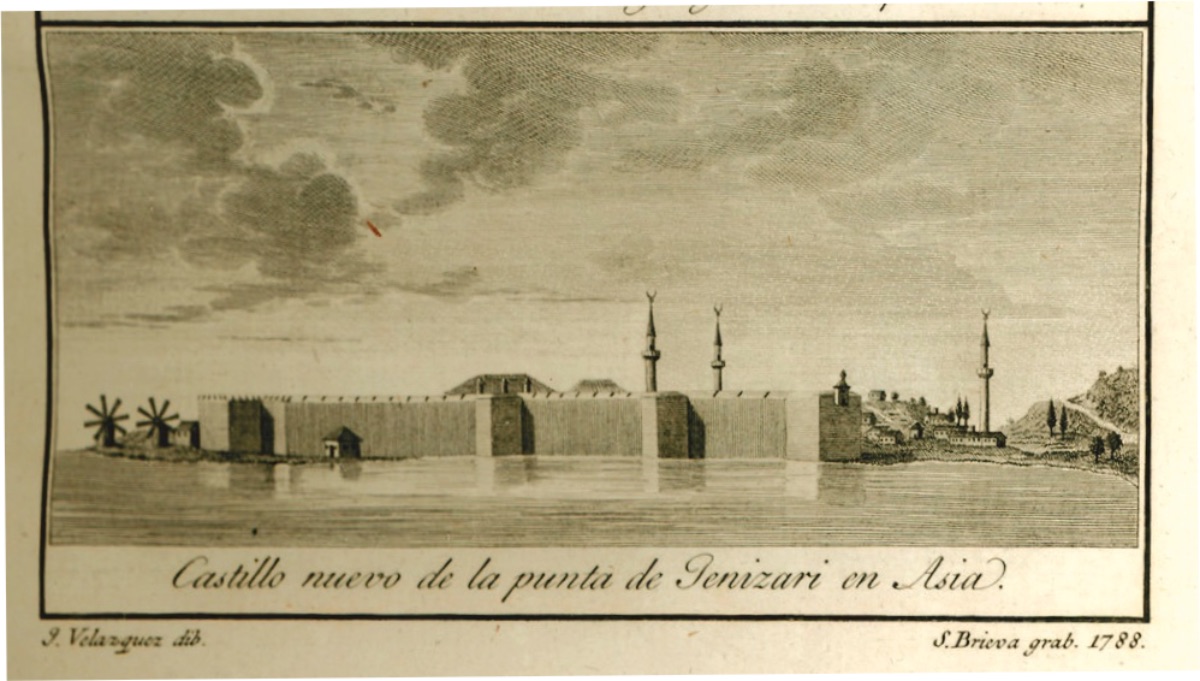
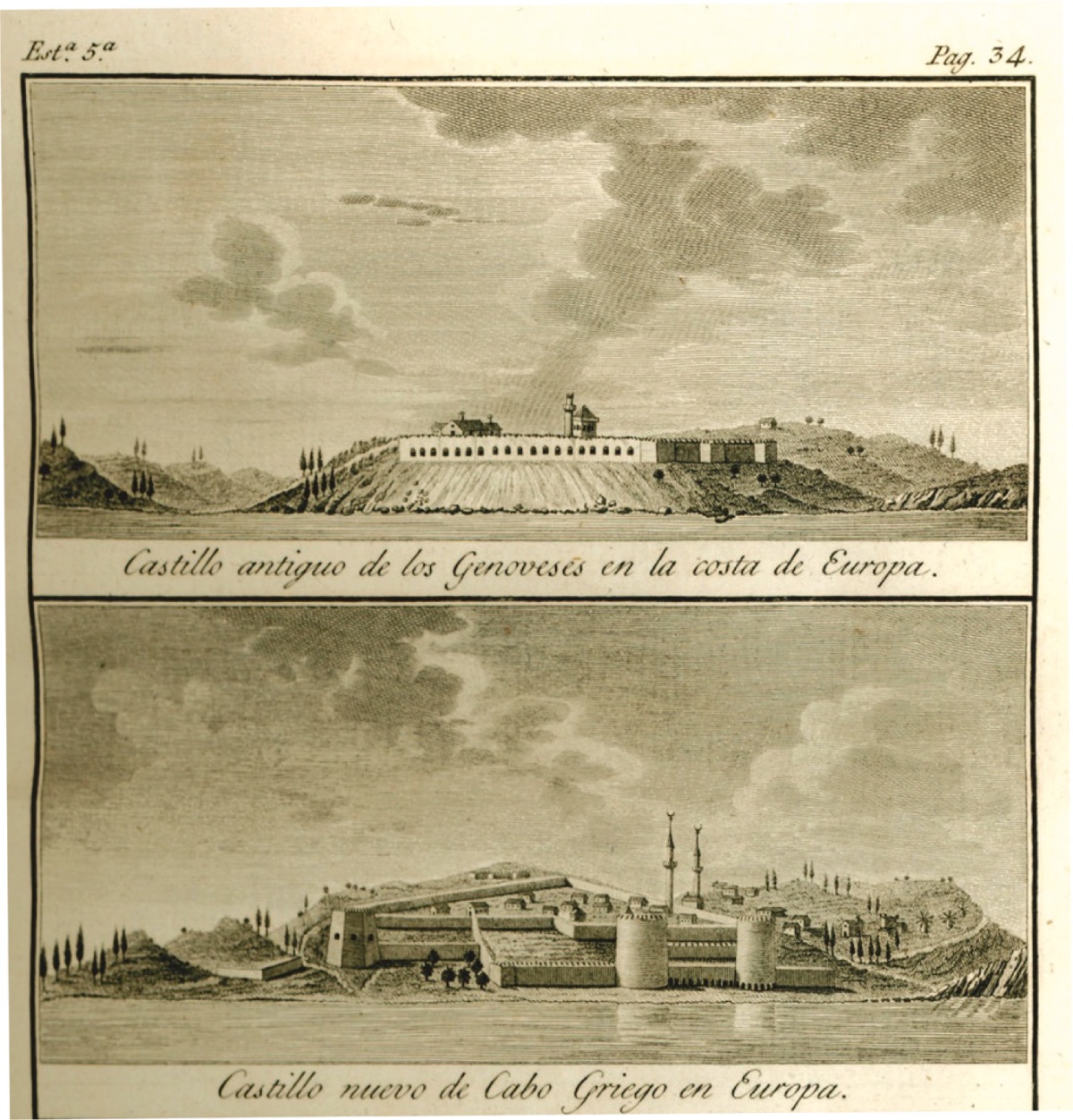
I am looking at the first castle on the European side of the Dardanelles (Hellespont), the old Hellespont. Contrary to the exaggerated accounts of some travelers, the entrance is not that narrow, nor are the cannons that large. The surroundings are very beautiful, but much more beautiful towards the Asian shore, and quite fertile along the strait. The second castles of the Dardanelles are established at the narrowest point of the Dardanelles (Hellespontus). Here are the ancient cities of Abydos and Sestos, where the unfortunate Leander, a victim of his love, lived. When Xerxes was leading his army across the bridge he built over the Hellespont, he became very angry when the waves destroyed the bridge. Inside the castle on the Asian side, a few broken columns and a round altar in Roman style can be seen. This altar is very large and solidly built. The French consul resides here. At the same time, many Greeks live here; the surroundings are very beautiful, and very good wine is produced. The castle, considered impassable by the Turks, can be taken with just two warships. All the cannons are at the same height as the water level. There are cannons forty steps long, and some cannonballs weigh one hundred and fifty kilos. From here, I saw Gallipoli (Gallipolli); it is quite a large city; it is located on the shores of what is now called the Sea of Marmara or the Mediterranean, Propontis. There are more Greeks than Turks in the city. It was the last city lost by the Byzantine Empire before the fall of Istanbul (Constantinopol). Suleiman I took the city in 1357. The ancients called it Gallipolis. On the opposite Asian shore is the settlement of Çardak (Chardat) where Turks live. Here is the ancient Lampsakos, which Xerxes gave to Themistocles to send him wine. The master sophist Anaximenes, who lived in the city, saved it from the wrath of Alexander the Great. For details, see Pausanias's Book 6, Chapter 18. In the surroundings, columns built in Doric style, most likely remnants of a temple, can be seen."