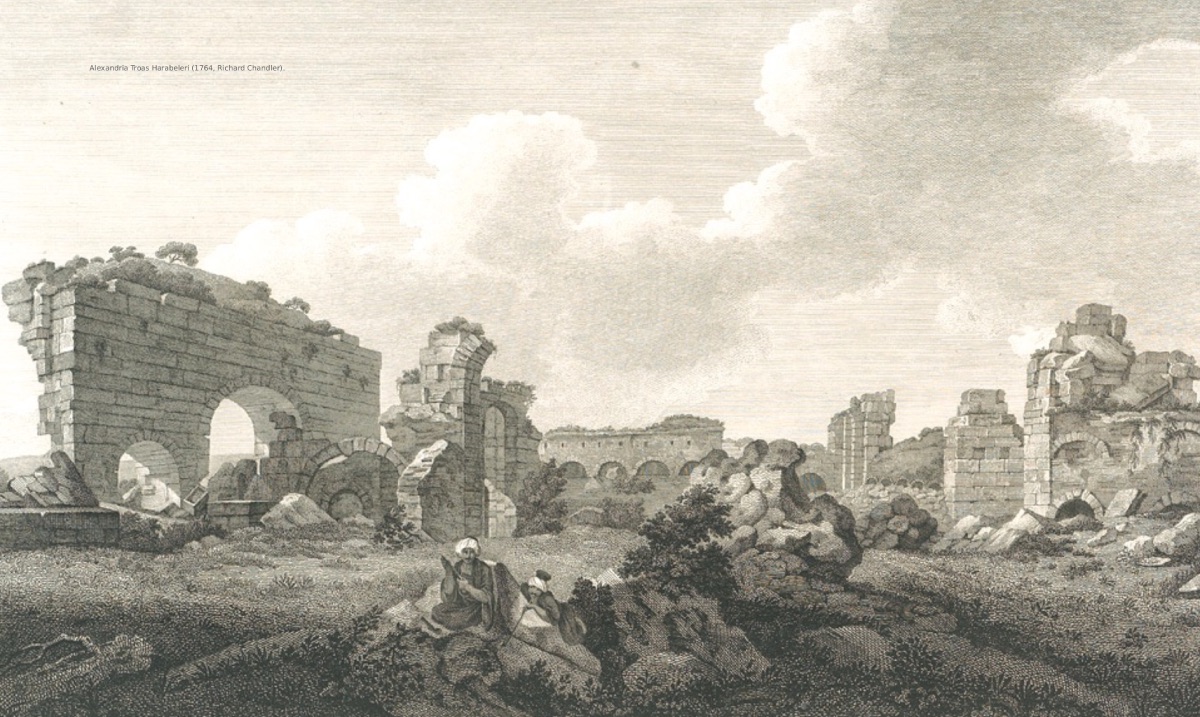
Ruins of Alexandria Troas (1764, Richard Chandler) English traveler and researcher Richard Chandler (1738-1810) was the first person sent to the Aegean by the Society of Dilettanti, an organization similar to a society founded by the wealthy and noble in London in 1734, to research Greek culture for the purpose of acquiring knowledge about the classical Greek and Roman antiquity culture. Chandler was chosen for this mission because he was recommended by Robert Wood, the most important Homer expert of that time, for this initial mission. Richard Chandler embarked on his journey with architect Nicholas Revett and painter William Pars. The sole purpose of the mission was to document and examine ancient artifacts in Anatolia and Greece. In June 1764, they set sail for the Dardanelles and the Anatolian coasts. Chandler's journey is considered the most important trip made for the culture of antiquity in the 18th century. However, Chandler approached the Turkish identity in a strict and sometimes prejudiced manner in his narratives, and he othered them:
"We are entering the Dardanelles, with Troas on our right and the Cherronese or Thracian peninsula on our left. We arrived at Yeniköy at six in the morning, opposite the Mastusia cape. They are scattered in a very narrow strait. Later, we passed two castles built by Mehmed IV in 1659. The one on the European side is higher, while the other is lower; both have settlements. The houses, elegant minarets or domes of mosques, cypresses, mountains, islands, and the shimmering water create an extremely beautiful view...
We see a wide plain surface, bringing to our eyes the war in the Iliad, heroes with their helmets, and we see the Karamenderes (Skamander) river, which has formed a sandbar at the exit of the strait...
We are now approaching the inner castles built by Mehmed II, guarding the quite narrow strait divided into two continents. Both have settlements, a white flag is hoisted on the Asian side, and on the seaside, there is a red flag with a cross mark. These belong to the English and the French...
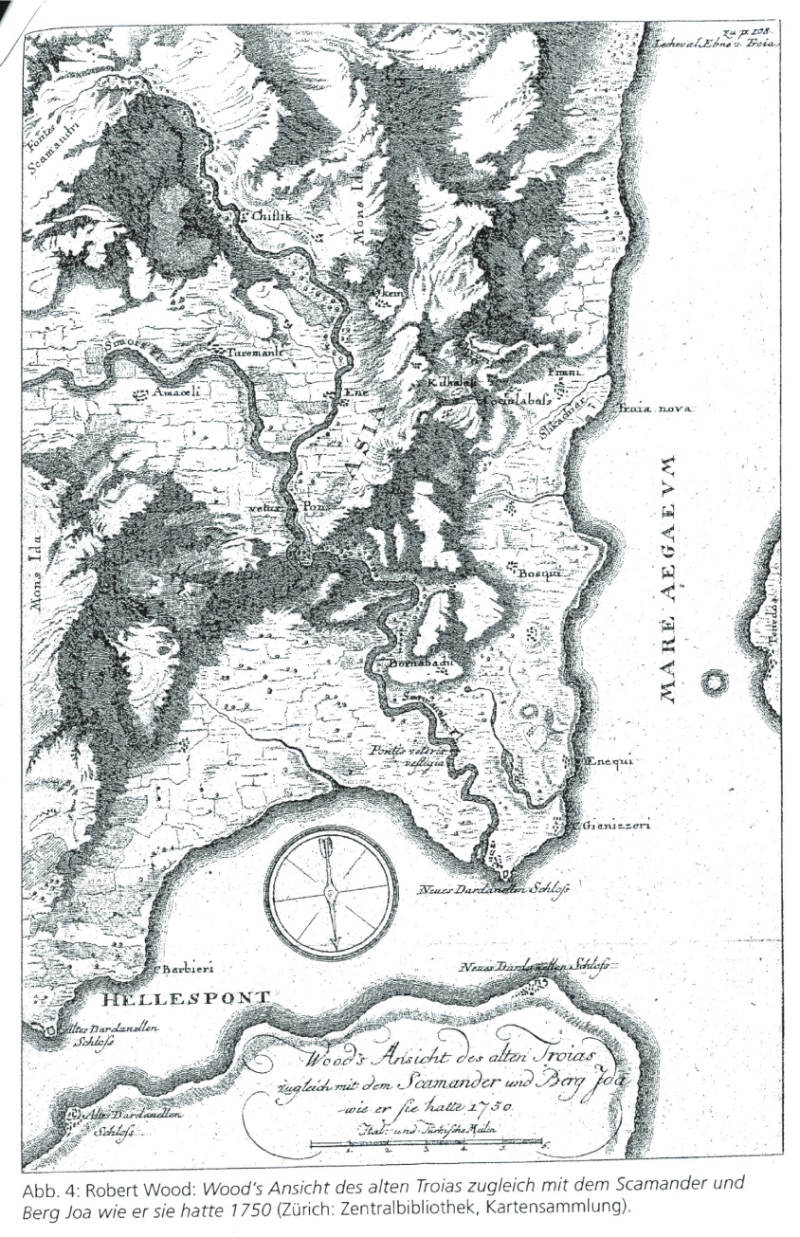
After disembarking from our ship Anglicana, we had plenty of time to watch the wild sailors in our boat, with bare arms and necks, their faces tanned by the sun, until we reached the shore. The current brought us below the castle, where we saw two Turkish women on the shore. But what types! Both were dressed in white sheets, with shapeless old shoes on their feet. A group of Turks gathered on the shore to look at the ship; as if watching a new type of human. They are generally large and tall; some have long, attractive, or respectable beards. Their large and noble appearances, long turbans, and loose garments in different vivid colors, the heavy clothes on them greatly contribute to their majestic appearances. The Dardanelles and Karamenderes Delta (1750, Robert Wood)
We were greeted on the shore by the English consul, a fat, good-looking Jew. After greeting us in poor Italian or French, he took us through the city to his house in the neighborhood allocated to people of this nation.
We climbed a few steps to a room with a double-layered floor, entered a room covered with carpets. Three sides were surrounded by a low sofa covered with cushions for leaning. A cool breeze was coming in through the wooden shutters. According to Jewish beliefs, it is forbidden to touch fire from Friday sunset to Saturday sunset; our host was anxious about our comfort. Nevertheless, shortly after, he brought a light tobacco pipe traditionally used for relaxation, stuffed a spoonful of sweets into our mouths, and offered coffee in porcelain covered with filigree to prevent hands from burning.
The Eastern sitting model with crossed legs was very difficult for us. But at dinner, there was a low, wide tray placed on the carpet. The food dishes were served quite hastily, followed immediately by a cup of wine. We had no plates, forks, or knives, we ate with our hands. The entire meal and everything around was antique. Later, the meal was completed with the best quality fruits, delicious figs, melons, and various types of grapes freshly picked from the vineyards typical of hot climates. The consul ate with us, but his brother and another Jew waited. When our meal was over, one of the servants brought a bowl and towel, they poured water on our hands. Then everyone was served coffee. Tired from the oppressive air, we went out to walk on the beach with our host and then to inform the governor of our arrival.
In the evening, we went out to tour the city with the consul. Most of the houses were wooden, and the streets were quite narrow. We saw a pottery factory that had not lost its importance; we think that the fashion of the jugs has not changed, and the old profiles and forms from ancient times continue. The location of the settlement is low, which is disadvantageous in terms of epidemics. Besides, the damage of the plague epidemic, which visits the residents here every year as usual, is remarkable, although the disease does not stay here for long. The elevated cemeteries widely surround the city; with many broken granite column pieces and marble fragments serving as tombstones, some have Turkish inscriptions carved, decorated, and painted on them. In the area of Armenian graves, we discovered a long Greek inscription. It was engraved on the surface of a white marble, but it is not legible. On the rocky elevation towards the Sea of Marmara (Propontis), there are many windmills.
To the south of the city and the castle, the river (Sarıçay) coming with great force from Mount Ida after snow and rains overflows its bed. A wide wall and a row of trees have been made to protect the houses during floods. At the mouth of the river, there is a sandbar like the Karamenderes (Skamander). The riverbed is wide and stony; filled with green bushes; but in the water-filled pits, women with troubled faces are intensely washing their laundry and laying them on the ground to dry...
We had agreed to continue exploring the nearby neighboring places in the evening. We planned to visit the islands near the entrance of the Dardanelles (Hellespontus). Early in the morning, the consul asked for money for food, drink, and other necessary things like a boat. He set to work between eight and nine. We had four armed Turks and a Jewish servant with us. The last two and the consul sat cross-legged on a small carpet in front of us; behind, the boat's captain controlled the boat with oars looking over their shoulders...
After passing the entrance of the harbor or bay, anciently named Morto Bay (Coelos), we landed on the Thracian peninsula around eleven.
In the settlement near the first castle on the European shores at the entrance of the Dardanelles (Hellespont), we went up to the very poor hut of a poor Jew. Here, meals were prepared in a room with a dirt floor covered with a cloth towards the seaside. The midday sun was unbearable. The consul, as always, slept; we also rested or enjoyed the view from the window. Below us was the sparkling Dardanelles (Hellespont). To our right was the Mastusia cape, opposite the Asian city and castle, the beautiful plain divided by the Karamenderes (Skamander), and the hills we mentioned earlier, two of which are not far from the shore, above Sigeon and not far away.
The ancient name of this average and very poor city is Eleus (Seddülbahir/however, the ancient city is now on the hill where the Çanakkale Monument is R.A), the streets and alleys are narrow and mixed. The north side of the castle extends along the coast to the cliff.
After we landed, the Turks rowed around Mastusia and waited for us without any incident. After resting a bit in the governor's garden, they pulled the boats ashore and leaned them against the castle walls. We saw a large Corinthian column and an ornate altar, hollowed out for grinding corn. At the end of the other side of the town (Seddülbahir), there is a bare hill. This place has long been accepted as the sacred ground of Protesilaus and most likely the temple to which the marble pieces belong. Protesilaus, killed by Hector, was one of the most important soldiers in the Trojan expedition. After his death, he was revered as a hero and became famous as the protector and heir of Eleus...
We then planned to go to Limni (Lemnos), but the contrary wind drove us to Bozacada (Tenedos).
Bozcaada (Tenedos) is a rocky but fertile island. In ancient times, its circumference was calculated as eight stadia or ten miles; its distance from Sigeum is twelve and a half miles. Due to its location very close to the entrance of the Dardanelles (Hellespont) and being a safe harbor where ships going to Istanbul (Constantinople) could take refuge and anchor in bad and windy weather, it has been very important since ancient times. Emperor Justinian had a building constructed with large warehouses where grain from Alexandria would be stored. This building was ninety meters long, 25 meters wide, and a very tall building. Thanks to this warehouse, ship voyages from Egypt were carried out without leaving it to chance, and the grains in the warehouse were delivered to the capital. The turmoil in the Greek Empire caused some bad events to occur here as well. Pirates, who made these seas unsafe, nested here for many years. This situation continued until the Ottomans took it in 1302 (this date is incorrect R.A.) and brought the surrounding islands under control with their ships.
The harbor of Bozcaada (Tenedos) was surrounded by a wall, but no remnants of this wall can be seen above the water surface. Only the foundations of this wall have been filled with stones to function as a breakwater. The harbor is backed by a hill, and to the south, many windmills and a battery are visible.
Opposite, there is a castle. This castle was taken by the Venetians in 1615 after a four-day siege but was abandoned in a very poor condition shortly after. The numerous houses are located at the foot or on the slope of the hill. The area in front of the houses has been filled with earth thrown into the sea. It is estimated that 600 Turkish and 300 Greek families live on the island. The Greeks have a beautiful church.
We did not find many remarkable ruins on the island. When we arrived, a large and solid sarcophagus now used as a fountain caught our attention. The top stone or lid had a hole, and water was flowing from it. There is an inscription on one side of the sarcophagus. A little further on, we saw a column piece with channels where grain was pounded; in an old ruin, a floor was uncovered. In the streets, walls, and cemeteries, we saw many marble column pieces and a few inscriptions.
On Sunday evening, we sat with the Greeks of the island at a festival; a mixed group was playing music and dancing a little further away. The women were clustered on the flat-roofed houses, watching them, while also enjoying the sweet air and beautiful sky. We were very pleased with the room we stayed in. It was very tidy, we slept in our clothes. Throughout the night, a cool breeze blew through the window bars, making the silence even more beautiful. In such countries, people get up in the dark of the morning due to the heat. In the early hours of the day, we received freshly picked grapes and other fruits sent as a gift by the French consul with a Greek with a long and impressive beard. For breakfast, in addition to bread and coffee, they also brought a wonderful wine called muscat, which had a very nice taste and smell. The island is famous for the grapes from which this wine is made.
Although with some delay, we boarded the boat and set off from Bozcaada (Tenedos) harbor, leaving the island on our right. Around ten o'clock, we landed on a beautiful beach; we had covered almost half of the island.
Now, we are next to a structure on the north of the island that we plan to investigate. A small arched room is visible, as if ancient walls under a ruined church. A few steps lead inside with the help of light. The floor is covered with water. Next to it, there is one or two fig trees and a fountain with a modern Greek inscription placed inside its wall...
We ate, slept a bit in the shade; shortly after, the French consul came to pick us up. Around two in the afternoon, with a strong wind, we steered towards Old Istanbul, anciently named Troas and Alexandria Troas. The distance from Bozcaada (Tenedos) is about forty stadia or five miles. Some ruins can be seen impressively; the magnificent Mount Ida with its irregular summit covered with trees in the background...
The Troas harbor we approached is semicircular and surrounded by a hill and filled with ruins. Many small granite columns stand upright, some half-buried, and most of their surfaces have been eroded by weather conditions. Most likely, ships were tied to these with ropes. The sand platform at the entrance cuts off its connection with the sea, the small harbor is dry. There is water in the large harbor but it seems shallow...
The beginning and end of its ruin are most likely before the disappearance of the Greek Empire. Many houses and public buildings in Istanbul (Constantinople) were built with its materials after this period. We only found a few insignificant white marble pieces scattered throughout the entire ruin. Some pieces in the harbor, two of which seem to have been brought there to be loaded onto the ship. The depot is now completely depleted. The name Troas has not been used after 1389...
We turned from Kemallı to the vineyards. Our aim was to quickly distance ourselves from the dangerous bandits that emerged due to the unrest caused by our presence here. We hurriedly boarded the boat and began to travel along the Troas coast in the dark. After rowing five miles, we landed and slept on the shore. The magnificent night turned into a more terrifying melancholy with the howling of jackals roaming in packs, presumably to hunt.
Three hours before sunrise, we set off again and reached a striking rocky shore by seven. We then landed at Enekioi or Yeni Köy. The village is so poor that we could not find grapes, wine, eggs, or oil to fry them for our breakfast. It was once important, built on a high place. At the church door, there is an inscription belonging to a Latin tomb. Pliny mentions the existence of a village named Nea or Yeni Köy in Troas, perhaps it is there. There was an image of Minerva (Roman period goddess R.A.) on which no rain had fallen. As it is said, it has never aged after being abandoned here.
We left Yeni Köy (Enekio) and arrived at a non-Hellespont shore at midday. Not far from Sigean cape, and with steps, we reached Gavurköy (Giaurkioi), a Greek village built on the site of the once Siegeum city. High from the sea, it now resembles Yeniköy (Enekioi) both in misery and location. They gave us a small place in a country house for accommodation; but warned us not to fall from the floor. The owners of the house were very poor. In the courtyard, a woman was crying and lamenting softly; we wanted to know why; they told us that the villagers had to pay piaster (currency of the period / kuruş R.A.) to keep pigs. The Turk collecting this money for the Ağa was asking for ten pereaus (currency), and since they could not afford to pay it, he was going to take their son to prison.
On the high hill of Yenişehir (Gavurköy Giaurkioi), there was the Sigeum castle. On the slope, facing Mount Ida, the Atheneum settlement or the main church encompassing the Minerva temple with marble remains scattered around. The famous Sigean inscription stands on the right, and on the right, there is a pedestal of high-quality white marble; both are used for sitting... A marble found within the same building and standing near the temple is now located at Trinity College in Cambridge... In 1718, it was taken by the pope or Greek priest and sent to the ambassador Edward Wortley Montague in Istanbul. The place where this piece was removed from the wall can still be seen...
From the slope of the church (at Sigeum), we could see many small hills and a wide plain, except for cotton fields, the scorched reddish-brown fields... Here, it is necessary to state the fact that Ilium or New Troy is at the intersection of two rivers, and the fact that the Dümrek Stream (Simois) river, mistakenly confused with the Karamenderes (Skamander) river, is the river closest to Sigeum and Baba cape or Lectos...
According to a widespread rumor, the consul who left us at Bozcaada (Tenedos) was attacked by bandits on the way to Gelibolu. When we returned to the village, this rumor was confirmed, our Jew was suffering greatly. He set off with his men from Çanakkale (Dardanell) by boat, as usual, they approached the shore for dinner, bandits suddenly attacked them, and quickly overcame them. As I said, the consul fled towards the water up to his chin, but they continued to shoot at him, he was severely injured...
Early in the morning, we set off from the hill where Sigeum is located, to board our boat waiting for us at Kumkale (Chomkali), half an hour away from Gavurköy (Giaurkioi/ Yenişehir). After walking for eight minutes, we reached between or surrounded by vineyards. One was the tomb of Achilles and Patroclus, the other on our right was the tomb of Nestor's son Antilochus...
The village of Kumkale, compared to the miserable villages we saw before, is in better condition; but it is not very large. While our men made the necessary purchases, we slowly tried to find a coffeehouse. In the streets, we saw two column capitals hollowed out to eat wheat. Sarcophagi and ancient tombstones are used as water reservoirs. One had an inscription that was too damaged to read. All these pieces were brought from nearby ruins, even Kumkale (Chomkali) and the modern castle were built from these stones."