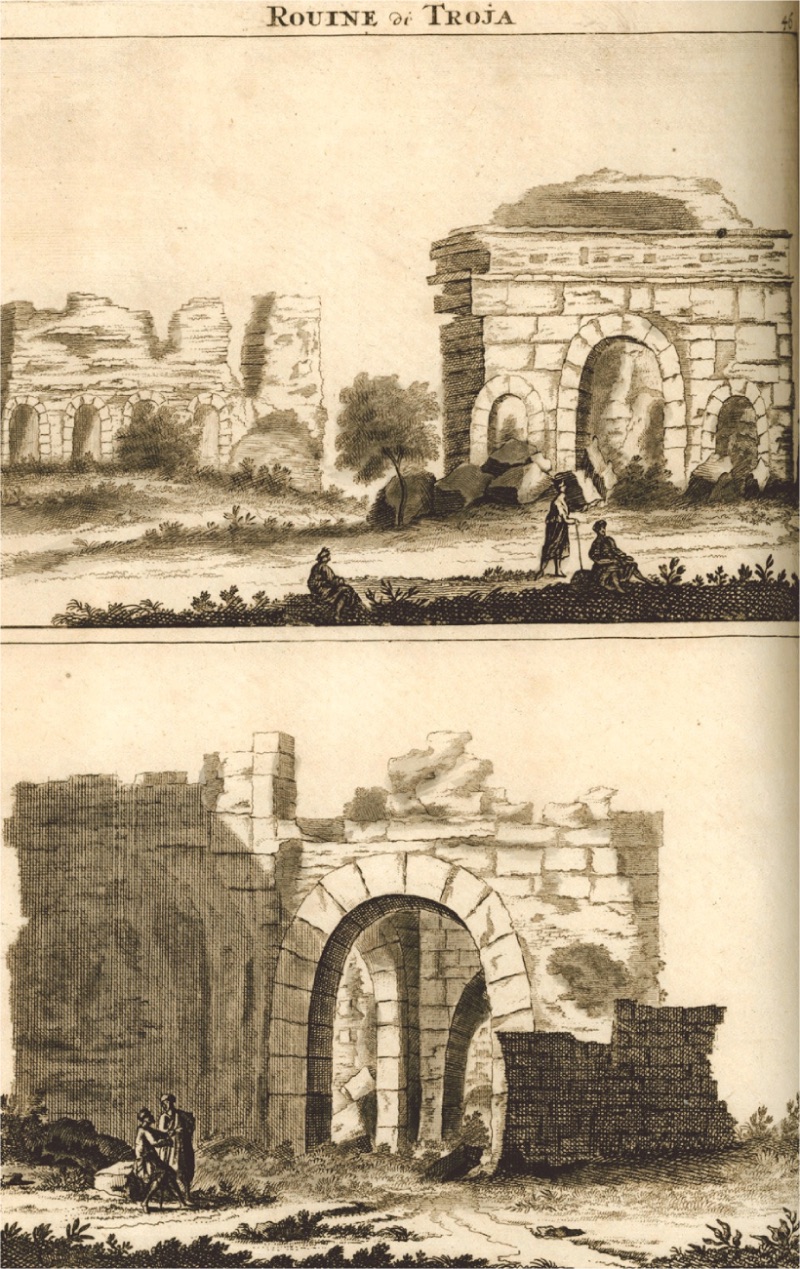
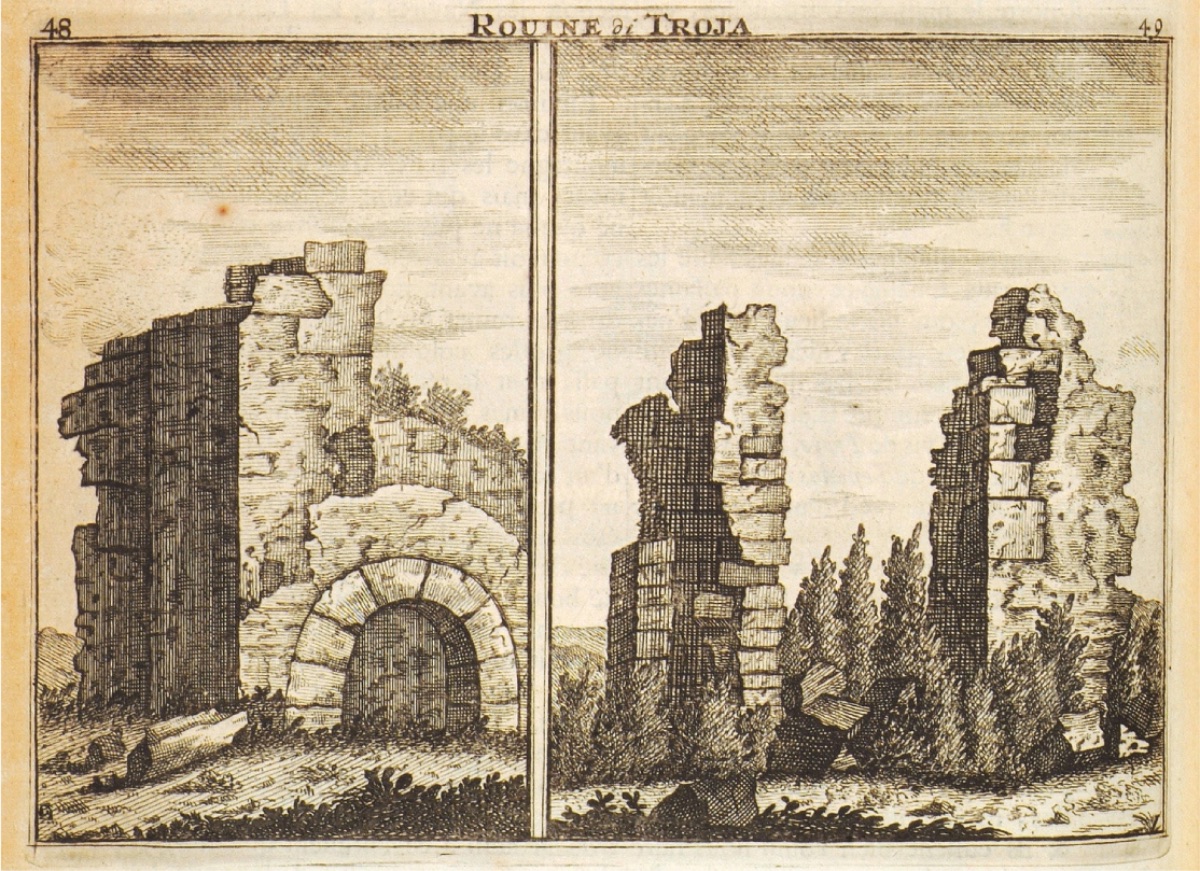
Ruins of Alexander Troas Believed to be Troy (1714, Cornelis de Bruyn) P. Angelicus Maria Myller is a German monk from the "Ordens der Diener Unser Lieben Frauen, Bohmischer" order. In 1718, during his pilgrimage to Jerusalem, he passes through the Aegean islands and lands on many of them to speak with the islanders. During this journey, he stays in Bozcaada and makes trips to Alexandria Troas, which was believed to be Troy at the time, and the Dardanelles. In 1726, he publishes his travel memoirs under the title "Peregrinus in Jerusalem" in Vienna and Nuremberg. Other editions of this work are published in 1729 and 1735. The admiration for Greek culture of the period is quite evident against a theological background:
"On July 13, at sunset, we reached Bozcaada (Tenedos). This island is one of the islands under Turkish rule, inhabited by Turks and Greeks; it is 10 miles long and 5 miles wide (approximately 1500 meters R.A.) with a settlement of the same name; it is about 10 miles away from Troy near the Anatolian coast and not far from Capo de Janizari (Yenişehir Burnu/Sigeon/ R.A.).
It was formerly known as Leucophris, and the name Tenedos comes from Tenes, the son of Eneni, who lived in the city of Troy for a while. According to what is written about Tenes, when accused by his stepmother, his father throws him into the sea to kill him. However, the waves carry him to the shore; he becomes famous for surviving, and the island is named after him. But later, Tenes is killed by Achilles in the Trojan War. Those left behind are so saddened by his death that they build a temple on the island in his honor.
During the Trojan War, the Greeks stayed for a long time in the harbor of Bozcaada (Tenedos); they hid their ships here. From here, they went to attack the city of Troy and conquered it... Tenedos was very famous and wealthy during the time of the Trojan king Priamos and Laomedon. But much later, it became famous not only because of the Trojan War but also due to the conflict between the Venetians and the Genoese. In 1655, the island was taken by the Venetians for the last time. However, the Turks soon captured it. The island is still under their rule; they call this island Boge adahlen or Bonchaadda (Bozcaada) in Turkish. There are flat lands in the middle of the island. However, the area where the harbor is located is surrounded by hills; very good wine is made here, along with many different oriental fruits. Ruins of Alexander Troas Believed to be Troy (1714, Cornelis de Bruyn)
On July 14, there was a rather strong west wind. Due to this wind, which is very suitable for sea travel, we set sail from Bozcaada (Tenedos) towards Anatolia, Asia Minor...
In the evening of the same day, we reached Troy (Alexandria Troas. R.A.) without any accidents. But we waited a bit to protect our ship from the stormy west wind...
Later, we had not even walked forty steps towards the fields on land when we saw a very beautiful plain. Here I saw that the soil was black and ashy. But beyond that, I made holes in different places with a tool I had. Together with my companions, we were astonished to see that the soil was quite blackened, as we had seen in burned cities and burned farms. I brought a piece of this soil to Europe.
Later, we saw many Turkish peasants working in the fields in the same Trojan fields. We approached them to get more information about this region and the products in the fields. They welcomed us so obediently that they shared much information about the lands of Troy with us. But at the same time, they gave us many products like Turkish watermelon from their fields. They also wanted to guide us to discover some things..."