
"(During the Ottoman-Venetian War of 1645-69 due to the island of Crete, the Venetians attempted to block the Aegean entrance of the Dardanelles to prevent the Ottoman Navy from reinforcing the land forces trying to completely conquer Crete, leading to fierce battles in the Dardanelles. The Venetians captured Bozcaada in 1656, but the Ottoman navy recaptured the island in 1657)." "On the ninth, we departed from the island of Mytilene with a good wind and reached Monta Sante or the Holy Mountain (Ayvalık Şeytan Sofrası?, R.A.) in two days: This hill, our savior (according to the belief of devout Romans), showed all its earthly beauties when forced by the devil.
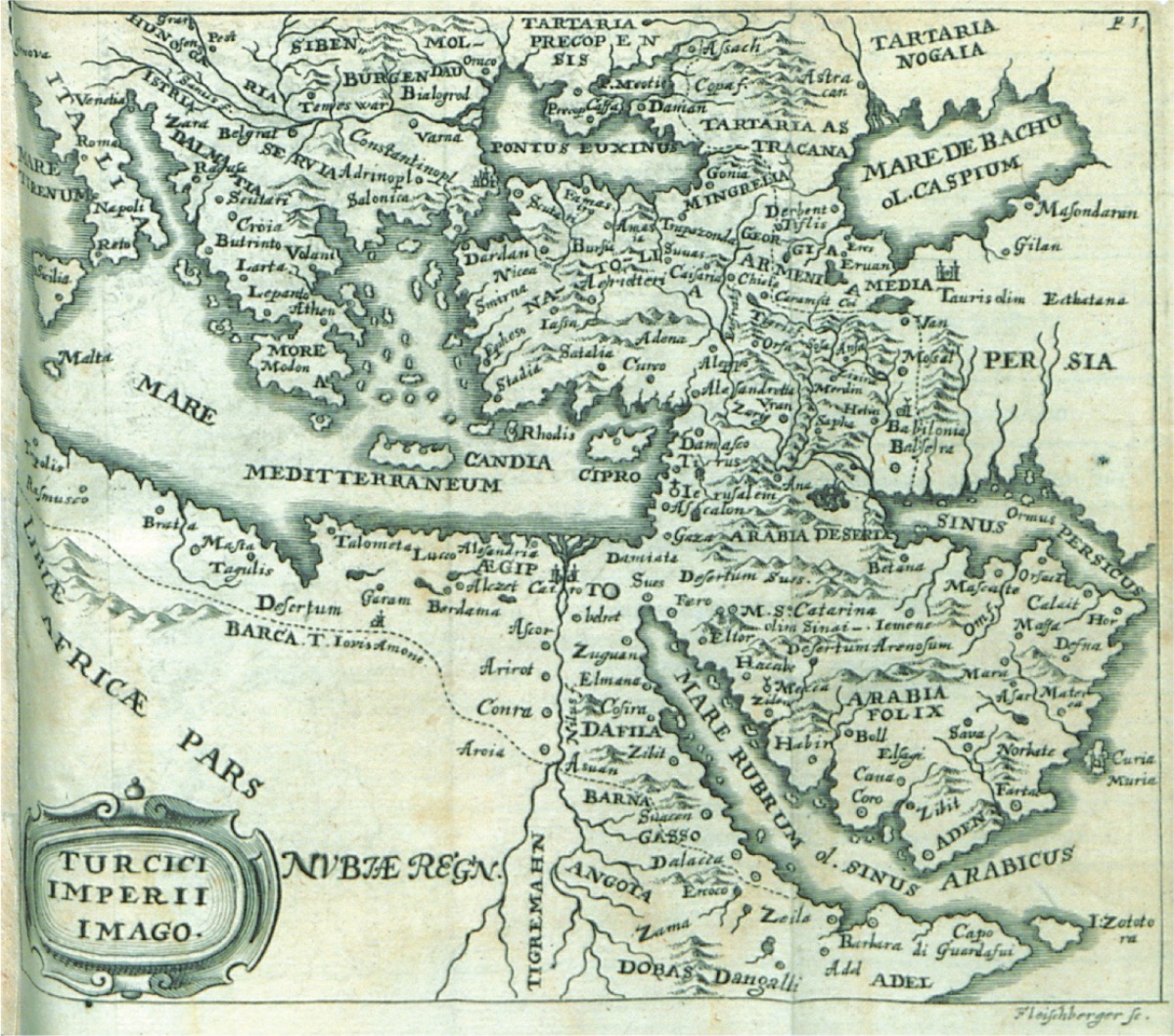
On the twelfth, we set sail towards the waters of Constantinople; we saw the Venetian ship off the coast of Troy; although we could not decide exactly where the famous Troy, which we read so much about from the ancient poet, was; everything visible here looks quite old. The city gate made of white marble and the foundations of walls surrounding the city seven times with a small village; however, not in a circular shape but more like a snake, or like a tower (most likely the aqueducts of Alexandria Troas are being described here, R.A.). There are some pits and red soil towards the sea; this was formerly dug by the Turks to control the Propontis (Marmara Sea) or the Constantinople channel (the writer confuses the Aegean with the Marmara here, R.A.).
On the fourteenth, we prepared again, and I was on the Little Princess ship.
On the fifteenth, we saw the Bey's warships, they saw us standing in the strait and rowed towards the Greek coast, there were 22 of them when they stood together.
On the sixteenth, an English ship named Miedleton from Sante brought bread, oars, and ammunition for the fleet, but when approaching the Dardanelles, it was violently attacked by Turkish galleys. When we heard this, we did everything we could to help them, but the weather was so calm that the sails were stuck to the mast. Meanwhile, the Turks were attacking the English ship intensely; the English were bravely defending themselves. After a few hours of conflict, when the Turkish fire hit the hull of the ship, the English realized the deck of the ship was shattered and thus the ship was burning. Despite this, even when the main mast began to burn, they did not cease their counter-fire until the ship began to sink and they started swimming; they preferred to burn or drown rather than surrender or dishonorably hand over the ship. Nevertheless, the Turks tried to capture as many as possible to enslave them. There was also an English woman known as Penters, the owner of the Entertainment Club in Venice, on the ship; many of our countrymen were very saddened to hear of the death of this woman who did much good for the distressed English and Dutch. The Midleton ship had 30 cannons and 60 crew members, of which 40 drowned and died. We were able to gather them an hour and a half after the battle. Later, in the Dardanelles, we learned from the slaves we employed that more than 500 people on the warships were killed and more were wounded.
While anchored at the entrance of the channel and standing defenseless before the Dardanelles, most of our men were suffering from scurvy infection and were in need of fresh water. The only water source we could obtain was from the river of Troy, which required great effort and risked our lives. The Turks were hiding in numerous secret pits, waiting silently and surprising us. Due to my bad luck, I and 7 other friends were sent with a boat to fetch water. We arrived at Troy, saw very rich vineyards from afar. Longing for refreshment for a long time, we drew lots to decide who should go to pick grapes, and I was chosen. Without wasting much time, I set off along the open shore, there was no one in sight. I bravely climbed up and began picking with both hands. While doing this, I heard a noise, and when I turned around, I saw Turks running towards me from the many hidden places between me and the river. Our men had just reached the shore and were trying to fill their barrels with water. Seeing the enemy, they quickly returned to the boat waiting on the shore, using the weapons on the boat to distract the Turks until everyone got the boat moving, thus managing to escape.
Meanwhile, I was stuck there and had buried my head among the vines. Looking at the road ahead, I realized I had no hope of reaching the seashore. I began to think about what to do next and, anticipating that they could be quite ruthless when they captured me, I decided it would not be wise to resist against so many men. When they came to understand what kind of a fool they had captured, it didn't take long for them to realize that garlic was ready to ward off the ghost of fear. They first took me to a small village where Troy once was (this should be the village of Yenişehir just south of Kumkale (Sigeon- R.A), and then to the fortress they built facing each other to control the entrance of the Dardanelles. Here they put me inside a warship, stripped me of my clothes, cut my hair, and sat me in front of a long oar. There was enough work to keep us occupied here, and they only gave me a linen pants to keep me from being naked. They chained me with a Russian who had been on this ship for 24 years; all foreigners were from Venetian warships and had been on this ship all their lives, with no chance of rescue. When I came to my senses, I began to think about the mistakes I had made and realized I would have been happier picking beets and cucumbers in Durgerdam (the town in the Netherlands where Struys was born, R.A) than picking grapes in the vineyards of Troy.
No voice can fully describe, nor can any pen fully write, how inhumane and barbaric what was done to us was. The guards of this warship were notorious as the most brutal among all ships, yet we gave quite a diligent impression; we were sure that our bare ribs would be whipped when we sat down. If someone hid, they were unjustly sacrificed, and when a scream and shout were heard, some were punished for carelessness, some for laziness. However, the Russian kept saying that we should escape, but obstacles kept arising one after another, and at the same time, the coast was very closely watched by the Turks. The Russian had tried to escape many times, but each time he was caught, and neither his nose nor his ears remained. These punishments frightened me, I didn't have that much courage. But one day, what they said in a row encouraged me greatly: Look, brother, which is better, to remain a slave forever, or to escape if you can? Choose the more fruitful situation, and we should try this way, I am sure I will receive the harshest punishment, but at worst, you will get a hundred lashes on your soles. This fact, they told me if I tried to escape again they would burn me, and I am detained, but I would rather try to escape than live every day under the whips of these hellhounds and endure the thousands of tortures you have seen.
After enduring this situation for six weeks, we found the opportunity to escape from this miserable slavery: To gain our freedom in the water, my friend chained with me first went far on land and returned quietly, and we did this 2-3 times; thus we prevented suspicion, the last time we were quite far from sight, thus we accomplished half of our plan. When night fell, it started to rain, we were in a sheltered place inside a rock, my friend lit a fire and we could see ahead, after some effort we freed ourselves from our chains. The night was quite dark, which was an advantage for us, so we reached the shore an hour before dawn, we could see all the tents.
It was a very rainy and stormy night, the guards had not left their places, so we could pass through them without any control; we started swimming before the checks began. However, it didn't take long for them to suspect, but since the water was very salty, it was not easy to ignite the last powder they had like fire. Therefore, they shot their long arrows from the bow of the ship. The arrows passed by our noses, sometimes staying in the water, until the last one hit the Russian's body. Despite this, we swam out of the line of fire, the poor man was crying out in pain, "leave me alone with this arrow, leave me alone," he said. Thus, together, we swam two leagues (1 league approx. 5.6 km) to where the Venetian warship was; the current was on our side. When we reached the ship, we were taken aboard the Amraham Offering galleon, the arrow in the Russian's body was removed, the arrow that hit the bone caused him great torture until it was removed, it was a harpoon with eight hooks. But despite this, thanks to the very skilled surgeon, his wound healed quickly. We are grateful to God for taking him from the hands of tyrants and giving him to us, for protecting us in dangerous storms, and for bringing us among Christians."