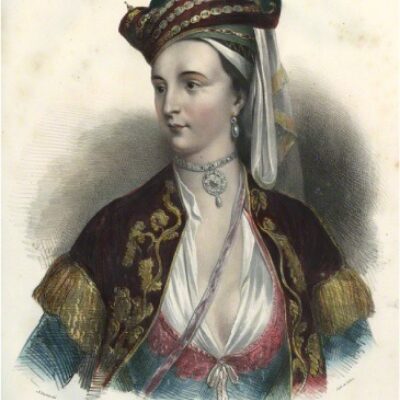
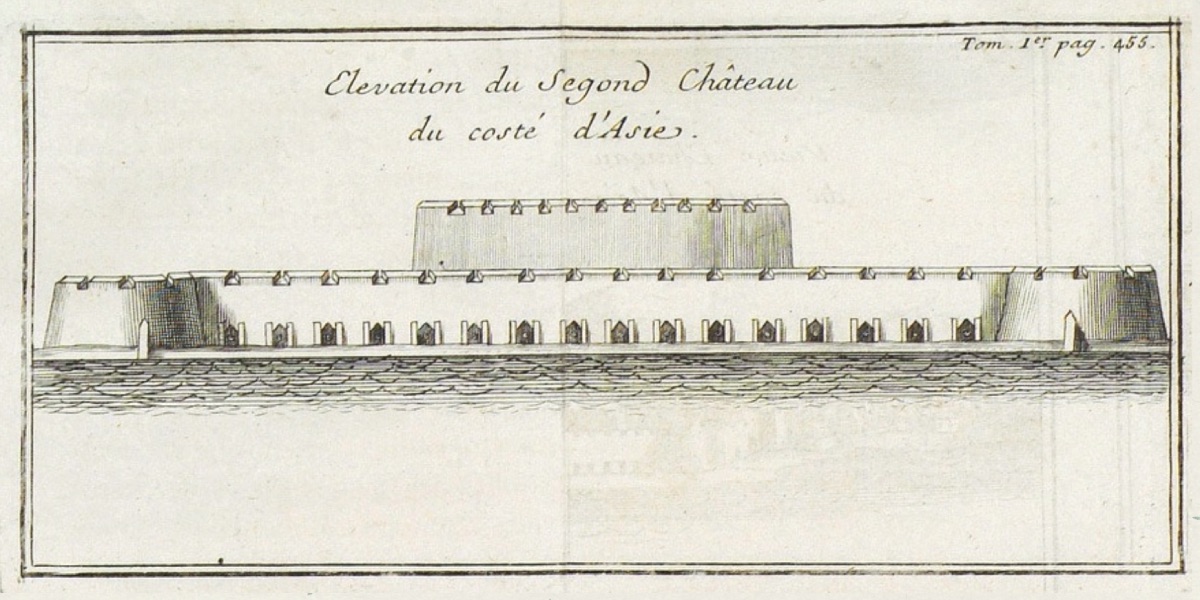
Çimenlik Castle (1717, Joseph De Tournefot) Mary Wortley Montagu (1689-1762) is one of the most famous English female poets and writers of the 18th century. She comes from a noble family. She falls in love with Edward Wortley Montagu, a politician 11 years her senior. Despite her family's opposition, she marries Edward Wortley Montagu in 1712. In 1716, when her husband is appointed as the British ambassador to the Ottoman Empire, Lady Montagu comes to Istanbul with her husband and son. During this period, coinciding with the beginning of the Tulip Era, she spends two years in Istanbul. She writes many letters to her friends in England, describing her impressions of Istanbul in great detail. In 1718, she returns to London with her husband and becomes a sought-after member of society. She writes stories and articles on various topics. She engages in public debates on various issues with other nobles. Due to some of her views, she is considered one of the early advocates of feminism. Lady Montagu had suffered from smallpox, and the marks of the disease were visible on her face. Observing that the smallpox vaccine, not yet available in England, was widely used in Istanbul, Montagu immediately had her two children vaccinated there. Through her letters from Istanbul and her personal efforts after returning to London, she introduced the smallpox vaccine to the English. She praises Ottoman civilization and describes the value Ottomans place on women:
"July 31, 1718:
I left Istanbul on the sixth of last month. Despite all my desires to share with you the pleasure of my journey through the most beautiful part of the world, the first port where I could finally post a single letter was Tunis. In the most beautiful region of the world, every scene reminds one of a poetic view:
Burning with poetic enthusiasm,
I watch the immortal islands and the famous sea.
Often, while the muse strums her harp here,
The song of all the rising mountains was sung.
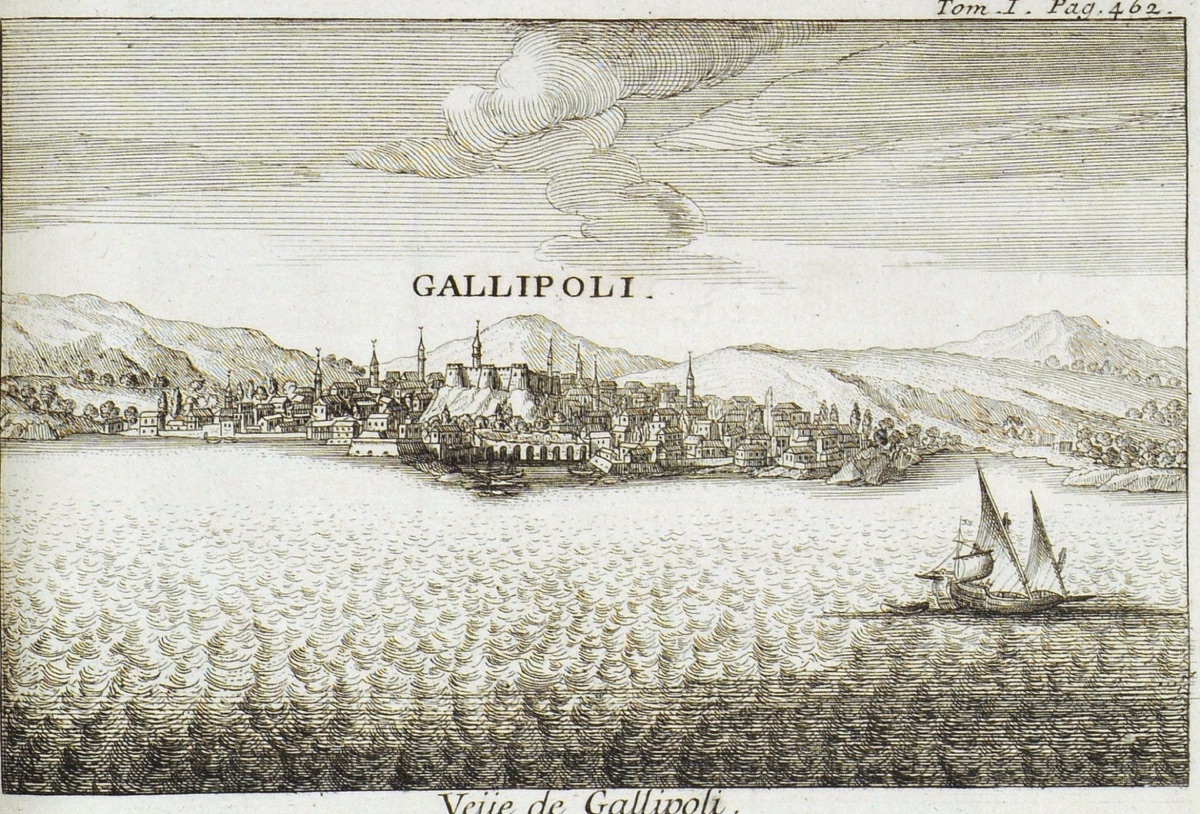
I apologize to you for this poetic madness. If possible, I will continue the rest of my narrative in prose. On the second day, after donning my veil, we passed by Gallipoli, a beautiful city established on the Gulf of Chersonese, which they respect for being their first conquest in Europe. The next morning, on the fifth of the month, we anchored in the Hellespont, now called the Dardanelles, between the castles of Sestos and Abydos. Here, there are two old and insignificant castles. They dominate the hills. If I hadn't heard our captain and officers mention them, I wouldn't have paid attention to these ruins. My mind was on the tragic story you know so well.
The swimming lover and the bride of the night,
The loves of Hero and the death of Leander.
Verses again! I have certainly caught the poetic air of the places I passed through. The air of Abydos is undoubtedly filled with love. It is this sweet passion that, during the siege by Orhan, betrayed the castle into the hands of the Turks. The governor's daughter dreamed of her future husband (I couldn't find out if she put a wedding cake under her pillow or fasted on St. Agnes' Day) and mistook one of the attackers for her lover. Willing to submit to her fate, she throws him a written note. The man shows the note to the general. The general, willing to test her sincerity, orders the young man to return at midnight with a select group of warriors and withdraws his army. At the appointed hour, the young girl lets the young man into the castle. The man slaughters the garrison, captures her father, and marries the girl. This city was once the capital of the Gallipoli peninsula on the Asian side. Since I saw the strait, I no longer find Leander's adventures so real nor the decks of Xerxes' (son of Darius, Persian king) ships so extraordinary. Gallipoli (1717, Joseph De Tournefot)
The strait is so narrow that it is not surprising for a young lover to attempt to swim across it or for a king to try to pass his army over it. Knowing that storms occur frequently, it is not surprising that the young lover was lost and the bridge destroyed. From here, we have a beautiful view of Mount Ida.
Where Juno once caressed Jupiter,
Where the master of the world submitted to love.
A few miles away, I saw the piece of land where poor old Hecuba is buried. A league further, there is the famous Cape Sigee (New City Cape). We anchored here, and my curiosity gave me the strength to climb the hill to see the site of Achilles' tomb. To pay his respects, Alexander ran around the hill naked and undoubtedly consoled himself with his shadow. I saw the ruins of a very large city and found a stone on which Mr. Wortley very clearly remembered the words "City of Sigee." We ordered the stone to be taken to the ship. However, despite his ignorance, which did not allow for an explanation, a Greek priest brought us other attractive stones. On either side of the door of the small church, there is a huge stone almost ten feet long, five feet wide, and three feet high. On one face, there is a beautiful sculpture forming a relief. It shows a woman, undoubtedly a goddess, seated on a pedestal chair. A woman in tears presents a small child she holds in her lap to her. This is followed by a procession of women carrying children in the same manner. This is certainly a very ancient tomb. However, I do not dare to attempt a good explanation. On the stone on the left side, there is a very beautiful inscription. I am sure I copied it accurately. However, the Greek is too ancient for Mr. Wortley to translate. I am sorry not to have the original of this inscription, which we could have bought cheaply from the poor people. But our captain convinced us that it was impossible to move the stone to the sea without a specially made machine and that it could not be placed on his boat.
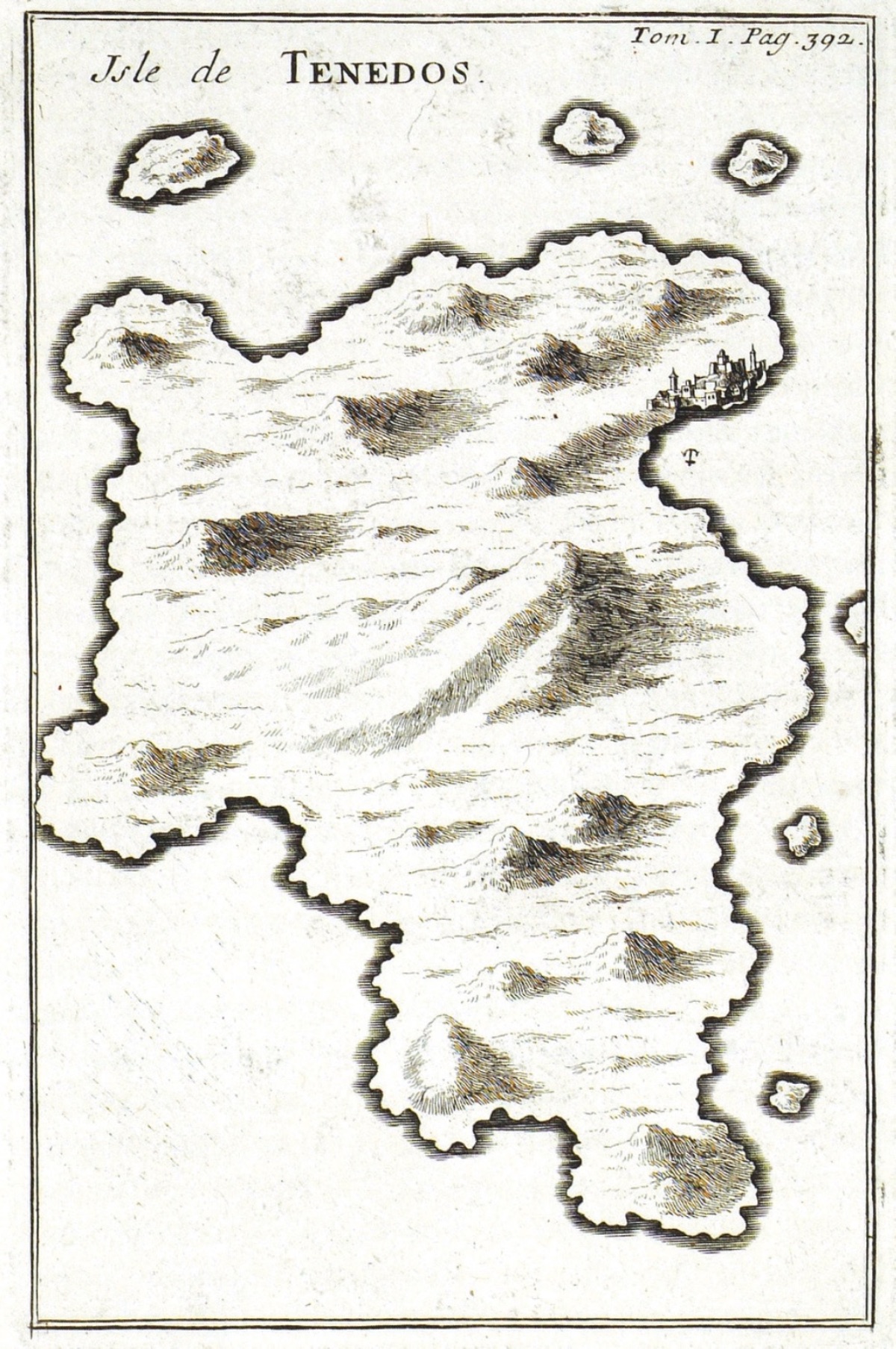
TOURNEFORT, _tenedos__Joseph Pitton de Relation d'un Voyage du Levant, fait par ordre du Roy Contenant l'histoire ancienne Among the ruins of this great city, poor Greek peasants now live, wearing Chio clothes. The women wear short skirts held up with suspenders. They have shoes and very clean stockings, with wide sleeves of fine white linen and large Muslim veils with wide pleats that fall over their shoulders. Mr. Sandys (I am sure you have read his book, one of the best of its kind) mentions these ruins, assuming they are the foundations of a city begun by Constantine before founding Byzantium. But I do not understand why, and I am inclined to believe they are much older. From this cape, we had a very clear view of the Simoeis River flowing in a wide valley descending from Mount Ida. Currently called Simoeis, it appears as a small muddy river in a valley, but perhaps it swells in spring and joins with the Scamander. This is the Xanthos, called by the gods Homer, and it is this noble name that the Oenones nymphs claim in the letter they wrote to Paris. The maidens of Troy used to offer their first favors under the name of Scamander until this polytheistic ceremony was lost, as beautifully described by La Fontaine. After the confluence of Simoeis and this river, the two flow together into the sea. The only thing left of Troy is the land the city spread over. For I am absolutely certain that all the ancient structures found in the vicinity belong to a much more recent time...
On the northern part of Cape Sigee, we saw Cape Rhoetos, famous for the tomb of Ajax. Faced with these famous rural areas and rivers, I marveled at the accuracy of the Homeric geography I had in hand. Almost all the adjectives describing the mountains and plains are still accurate, and I spent two hours in pleasant dreams on Mount Martesinos, like Don Quixote. The next night, we sailed towards the shore generally considered to be the site of Troy, and I think, as is customary, these ruins shown to foreigners are those referred to by the Turks as "old Istanbul" (Alexandria Troas. R.A.). I rented a donkey to travel a few miles inland and walk around the very extensive old walls. Among the ruins of a castle on a hill and another in the valley, we found two pedestals with broken columns on which I took down the Latin inscriptions.
Undoubtedly, the nearest ruins are those of a temple dedicated to Augustus. Since it was built by the Romans, I do not understand why Mr. Sandys calls it a Christian temple. There are also many tombs of high-quality marble, which are gradually eroding and being used to make large cannonballs for the Turks. This evening, we passed by the island of Tenedos (Bozcaada), once under the protection of Apollo. Its circumference is only two miles long. But it is now very rich and populous and famous for its exquisite wines. I will say nothing about Tennes, who gave the island its name. However, by mentioning the island of Lesbos, along whose coast we traveled, I must speak of Mytilene, where Sappho sang, Pittacos reigned, and the great masters of poetry, philosophy, and music, Alcee Theophraste and Arion, were born..."