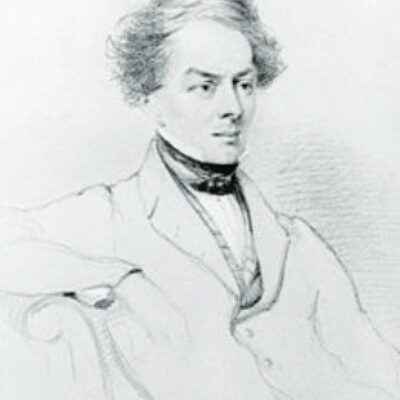
Ruins at Assos (1838, Charles Fellows) An English archaeologist, Sir Charles Fellows (1799-1860), began drawing pictures from a young age. One of these drawings was used on the cover of Lord Byron's book. From 1820 onwards, he lived continuously in London. After 1832, he settled in Izmir and began his travels from there to Italy, Greece, and eastern countries, but especially the western Anatolian coasts. Fellows also used the drawings he made during these travels in Lord Byron's "Childe Harold." During his travels in 1838, 1839, and 1848, he explored the then little-known region of Lycia. Thanks to Fellows, seventy-two statues and architectural works were sent to London in 1842 alone. In 1843, Fellows published his findings in three volumes, albeit in a non-scientific manner. The majority of the works Fellows sent to England during that period are in the British Museum and are generally known as the "Xanthos Marbles." Based on some of his publications, he suggested to the British Museum officials that the British Ambassador in Istanbul speak with the Sultan to transport the Lycian artifacts to London. Following this suggestion, many artifacts were transported to England. Fellows also touched upon the relationship between modern place names and their ancient names, as well as the cultural issues faced by regional ethnic groups in the places he visited. His observations from his 1838 trip to Çanakkale also include such details. Fellows' observations, who came to the region via Izmir and Bergama, provided great ease for travelers who followed him:
"In the dirty inn of Edremit (Adramit), I had two room options, the best of which had recently been filled with bags of cheese and olives. It was swept and a large fire was lit to clean it, but it was almost an hour before I could enter. I chose this room. There were two good slaves crouched in the corner on a clean cover. It was clear that their owners treated them very well, feeding them good food. All the slaves I saw during my stay here were generally from Ethiopia; their legs, from the ankles to the knees, were certainly the longest I have ever seen in other races. Someone who only saw their legs might think they were quite thin; but they are not at all.
After our guide found five horses for me, we had a sensation in this small village called Çetmi (Chetme), a settlement chosen by early Greeks like a crow's nest at the end of a high cliff by the sea. There is no inn here. Therefore, I requested the most important person here to show the usual hospitality shown to strangers once more, thus seizing the opportunity to observe Turkish traditions. While waiting on my horse for the prayer in the mosque to end, people began to gather around me. Among the young people living in the village, I began to be examined as an interesting object; but an older person, whom I assumed to have authority, finally greeted me in Turkish with "Ogroler" (meaning "welcome stranger"). This person, who knew I was waiting to speak with him, was the agha or the village's administrator, the most important person. However, he did not show me the courtesy of conducting his official business in the street; we walked half a mile straight after him to his house, where he climbed a few steps to a place or a wooden platform like a railing. Carpets and his hookah were brought, he sat in a position to listen to what I wanted to say, and signaled for me to sit. During the entire conversation, he did not say a single word and did not look at me. With a gesture, he invited us into his house, our assistants stayed outside. After this ceremonial meeting, as soon as we turned our backs, I saw this official agha observing me and those around me on his tiptoes. While I guessed he thought I was a "Milordos," he sent a beautiful dinner from his own house, adhering to Turkish traditions. On a large tinned copper tray, there was a bowl of soup, a plate of rice, olives, and alongside bread and sweet things. This name "Milordos" was a name given by the Turks to those who did not have a visible purpose for their visit, regardless of their nationality. Who is this, a government envoy or a merchant? The Turks know no other reason for traveling besides these two; if a foreigner is neither of these, he must be a "Milordos"...
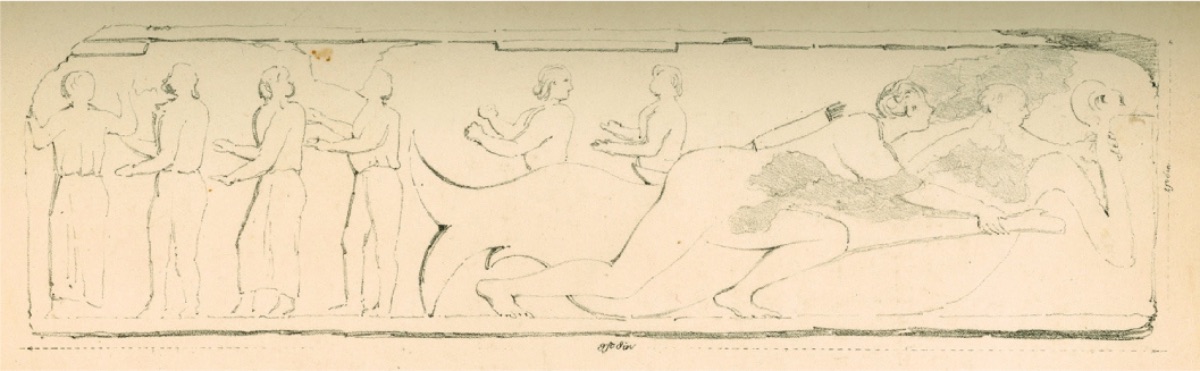
Frieze of the Temple of Assos (1838, Charles Fellows)
March 2...
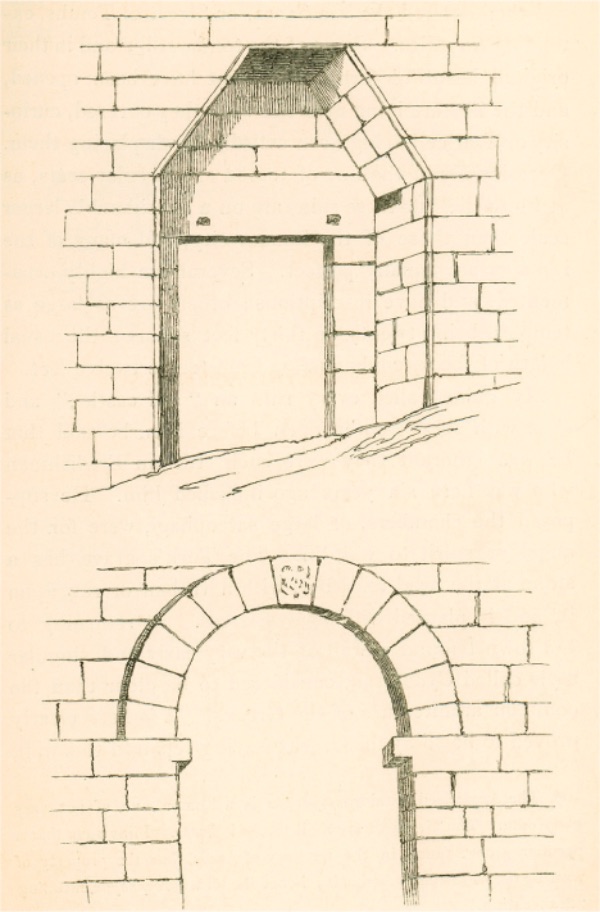
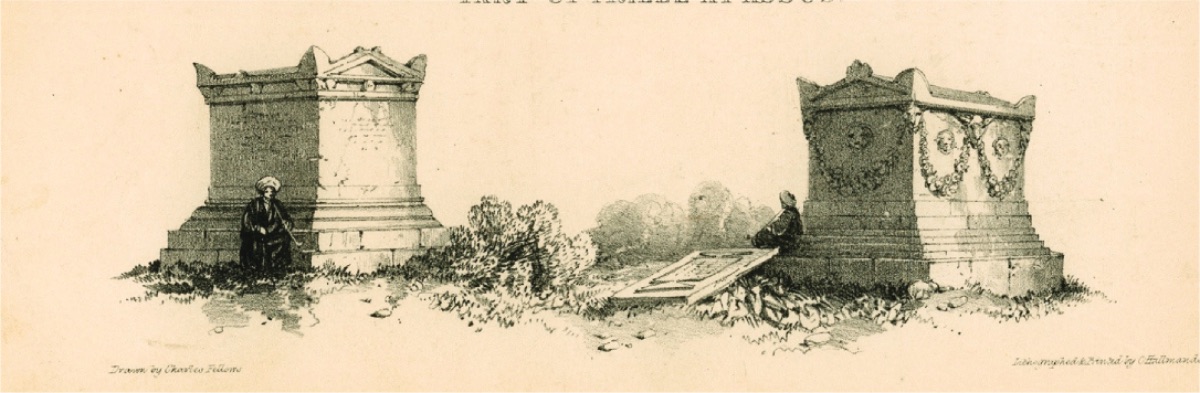
About six miles from Behram (Beahrahn), lies ancient Assus or Assos. We left the seaside and began to climb a rocky area, with a rich but useless vegetation: we passed a small lake and then entered a bushy area. I found scattered stones and sarcophagus lids. As we approached the town, the magnificent beautiful Greek craftsmanship of the city wall that cut our path was visible, and another view of the Acropolis. The walls are flawless and in many places thirty feet high; each stone is carefully cut and laid without mortar. The temple is located at the top of cliffs sixty or eighty feet deep, from where the stone used in the foundations of both the structures and many houses in the town was taken. There are ruins where the village is; but only a few huts were left for my use.
...
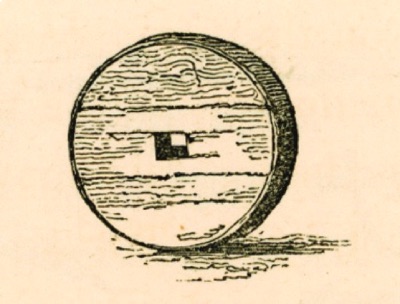
... The village houses in Turkey are very similar to each other. I have entered many and will describe my impressions of the place I stayed last night in Behramlı (Beahrahm). From the outside, they look like a square box and inside they are two to fourteen feet wide: all are made of stones cut and stuck together with mud. The roof is flat and covered with earth; generally, a small cylinder made of columns is used to compress the earth and keep it dry. There was no window, and therefore light could only enter through the door, which had no lock or anything to secure it. Only a small latch at the top of the door held it, and when the door was closed, the latch fell down. The "s" shaped latch hanging outside was lifted up and opened when entering. The interior walls and intermediate floors were made of earth mixed with straw; the ceiling was made of horizontally and vertically placed wood; the interior partitions were black due to the wide open fireplace, and the house was quite dark when entering.
Here, the lamps were made of tin or clay and were in the forms used by the Greeks and Romans.
Two Sarcophagi in Assos (1838, Charles Fellows)
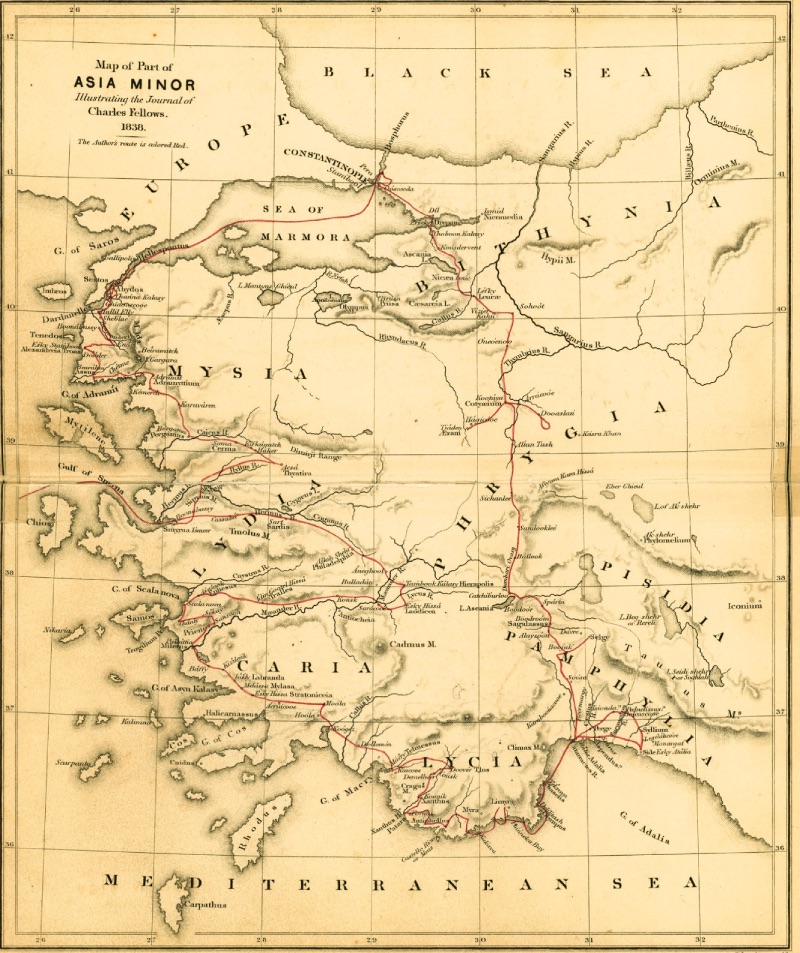
When a traveler arrives, the owner or servant of the house indicated by the officials sweeps the room to be stayed in and lays a cover on the floor, offering this single piece of furniture in the place for service. The person serving me nailed three or four nails to the wall to hang his own weapon, whip, and hat along with my hood, and hung a bed and hammock over the carpet. Meanwhile, food, paper, my notebook, or whatever I wanted was placed on a box used as a table. Anyone who saw the traveler's thus furnished room would understand that the room was quite comfortable. So far, I have continued my English habits, I have not had to smoke a hookah, and I have tried Turkish coffee three times since I set foot in Asia: I did not like the taste at all. To explain how it is made, each cup of coffee is prepared separately. A container one span wide and two spans deep is filled halfway with coffee, pounded with a pestle, then filled with water, and cooked over a fire for a short time, and the contents (thicker than chocolate) are poured into a metal container, easy to hold, about the size of a Chinese cup or half an egg, without mixing milk or sugar. Western Anatolia Transportation Routes (1838, Charles Fellows)
March 3
...
Now I am in Alexandira Troas, which the Turks call Old Istanbul (present-day Dalyan Köyü. R.A.). In the present-day village, there are nine or ten houses; all are the same as those described above: only two are inhabited. One of them is a strange character who hosted us and introduced himself as a consul; in his conversations with us, he stated that he participated in the Battle of the Nile. The other house is inhabited by a woman and her son; besides them, no one lives within six miles; these people remain here despite being threatened by the Turks to leave.
After passing the dense foundations a few steps above the ground in the city, we proceeded eastward two or three miles towards a hill with hot springs. This hill was like a beehive, with many arched structures on the side where the baths and springs were; one or two of them were still used by the Turks. I saw a statue of a woman here, about seven steps high, without a head, weathered due to the elements; now buried in the ground, it was used as a seat at the entrance of the bath. We traveled one and a half miles northeast on horseback; we followed the paved ancient road in the city and found very large columns on the roadside, standing unbroken among the bushes (These are columns brought from the Roman period granite quarries in present-day Koçali... R.A.).
Agricultural Tools Used in the Çanakkale Region (1838, Charles Fellows)-2 March 4
Time passes quite quickly in an enjoyable way. I am on horseback for about eight hours a day, until six-thirty; at night, I am busy writing or drawing.
In all Turkish settlements, there are many skeletons of domestic animals; they offer a rich collection for comparing the anatomy of camels, cattle, horses, and oxen. However, dogs cause the skeletons to be destroyed by the sun and wind. However, the ox's head escapes this fate; in agricultural areas, the ox head is placed on a stick or hung on a tree to scare birds. This tradition is practiced both in Greece and here: the head always has a beautiful white color, the horns are preserved; in this region of the world, the horns are quite short and thick...
...
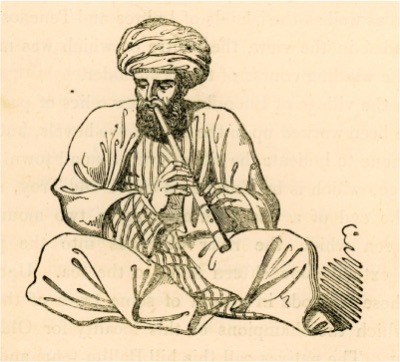
I made a trip from Ezine (Enae) to the site of Old Troy, a round trip distance of about fifteen miles. At the boundary of Ezine, there is an artificial hill, a very large hill. A hill or a tomb, depending on the situation, is used as a Turkish cemetery along with the surrounding land. It is filled with stones, flowers, and cypress trees. A mile below the town, the stream flowing at this point joins the Menderes, a river quite wide here, comparable in size to the Wye, and quite similar in appearance. It carries a lot of soil in the direction of its flow, sometimes covering land three times its width. About a mile ahead of the route we took, there is a wooden bridge over the river; only at this season can the river be crossed at the point where it opens into the plain of Troy. Interestingly, in this part of the country, although not far from each other, travelers can visit the old Troy in the west and then, on the return, go to the new Troy on the east side, and then make a journey to Çanakkale (Dardanelle). I believe that at some seasons it may be possible to cross the river at some points, but not now. The landscape during the horseback journey was quite beautiful. The river and the road generally cover the entire valley; the sloping hills that bound the valley are filled with trees; the soil at the terraces is quite well-kept, covered with green meadows and wheat fields. The large bells on the necks of cattle and goats and the shepherds' flutes add liveliness to the surroundings and provide a picturesque effect to this most rugged part of the geography.
The flutes used by shepherds in Asia Minor are very similar to those found in graves in Athens, which are in the British Museum. This flute, open at both ends, is played by shepherds while walking in the pictures on Greek vases. This instrument and the lyre are sufficient evidence of the level of understanding of music by the ancient Greeks, who reached a level of perfection in architecture and sculpture that was never achieved in any other period...
Agricultural Tools Used in the Çanakkale Region (1838, Charles Fellows)-3
About two miles before reaching the village of Pınarbaşı (Boonabassy), which means "spring head" in literal translation, we left the river and proceeded over the hills. A map-like view dominates the lands where the endless conflicts of once great nations took place: such great nations no longer exist, where did these people live who wrote the history of a period of the world. The Karamenderes (Scamender) river, winding in the center, the continents of Europe and Asia, and the islands of Gökçeada (Imbros) and Bozcaada (Tenedos) are also included in this view.
Agricultural Tools Used in the Çanakkale Region (1838, Charles Fellows) In the village of Pınarbaşı, some pieces from past days are used among the adobe of the huts, but there is no one to show a settlement or village here. This village is named Old Troy by Europeans; it is located in the mountain range that ends on both sides, fifteen miles before the river reaches the sea. On these hills, we rode up to the hill famous as Old Troy to search for city ruins. The villagers call this hill Bollhu-tepe (Ballı Tepe/or Ballıdağ. R.A) and it is located on the elevations above Pınarbaşı. On the rocky summit of the hill (actually a very small area as a city), we saw two columns standing around. I think bringing them together is both naturally and artistically very problematic, and if artistically, in the large piles that the villagers show as remarkable, there is doubt about what some of our adventurous brothers have seen. This place, where I did not see a single square stone or any artistic and ancient find, is accepted as Old Troy. Nature was very beautiful, so rich that I gained new information about the geography of this region. I saw many cormorants, two eagles. One of them, boldly perched on a tree as I passed, was looking down at me steadily with its sharp eyes; it was not one of the largest of its kind, but one of the smaller ones in Turkey.
...
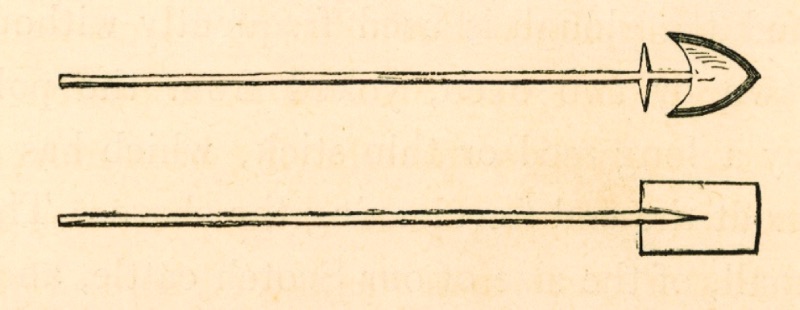
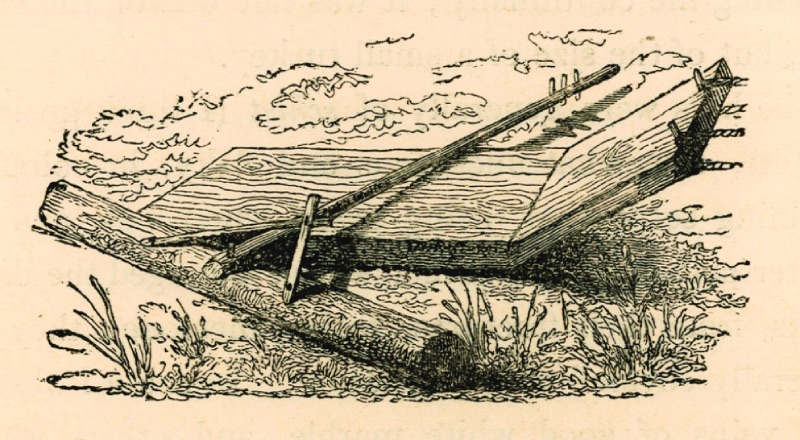
Today I had the opportunity to examine some agricultural tools of the country; one is used for threshing crops and cutting straw. It consists of a smooth thick piece of wood standing on the ground, another smaller one has a part where an animal is tied horizontally. This tool passes over the wheat spread on the hard rocky surface; the flints embedded in the wooden surface are hard enough to cut even stone, an ox is tied to the end of this tool to pull it.
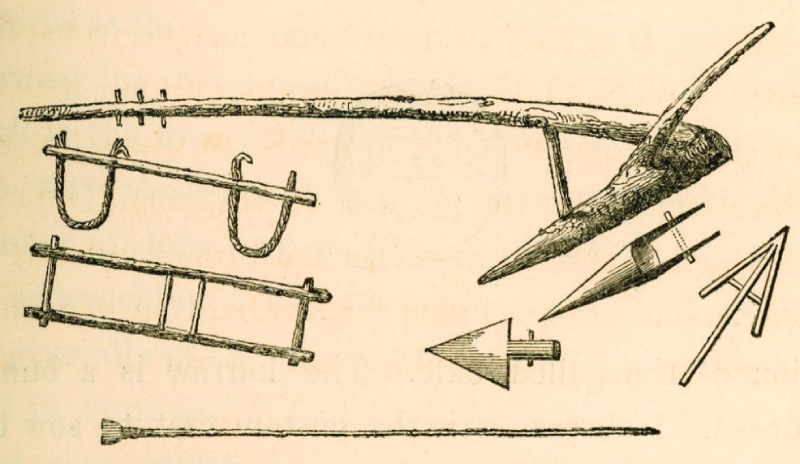
Threshing is done in a rather primitive way, when there is a suitable wind, the wheat is tossed in the wind. The plow, each part of which is still named with its Greek name, is made quite simply and is only suitable for soft soils. It can be used with one hand...
...
Agricultural Tools Used in the Çanakkale Region (1838, Charles Fellows) As I climbed up from the plain below, I observed a clearly isolated hill. At first, I believed it was really a tumulus, but upon examination, I saw that it was located on the plateau extending from the north. This situation led me to think that this place might have been made more by human hands than by the effect of ancient water. Meanwhile, my book claimed that this hill was the tomb of Ilus. Before continuing north, we came to a village or a settlement consisting of a few huts called Çıplak village (Sehblac). It is suggested that New Troy-Ilium Novum is near here. I saw many columns, friezes, and various pieces belonging to many temples among the oaks here. These pieces are now in the Turkish cemetery, but I do not think they were brought here by the Turks, because they are quite heavy to move. Alongside the numerous blocks, there were also ordinary stones. Some were corner stones with no function, and all these indicate the remains of a structure near here. However, I did not find any foundation and none of their forms indicate a distributed structure today. In general, their craftsmanship is not the product of early fine workmanship, the script of the inscriptions is Greek character, but most likely belongs to the late period, during the Roman occupation.
Beyond this village, with a three-hour journey, there are similar pieces in Halileli (Halilil Elly) village, very similar to those here, the ruins are scattered over a half-mile area, some have rich reliefs and inscriptions. The relationship with these finds is much more evident, and I also saw the foundations of some small temples. These two places have a slightly higher elevation than the plain, and accordingly, a wide field of view, but generally, these pieces collected for large cities by ancient people, especially the Greeks, do not resemble each other.
The poetic idea of the plain of Troy, the places where Homer's wars took place, are generally allocated to quite low areas and marshy. Looking at the creatures here today, all of them are bulls with their heads buried in the marshes, frogs in shallow streams whose voices are more dominant than all other creatures, sometimes making sounds like crying children, howling dogs, doves, crows, and if there are many, birds singing in harmony... Finding nothing more interesting in this plain, I decided to reach Çanakkale (Channakkalasy) by evening. Therefore, I crossed the twenty-five miles at a speed of seven or eight miles an hour, at Tartar speed (the courier of the Turks), over the limestone hills and halfway, stopped at Gavurköy/Erenköy (Ghaiourcooe) on such a hill on the Asian shore of the Dardanelles. The view from here at the entrance of the strait was very beautiful, both for me and to rest my horse's feet, I sat and enjoyed the unique view. Dervish Playing the Ney (1838, Charles Fellows)
Our consul lives in this village, twelve miles from Çanakkale. On the way, we saw his assistant (dragoman), who told us that I could take the key to his house and use it as my own. The consul's house had become a ruin after a fire. The consul's assistant took my name and the next day Consul Mr. Launder came to the village to pick me up. He sat with me for hours, treated me with care. His house had been destroyed twice in a year, and in the last fire, he escaped with only his clothes and bag, all other belongings, along with his valuable library, were burned. The Sultan's government does not allow this house to be rebuilt; according to the Turks, if the wood and workmanship were better, the houses would be more durable.
Half of the city was completely destroyed last year, but soon, it began to be rebuilt, generally with entirely wooden houses; these new houses present a unity and look beautiful like Swiss villages. Alongside the numerous tent houses, temporary shops, coffeehouses, or semi-ruined shops are multiplying. The Turkish name of this quite large place, due to the large number of pottery produced here, is Channakkalsy (meaning Çanak Kale). We, however, only refer to it by the strait, Dardanelles: on the map, this city is marked as Sultana (Kale-i Sultaniye, R.A.), a name known only to cartographers...
...
The Greek (Grek) consul here, Signor Nicholas Vitali, is a very intelligent person. He was lucky in discovering a tomb; in the tomb, according to me, only terra cotta (Roman period pottery, R.A.) was unearthed here for the first time. He gave me one of the three artifacts he found as a gift, you can see the drawing I made of it.
In my opinion, it belongs to the high ancient period, with quite interesting garments."